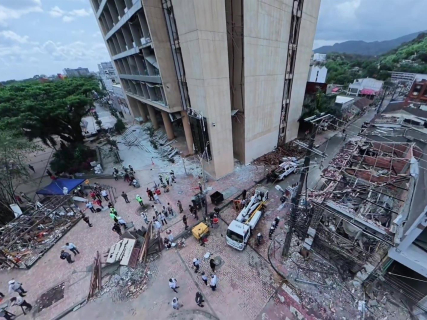










Colombia is going through a serious security crisis after chaining, in just 72 hours, coinciding with the tenth anniversary of the peace agreement with the former FARC guerrilla, up to six attacks that have caused dozens of injuries and, despite everything, only one military fatality. This surge in violence has become the biggest challenge for the president, Abelardo de la Espriella, since taking office last August.
De la Espriella links this increase in attacks to his military offensive, which includes "up to ten" bombings in these three months and several operations against armed structures. To this spiral was added on Tuesday a tense hostage-taking at a supermarket in Cartagena, already resolved, which kept the country on edge for more than 16 hours.
The most serious episode occurred on Monday night, on the eve of the tenth anniversary of the historic pact with the FARC, when a car bomb exploded in front of the office of the Governor’s Office of Meta, in Villavicencio. The blast caused about thirty injuries and damage to the power grid that triggered a massive blackout in another five departments in southwestern Colombia.
The president pointed to Ómar Pardo Galeano, alias "Antonio Medina", one of the leaders of the dissidence of the Estado Mayor Central (EMC) of the FARC, led by Néstor Vera Fernández, known as "Iván Mordisco", as the person responsible, and said that in that same Meta department several additional attacks were thwarted.
Violence has struck hard again the urban areas of the departmental capitals, which had gone years without recording events of this magnitude. Added to the Villavicencio attack is the use of explosive drones on Monday against Police facilities in Cúcuta, the capital of Norte de Santander, in the northeast of the country.
That attack, as well as another similar one carried out a few hours later against a Police station in the municipality of Curumaní, in the department of Cesar, were attributed to the guerrilla of the Ejército de Liberación Nacional (ELN). This group is also blamed for the attack that opened this chain of aggression the previous Saturday in La Jagua de Ibirico, also in Cesar, where a soldier died.
On Tuesday, a new drone attack was recorded against police facilities in the hamlet of Campo Dos, in Tibú, in the heart of Catatumbo, one of the most conflict-ridden areas of the country. There, dissidences of the FARC and the ELN are fighting over control of a key corridor for drug trafficking, illegal mining, and other lucrative illicit economies.
According to data from the Ministry of Defense, the use of offensive drones has surged during the first two months of De la Espriella’s term. So far in 2026, 350 incidents have been documented, which amounts to an average of one per day and an increase close to 140% compared to the previous year.
A decade of the peace agreement with the FARC
This Tuesday marks ten years since the signing of the ambitious peace agreement with which the aim was to put an end to more than half a century of war between the Colombian State and what was the oldest guerrilla in Latin America.
However, this decade has been marked by the State’s inability and, at times, negligence in making the agreed-upon plans a reality, especially regarding agrarian reform in a country with a distribution of land that is profoundly unequal—considered the origin and engine of the conflict.
Although in the first years after the signing there were historic drops in homicide and kidnapping rates—more than 13,600 guerrillas handed in their weapons—the void left by the FARC after their demobilization was filled by old and new armed groups in the face of the lack of effective State presence across large parts of the territory.