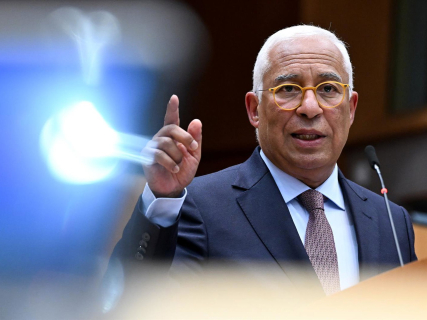

The President of the European Council, António Costa, defended this Thursday in Mexico the validity of multilateralism and the strengthening of international alliances against those who "prophesy a return to the law of the jungle", underlining the importance of cooperation "against rupture and isolation" in a context in which, he warns, "the rules-based multilateral order is being called into question".
"Especially worryingly, the rules-based multilateral order that was born after the Second World War is being called into question. And it is not surprising that those who prophesy a return to the law of the jungle are proliferating," Costa said in a speech to the Mexican Senate, on the eve of the summit between the EU and Mexico where the modernization of the association agreement will be signed and political and economic cooperation will be strengthened.
During his address, Costa explained that the Union is reacting to current geopolitical tensions by strengthening ties with strategic partners such as India, Australia, Mercosur, Indonesia, Chile, South Africa, and Mexico, and has highlighted the dialogue "between partners who believe in stability and respect for international law".
"The European Union needs Mexico. The world needs Mexico," remarked the President of the European Council, insisting that "the future is not written" despite the scenario of global uncertainty.
The leader highlighted that the new agreement will allow for the elimination of more tariffs, the boosting of trade and investment, and the creation of additional opportunities for Mexican companies in the European market. "It is a new bridge between Europe and Mexico: broader, stronger, and better prepared for the challenges of the 21st century," he stated.
Update of the trade agreement and investment agenda
The President of the European Council also highlighted that the modernization of the pact will boost political cooperation in areas such as security, migration, climate action, the green and digital transition, innovation, and the protection of human rights.
Costa highlighted the economic weight of the bilateral relationship, recalling that the current agreement supports 5.5 million jobs in Mexico, 82 billion euros in goods exchanges, and more than 25 billion in services trade.
The European leader has also expressed his gratitude to the Mexican president, Claudia Sheinbaum, for having "relaunched" ties with the EU and facilitated the signing of the modernization of the agreement, and has stressed that the European 'Global Gateway' investment initiative will support the so-called "Plan Mexico".
"Europe wants to invest more in Mexico. And it wants to do so especially in strategic sectors: in clean energy, digitalization, sustainable infrastructures, technological industries, and resilient supply chains," Costa indicated.
On the international stage, the President of the European Council has reiterated the EU's support for Ukraine in the face of the Russian invasion and has advocated for a "comprehensive, just, and lasting peace" that "fully" respects the country's independence, sovereignty, and territorial integrity.
"The war of aggression against Ukraine by a permanent member of the Security Council is unacceptable and threatens the security of all nations on the planet," he concluded.