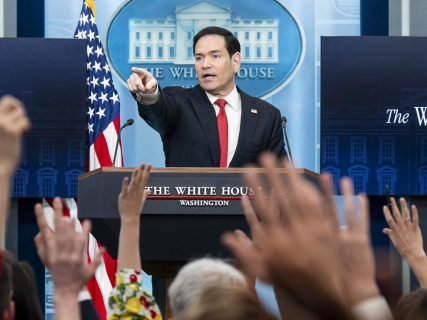

United States Secretary of State Marco Rubio has assessed this Thursday the probabilities of reaching an understanding with the Government of Cuba as "low," due to the alleged refusal of its leaders to modify a system he has described as "failed."
"The President's (Donald Trump's) preference is always a negotiated and peaceful agreement. That remains our preference. As for Cuba, I'm going to be honest, the probability of that happening, given who we are dealing with right now, is not very high," the head of US diplomacy told the media before leaving for Sweden to attend the meeting of NATO Foreign Ministers.
"If they change their minds, we are here," he added, without closing the door to the military option regarding Cuba, arguing that the Caribbean country can represent a risk to the national security of the United States due to its geographical proximity.
"We will be affected by the migratory crisis, by any act of violence and instability that occurs there. This directly affects the national interests of the United States," he warned, recalling that the island is located only 90 miles, about 144 kilometers, from US territory.
If "there is a threat to the national security" of the United States, the President "not only has the right, but also the obligation to confront that threat," Rubio defended.
"The future of Cuba belongs to the Cuban people, as far as how it is governed, what the system is like, and so on, but the threat to national security is something we are going to focus on 100% because it is about the United States," he concluded.
Cuban Leaders Reluctant to Reform
Rubio insisted that Cuba is a "failed state" and that its model "does not resemble what anyone is doing anywhere in the world." "There are other ways to do it that could offer the Cuban people prosperity and opportunities," he remarked, emphasizing that in the Bahamas, Jamaica, the Dominican Republic, or in Florida "people have the right to have a business, work for themselves, and be able to vote for their leaders."
"All of that is possible around Cuba, why isn't it possible within Cuba? And right now, there simply don't seem to be people in charge of the regime who are in any way open to any of those changes," he stated.
In recent days, Washington has increased pressure on Havana. Rubio addressed the Cuban population directly to propose a "new relationship" without the mediation of the island's authorities, whom he accused of "looting billions of dollars." Afterwards, the United States Department of Justice indicted former president and historic leader of the Revolution, Raúl Castro, for the downing in 1996 of two civilian aircraft in international waters belonging to the Cuban exile organization Brothers to the Rescue.
Debate on humanitarian aid to Cuba
Regarding humanitarian aid valued at 100 million dollars and whether Cuban authorities accept the conditions of this package, which Washington insists on channeling through the Church, Rubio has assured that Cuba has already given its approval.
"They say they have accepted it. We'll see if that's what it means. Because the point is that we are not going to provide humanitarian aid that ends up in the hands of their military companies, which then take all of that," he explained.
"That is not going to work like that. I was in Rome a couple of weeks ago and met again with the Catholic Church. They are willing to take a step forward," added the Secretary of State, emphasizing that the United States wants to support the Cuban people, but will deliver assistance through organizations and not through structures controlled by the regime.