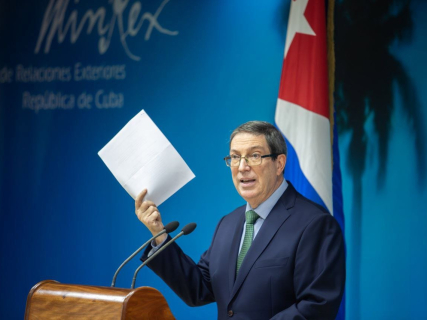

The Cuban Foreign Minister, Bruno Rodríguez, has denounced before the plenary of the Ibero-American Summit held in Madrid the “collective punishment” that, in his view, the United States is imposing on the island, also emphasizing that not all the governments of the region are at this time backing Havana.
The head of Cuban diplomacy has demanded that the Ibero-American Community act “without interferences, exclusions, or external pressures” and has warned that the international scene is “marked by unilateralism, the imperialistic and unviable attempt to impose peace through force,” as well as by violations of International Law and Human Rights.
Rodríguez has assured that, in the last ten months, “the Cuban people have suffered the unprecedented strengthening of the U.S. economic blockade.” As he explained, Washington has established “an energy cordon equivalent to a naval blockade” and applies “secondary sanctions to individuals or entities that establish commercial relations with Cuba.”
In his address, the foreign minister insisted that “the United States has taken its obsessive war of economic suffocation against Cuba to inhuman limits of collective punishment.” At the same time, he expressed his recognition of the Ibero-American countries that last week supported in the UN General Assembly the resolution condemning the U.S. embargo against Cuba.
The minister has highlighted that, unlike what used to happen traditionally, when most of the Ibero-American countries would often align with Havana, the greater proximity of several leaders in the region to the Administration of Donald Trump has caused a growing number of governments to abstain or even vote against the text.
On this occasion, the resolution was approved with 130 votes in favor, 17 against—among them Argentina, Colombia, Costa Rica, Ecuador, and Paraguay—and 25 abstentions—including Chile, the Dominican Republic, Honduras, and Peru—thereby reflecting more fragmented support within the Ibero-American bloc.