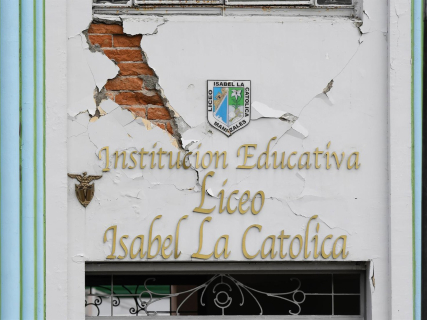
Earthquake in Colombia: a 5.6 tremor causes evacuations in Bogotá

The earthquake in Colombia this Tuesday, November 3, with its epicenter in Chaparral, has caused evacuations in Bogotá and damage in Tolima and Quindío. The mayor of the municipality where the tremor originated reports two women injured and the departmental authorities have announced virtual classes while they assess the damage

fotonoticia 20260826231245 1920

fotonoticia 20260826231245 1920

Add DEMÓCRATA to Google

Ask FREN

Published

Last updated

2 minutes

Most read

Elecciones 29N · Encuestas

La media de las encuestas

Media a 2 de noviembre de 2026 · 16 institutos

  • PP30,5 %
  • PSOE27,4 %
  • Vox19,1 %
  • Frente Amplio6,4 %
  • ERC2,4 %
  • Podemos2,4 %
010203040ene 2024jul 2024ene 2025jul 2025ene 2026jul 2026

Media del último estudio de cada instituto en 30 días y su evolución semanal desde el 23J. Partidos con al menos un 2 %.

Todas las encuestas

Elecciones generales del 29 de noviembre · Demócrata

An earthquake in Colombia with a magnitude of 5.6 shook different regions of the country early this Tuesday morning and forced residents of Bogotá to leave their buildings. The movement was recorded at 04:13, local time, with its epicenter in Chaparral, a municipality in the department of Tolima, according to the Colombian Geological Service (SGC).

The first assessments place the damage in Tolima and Quindío. In Chaparral, the mayor, Helver González Mora, told Noticias Caracol of two injured women who were taken to the hospital. The municipal official also noted that there are damaged homes and some destroyed, without having any knowledge at that time of any fatalities.

Where the earthquake was and at what time it was felt

The epicenter was located in Chaparral, in south-central Colombia. The SGC placed the origin of the movement at a depth of less than 30 kilometers. The time of the tremor, 04:13 in Colombia, corresponds to 10:13 in the morning in mainland Spain.

The agency initially published a magnitude of 5.3 and later revised it to 5.6. This is an update of the same episode, not two different earthquakes.

In addition to Bogotá, the movement was felt in cities such as Cali and Pereira. The EFE wire also reports that the geological service recorded several aftershocks minutes after the initial tremor.

Two women injured in Chaparral and damage to a church in Quindío

The National Unit for Disaster Risk Management (UNGRD) reported in its first assessment that one person had been injured by the collapse of a wall in a home in Chaparral. The mayor's report to Noticias Caracol places the number of injured women treated in a hospital at two.

These are assessments from different sources during the emergency evaluation. The figures should not be added together: the municipal report increases the number of injured people compared with the initial UNGRD statement.

In Quimbaya, in the department of Quindío, part of the structure of a church has detached. According to the information gathered by EFE, that incident did not cause any injuries.

Evacuations in Bogotá and virtual classes in Tolima

In Bogotá, the tremor caused evacuations in some residential complexes. Residents left their homes during the early morning, while the first checks were being carried out on the condition of the buildings.

The mayor of the capital, Carlos Fernando Galán, has reported that the initial review had not detected any damage or impacts in the city. The governor of Cundinamarca, Jorge Emilio Rey, has also ruled out major impacts in his department, according to the EFE bulletin.

The governor of Tolima, Adriana Magali Matiz, has activated the emergency protocols and has announced that classes will take place virtually throughout the department while the situation is assessed. The measure affects the territory where the earthquake’s epicenter is located.

The background of the August earthquake in Colombia

The new tremor comes almost three months after the August 10 earthquake, which had a magnitude of 7.4 and its epicenter in San José del Palmar, in the department of Chocó.

That movement caused serious damage in the west and south of the country. Cali and Pereira were among the most affected cities, with collapsed buildings and damaged structures, according to EFE. The consolidated tally in October published by the agency puts the consequences of that catastrophe at 335 deaths, 103 missing and 4,516 injured. Nearly half a million people were affected.

More key points, information and questions with FREN

AI-GENERATED CONTENT

What are the emergency procedures and protocols that must be activated in Colombia after an earthquake of this magnitude?

I do not have the technical or regulatory information necessary to accurately describe the emergency procedures and protocols that must be specifically activated in Colombia after an earthquake of a certain magnitude. I specialize in Spanish politics and institutions (Congress, Senate, Governments, regulations, and public debate in Spain), not in emergency management or the Colombian legal and operational framework.

For a rigorous answer about Colombia, it would be appropriate to consult:

  • Colombian disaster risk management and civil protection regulations.
  • The protocols of the National Disaster Risk Management System of Colombia and those of departmental and municipal authorities.
  • Operational guides from specialized organizations (for example, civil defense, fire departments, etc.).

However, I can help you with questions related to:

  • Procedures and competencies of Spanish institutions (Government, Congress, Senate, autonomous communities, etc.).
  • Processing of laws, royal decree-laws, and other initiatives in Spain.
  • Debates, votes, and positions of Spanish political parties and actors.
  • Regulations and public policies in Spain in various areas (civil protection, emergencies, health, energy, housing, etc.).

If you want, you can reformulate your question focusing on how emergencies or earthquakes are managed from an institutional and regulatory perspective in Spain, and there I can give you a detailed and tailored answer to what happens in our country.

What emergency protocols and plans are activated in Spain in the event of a major earthquake? What competencies do the central Government and autonomous communities have in civil protection and disaster management? What laws and regulations govern emergency management and civil protection in Spain?

What competencies does a Colombian mayor have in managing natural disasters according to the country's legislation?

In Colombia, mayors play a central role in disaster risk management and emergency response, according to the Constitution and especially Law 1523 of 2012 (which establishes the National Disaster Risk Management System – SNGRD). They are not just “collaborators”: they are the highest risk management authority in the municipality.

1. General framework of their competencies

From the Political Constitution (arts. 311 and 315) and Law 1523 of 2012, several key ideas emerge:

  • The mayor is the primary police authority of the municipality and responsible for security and coexistence, which includes protecting the life and integrity of the population against disasters.
  • They are responsible for directing disaster risk management at the municipal level and coordinating with the department and the Nation.
  • They must integrate risk management into development planning (development plans and land use planning).
2. Local institutional organization

Law 1523 of 2012 creates and regulates specific bodies in which the mayor is a key figure:

  • Municipal Disaster Risk Management Council (CMGRD): the mayor presides over it. They must convene it, lead it, and ensure it approves policies, plans, programs, and protocols regarding prevention, preparedness, and response.
  • Risk management office or department: the mayor must create it or assign the function to an existing entity, provide it with minimum staff and resources, and coordinate it.
  • Interinstitutional coordination: the mayor coordinates with the governor, the National Unit for Disaster Risk Management (UNGRD), and entities such as Civil Defense, the Red Cross, Police, and Military Forces when necessary.
3. Functions in risk prevention and reduction

The competencies are not limited to the moment of disaster. In the prior phase, the law obliges the mayor to:

  • Incorporate risk into the Municipal Development Plan and the Land Use Plan (POT): identify threats (floods, landslides, earthquakes, etc.) and define risk reduction measures (land use restrictions, mitigation works, resettlements, etc.).
  • Promote technical studies on threats and vulnerabilities, and use them for decisions on urban licensing and the location of housing, infrastructure, and facilities.
  • Exercise control over land use: prevent settlements in high non-mitigable risk areas, order relocations when necessary, and prevent constructions that increase risk.
  • Develop education and risk culture programs in coordination with the educational and community sectors (drills, information campaigns, etc.).
4. Competencies in disaster preparedness and response

When a threat materializes or there is an imminent disaster, the mayor has broad powers, framed by law and their status as police authority:

  • Activate emergency and contingency plans approved by the CMGRD (municipal risk management plans, response plans, sectoral protocols, etc.).
  • Order preventive or mandatory evacuations of at-risk populations and coordinate the logistics of temporary shelters and immediate humanitarian assistance.
  • Request or declare a state of public calamity in the municipality, when the magnitude of the event justifies it, to enable extraordinary measures (budget restructuring, direct contracting due to manifest urgency, etc.).
  • Direct and coordinate rescue organizations (firefighters, Civil Defense, Red Cross, health organizations) and other municipal departments (public works, social management, etc.).
  • Authorize and prioritize the use of municipal financial resources for emergency response, including humanitarian aid, critical infrastructure repair, and urgent service contracting.
  • Adopt administrative police measures to protect life and property: mobility restrictions, road or building closures in risk areas, access control, protection of evacuated zones against looting, among others.
  • Ensure timely and truthful information to the community about the situation, risk zones, meeting points and shelters, and official recommendations.
5. Recovery and reconstruction

After the acute phase of the emergency, the mayor remains responsible for:

  • Developing and implementing rehabilitation and reconstruction plans according to SNGRD guidelines and in coordination with the department and the Nation.
  • Managing external resources (from departmental, national, or international cooperation levels) and ensuring their transparent use aimed at reducing future risk, not just “returning to the previous state.”
  • Incorporating lessons learned into revisions of the POT and Development Plan, adjusting land use regulations, construction standards, and environmental protection measures.
6. Mayor's responsibility

Finally, Law 1523 emphasizes the mandatory nature of these functions: failure to fulfill risk management duties can generate disciplinary liability (for omission of functions), fiscal liability (for improper resource management), and even criminal liability if willful or grossly negligent omission contributes to the occurrence or worsening of the disaster. In other words, disaster management is not discretionary but a central legal duty of the Colombian mayor.

Could you detail exactly what Law 1523 of 2012 is and how it structures the National Disaster Risk Management System? What is the difference between the competencies of the mayor and those of the departmental governor regarding natural disasters? What control mechanisms exist in Colombia to sanction a mayor who does not properly manage disaster risk?

How many earthquakes with a magnitude greater than 5 have been recorded in Colombia in the last five years?

I do not have my own data nor specialized access regarding seismicity in Colombia, and my scope is focused on Spanish politics and public institutions (parliaments, governments, regulations, legislative processes, political actors, and related current affairs).

For this reason, I cannot provide you with a rigorous and updated figure of the number of earthquakes with a magnitude greater than 5 recorded in Colombia in the last five years. For a precise and reliable answer about earthquakes, I recommend consulting:

  • The Colombian Geological Service, which usually publishes official information about seismic activity in the country.
  • The United States Geological Survey (USGS), which maintains a global earthquake catalog searchable by country, magnitude, and period.
  • International specialized seismology organizations or reference scientific databases.

However, I can help you in depth with:

  • Information about laws, decrees, bills, and their processing in Spain (Congress, Senate, and regional parliaments).
  • Structure and functioning of Spanish institutions (Government, ministries, constitutional bodies, etc.).
  • Parliamentary votes, party and political group positions in Spain, and political-institutional context.
  • Legislative procedures, government oversight, budgets, and other figures such as royal decrees, motions, investigative commissions, etc.
  • Analysis and explanation of political and regulatory current affairs in Spain, as well as their institutional impact.

If you reformulate your question towards any of these topics — for example, seismic risk management in Spain from a regulatory perspective, the competencies of administrations in civil protection, or how emergency plans are regulated — I will be happy to help you with as much detail as possible.

Play

Test your knowledge with FREN!

How much do you know about this topic? Answer the following 3 questions.

Where was the epicenter of the magnitude 5.6 earthquake in Colombia located?

Question 1 of 3

What damages were reported in Quimbaya, Quindío, after the earthquake?

Question 2 of 3

What decision was made regarding classes in the Tolima department after the tremor?

Question 3 of 3