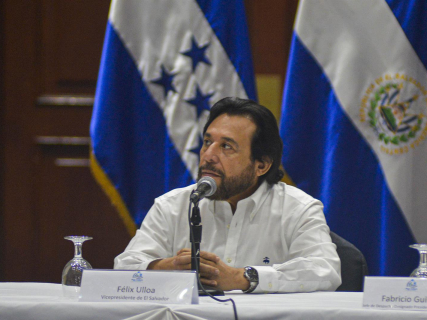

The Vice President of El Salvador, Félix Ulloa, has called this Thursday for solidarity from Latin America with Haiti and has backed the military operation that his country is carrying out there to rescue four Salvadoran citizens held by gangs. "It is not an occupation force; it is a bilateral arrangement," he emphasized.
"Haiti is a wound that hurts, it is a permanent wound in the heart of our America," Ulloa said, explaining that the absence of President Nayib Bukele from the XXX Ibero-American Summit in Madrid is because he is personally following the operation to bring back his fellow countrymen.
The Vice President has stressed that the region maintains a "debt" with Haiti and has lamented that only after the current wave of violence and the gangs' control over much of the territory "has the attention of the international community once again focused on the country" and that the United Nations launched a mission.
In this line, he specified that the mission of the Salvadoran troops in Haiti, focused on the recovery of four nationals — "who are not combat forces, but technical assistants" — constitutes "a bilateral arrangement" with the Haitian authorities and cannot be described as an occupation.
He detailed that there is a formal agreement with the Haitian Government that endorses the presence of Salvadoran military forces, whose priority is to rescue its citizens and, at the same time, support the Haitian people in the fight against gangs and organized crime.
"We have already managed to rescue a large number of people who had been kidnapped in a church by Haitian gangs; we managed to free a force from Chad that was being attacked by the gangs with the intervention of our forces," he highlighted, the 'number two' of Bukele.
Ulloa also took the opportunity to highlight the deep transformation that, as he said, El Salvador has experienced over the last ten years, moving from being "the world capital of homicide" in 2015 to "the safest country in the western hemisphere," with more than 1,300 days without homicides.
This new security context, he added, has driven a notable economic advance and he pointed out that, according to the World Bank, "El Salvador is one of the three economies of Latin America," with an estimated growth of 4.5%.