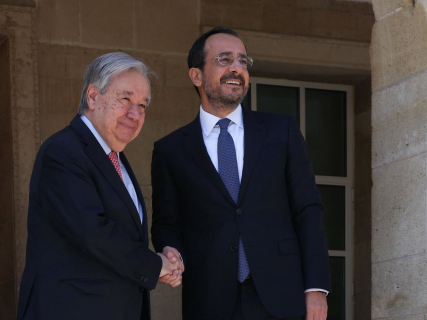

The Secretary-General of the United Nations, António Guterres, announced this Wednesday that he has the support of the Greek Cypriot and Turkish Cypriot leaders, as well as the guarantor countries, to initiate a new phase of talks aimed at reaching a resolution to the conflict that has divided the island of Cyprus since 1974.
"I have the consensus of both parties and the guarantors to hold a 5+1 meeting," he detailed in statements to the press from the headquarters of the United Nations Peacekeeping Force (UNFICYP).
Guterres emphasized the need to strengthen mutual trust during the preparations for this meeting, in order to avoid the next meeting being added to the long list of failed negotiation attempts regarding the Cyprus issue that have occurred since 2017.
"I do not want more 5+1 group meetings without results. I want a successful 5+1 meeting that paves the way for reaching a solution," the head of the UN stressed, who has not yet specified the schedule, although he expressed his desire for both parties to work "as quickly and effectively as possible."
The Secretary-General added that the process will take place "in consultation" with the involved delegations and the guarantor states. "The international community also has an important role to play in the Cyprus issue. In particular, I count on the continued support of the three guarantors: Greece, Turkey, and the United Kingdom," he noted, recalling that these countries were designated to safeguard the independence and constitutional order of Cyprus.
These statements come after his meetings the previous day with the President of Cyprus, Nikos Christodoulides, and the President of the Turkish Republic of Northern Cyprus, Tufan Erhurman, as well as meetings with representatives of civil society.
"I have had the opportunity to listen to many Cypriots. Their message has been clear: they want progress. They want their leaders to reach agreements and take the final step towards a solution to the Cyprus problem. They want a future in which this island is defined not by division, but by cooperation, opportunity, and peace," he expressed to the media at the end of his visit.
At the same time, he has claimed to "respect the authority" of UNFICYP both in the buffer zone and in the ceasefire lines established by the UN. "For more than six decades, UNFICYP has contributed to maintaining calm and stability in a delicate environment. Its continued effectiveness depends on the cooperation of all parties," he insisted.
Reactions from Turkey and Greece to the new diplomatic push
The spokesperson for the Turkish Ministry of Foreign Affairs, Oncu Keçeli, has assured that Ankara "appreciates" Guterres' initiative, although he has warned that it will only be viable if the Greek Cypriot side changes its stance.
"We reiterate once again that the prospect of a solution will not materialize unless the intransigent attitude of the Greek Cypriot side changes and their actions, which also negatively affect regional security, cease," he criticized.
Keçeli has emphasized that, in a context where "there is no common ground" to move towards a definitive arrangement, it is key to "focus on making progress in key areas of important cooperation within the framework of the process" driven by Guterres, something that, in his opinion, "will serve to build trust."
"We draw attention once again to the fact that the tested and exhausted solution models over decades are behind us (...) We reiterate that it is possible to reach a fair, comprehensive, and sustainable solution to the Cyprus issue, based on the realities of the island on the basis of sovereign equality and the equal international status of the Turkish Cypriot population," he pointed out.
On the other hand, the Greek Ministry of Foreign Affairs has "welcomed" the call for this expanded meeting "with the aim of resuming talks, based on the framework agreed under the auspices of the United Nations."
"Greece, in solidarity with the Republic of Cyprus and recognizing the importance of maintaining the momentum generated around the Cyprus issue over the last two and a half years, remains willing to constructively contribute to a successful informal meeting, encouraging all efforts and initiatives to generate trust, as a necessary condition for the resumption of talks," it indicated in a statement.
The Hellenic Government has also emphasized that the "resolution" of the Cypriot issue "within the parameters established by the United Nations Security Council and the reunification of the island remain a firm objective" for Athens.
New formulas on the table to resolve the division of the island
Guterres has traveled to Cyprus for the first time this week, accompanied by the Under-Secretary-General for Peacekeeping Operations, Jean-Pierre Lacroix, and the Under-Secretary-General for Political Affairs and Peacebuilding, Rosemary DiCarlo, in an attempt to relaunch the process.
The personal envoy of the Secretary-General, María Ángela Holguín, has been exploring with the delegations a possible way to overcome the deadlock. Among the ideas being considered is a model with two entities on equal footing and a limited number of shared competencies, an approach that deviates from the federal formula defended so far by the UN.
According to the British newspaper "The Independent," this proposal would also include the cession of certain areas by the self-proclaimed Turkish Republic of Northern Cyprus and the deployment of a small NATO contingent that would act as a guarantor of the agreement, a role currently played by the United Nations in the strip that separates both territories.
Cyprus has been divided since 1974, when the Turkish Army occupied the northern part of the island —36.2 percent of its surface— following a coup d'état promoted by the Greek military junta, out of fear of a possible union with Greece. In 1983, the Turkish Cypriots declared the Turkish Republic of Northern Cyprus, recognized only by Ankara, which maintains about 35,000 soldiers there.
Over the decades, multiple attempts sponsored by the UN to reunify this Eastern Mediterranean state on the basis of a bi-zonal federation have ended in failure. The most significant effort in recent years took place in 2021, when representatives from Turkey, Greece, and the United Kingdom met in Geneva with the main Greek Cypriot and Turkish Cypriot leaders for three days of talks without a definitive outcome.