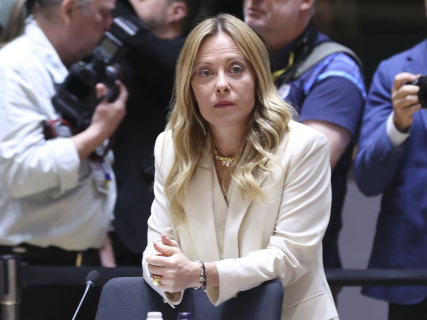

The Italian prime minister, Giorgia Meloni, sent this Thursday a letter to the president of the European Council, António Costa, to convey her displeasure over the lack of coordination among the Twenty-Seven in the peace initiatives for Ukraine driven by the United States, and to demand that the European Union decide, "once and for all," who should represent it in that process.
"What I keep asking for is that it be decided, once and for all, who sits at the negotiating table on behalf of the European Union, and with what mandate," Meloni emphasizes in the letter, released by Palazzo Chigi, in which she reproaches that several member states are promoting, on their own, different diplomatic initiatives that, in her view, make it harder to convince allies and Russia to put an end to "a senseless aggression."
In the letter, Meloni expresses her frustration that, in recent weeks, multiple meetings have been held in different formats, some without the presence of all the EU partners. She cites, among other examples, talks in Miami between the United States and Ukraine, the Oslo meeting with the participation of a high representative of the president of the European Commission, Ursula von der Leyen, as well as phone calls by the leaders of Finland and Norway with the Russian president, Vladimir Putin.
The Italian leader also criticizes that a new meeting of the Coalition of Volunteers is being prepared in Germany for next November 19, just a few days before a "Berlin format" meeting on the sidelines of the European Political Community scheduled for November 11 in Dublin. "On top of that," she adds, the technical meetings held these days in Brussels are added, with the participation of the Commission and only two member states: France and Germany.
According to Meloni’s complaint, to this picture is added the prospect of a European presence "not better specified" in the talks between Ukraine and Russia that will take place in Abu Dhabi under U.S. mediation on November 11. European sources point out, in fact, that a formal EU participation in that appointment is not contemplated.
"I have listed only the examples from the past month because I believe they explain better than any word the extent to which all of this is undermining our credibility in the handling of one of the most complicated files our nations are facing. And I am convinced that we all realize that, by portraying a Europe that moves forward in a dispersed manner, we are only furthering the interests of those who want this war to continue," warns the prime minister.
Meloni also insists, moreover, that her request does not aim to secure a seat for Rome in the negotiations, but rather the urgency of setting out a common position. "I am not asking for a seat for Italy in this or that format," she stresses, before warning that her government will not accept that agreements be closed "without a mandate" that Italy will later be forced to respect.
For this reason, she formally asks Costa to include this matter in the next informal European Council in Dublin —to be held next week—, with the objective that the heads of state and government of the Twenty-Seven adopt a definitive decision at the December summit, in coordination with the United Kingdom, Norway and other European partners.
The Portuguese leader replies to Meloni with another letter in which he announces that he will "set aside time" to address these concerns during the informal meeting of the European Council in the Irish capital. Costa, who thanks the prime minister for having wanted to "expose (her) concerns with such clarity," shares the idea that "the European Union must be appropriately involved in the discussions that determine Europe's security and the future of Ukraine."
"In light of the immense human suffering caused by Russia’s war of aggression against Ukraine, and of its far-reaching implications for Europe’s security, I agree with you that Europe must act with consistency, unity and determination," he says in his letter, in which he argues that Brussels must "convey a clear and unified message, defend its interests and support Ukraine."
Costa also reminds the head of the Italian government that he himself has defended that "the interests of the European Union must be represented by its institutions, in accordance with the Treaties." "As you know, I have raised this issue on several previous occasions in our conversations among leaders," concludes the president of the European Council.