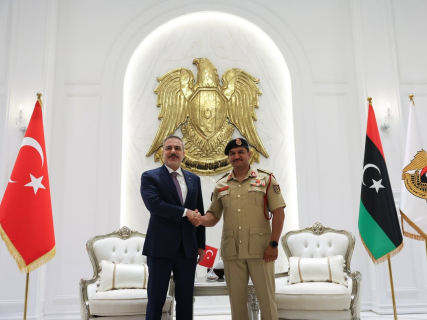

The authorities based in eastern Libya, one of the two parallel administrations that de facto share power in the country, have given their approval on Tuesday to a memorandum of understanding on maritime delimitation, in a significant turn in favor of Ankara. At the same time, they announced the annulment of a resolution adopted in 2020 in which they proclaimed the break of political relations.
The original memorandum was sealed in 2019 between Turkey and the then Government of Tripoli, recognized by the international community, through its Prime Minister, Fayez Serraj. The eastern authorities immediately rejected that understanding, as it was closed without their participation, and for years they have demanded that Ankara, a regional power, admit them as an essential political actor on the Libyan board.
In recent months, however, Turkey has rebuilt its ties with the strongman of the east, Khalifa Haftar, and especially with his son Saddam, commander of the eastern forces and an "emerging star" within the power structure of this administration, as highlighted by the recent meeting of the latter with the Turkish Foreign Minister, Hakan Fidan.
The current ratification, already published on the official website of the institution, is particularly relevant for several reasons: Turkey and eastern Libya had been without political interlocution for years due to Ankara's support for the Government of Tripoli. Furthermore, on the international level, it reopens an old dispute over maritime borders that also affects Greece and Egypt, countries that have long been rejecting an agreement aligned with the Turkish interpretation of maritime law.
Athens considers itself particularly affected because its claim to maritime spaces clashes directly with Ankara's position, especially regarding the waters south of Crete. The Greek Executive maintains that the memorandum overlooks the maritime rights generated by the Greek islands and has repeatedly labeled the pact as invalid.
Immediate reaction from Greece
Hours after the decision was made known, the Greek Foreign Ministry expressed its outright rejection of what it defined as a "unilateral parliamentary decision without legal basis," based on a fundamental error: the very existence of the memorandum, given that "Turkey and Libya do not have opposite or adjacent coasts that justify the delimitation of maritime zones."
"We call on Libya to refrain from any action contrary to International Law that undermines stability in the eastern Mediterranean," warns Greece's Foreign Affairs, which "has already informed" its position "to its partners and allies and will take all necessary measures to safeguard its sovereign rights."
"This decision," it emphasizes, "does not alter the illegal, null, and void nature of the memorandum, which is contrary to International Maritime Law and violates the sovereign rights of the states in the region," referring to Egypt and Italy, which do have adjacent and opposite coasts regarding Libya.
In parallel, both the Tripoli Government and the Libyan Presidential Council have applauded the shift of the eastern authorities, as well as the reactivation of contacts between both parties. For the Libyan Foreign Ministry, it represents "a positive step towards strengthening bilateral relations between Libya and Turkey, and the consolidation of joint cooperation in a way that serves the mutual interests of both countries."