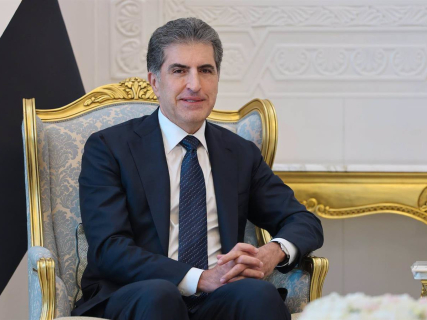










The president of the semi-autonomous region of Iraqi Kurdistan, Nechirvan Barzani, has expressed his "deep surprise and concern" at the order issued by the prime minister of Iraq, Alí Al Zaidi, to take control of the Kurdish oil fields and border crossings, a decision that puts at risk the fragile political and institutional balance that Erbil and Baghdad have maintained for years.
"We categorically reject entering into dialogue in military terms. Experience has shown that this approach does not resolve any problem and does not benefit Iraq or any of the parties," Barzani said.
Al Zaidi's initiative has managed, in an exceptional way, to bring together the two major rival formations in Iraqi Kurdistan: the Kurdistan Democratic Party (PDK), led by Barzani, and the Patriotic Union of Kurdistan (UPK), despite the serious internal crisis that had recently led the UPK to break relations with the PDK.
In a text distributed jointly, both organizations emphasized that the Kurdish region, beyond its political differences, is "the product of the blood and the long struggle of the people of Kurdistan," and described as a "red line" any attempt to undermine its "rights and achievements."
Barzani reminded the central Executive that Kurdistan is a "key partner in the construction of a new Iraq and in drafting its Constitution," and stressed that any negotiation on disagreements must "be based on the Constitution, respect for the constitutional entity and for the rights of the Kurdistan Region, and commitment to the principles of partnership and understanding."
"In this delicate stage, we emphasize the importance of Kurdish harmony and unity, and we ask all the forces and political parties of Iraq to act with wisdom and national responsibility," he concluded.
A few hours earlier, the prime minister of Iraqi Kurdistan, Masrur Barzani, had described as "unacceptable" the claim by Iraq's federal authorities to take over the region's oil fields and border crossings, a decision framed by the measures adopted within the investigation opened into alleged oil smuggling toward Iran.
In statements to the media collected by the Kurdish network Rudaw, the head of the regional government expressed his “surprise” at the package of decisions announced by the Iraqi prime minister, insisting that “it does not correspond to the content of the conversations held previously with the authorities of Baghdad”.
“Our delegations came to meet with us and conveyed various messages whose objective was to resolve the problems on the basis of the Constitution. What happened today is truly surprising and unacceptable under any circumstances,” he criticized.
Masrur Barzani emphasized the “constitutional obligations and rights” that safeguard the Kurdish region, and therefore he called on Baghdad to respect them and “that all of them be applied as they should be.” “Of course, we will fulfill the obligations that correspond to us, but we will not accept anything that is outside the framework of the Constitution,” he has insisted.
Despite his outright rejection of the measures announced by the central Government, the Kurdish prime minister said he was willing to continue talking with Al Zaidi to find formulas that fit within the Iraqi legal framework and take into account the special status of the semi-autonomous region.
“We have not closed the door to dialogue and we believe that everything must be resolved through dialogue, but this must be based on the Constitution. One cannot act unilaterally or violate constitutional rights,” he said, making a “call” to Baghdad and all the institutions in Iraq to “maintain the relevant conversations on the basis of the Constitution,” while predicting that, if the text of the Constitution is respected, a satisfactory outcome will be reached.
In this regard, he warned that “any measure that is not constitutional is completely unacceptable for the Kurdistan region”.
Baghdad’s political offensive is taking place in parallel with an investigation into a suspected smuggling network for crude oil toward Iran; that is the argument advanced by state forces to deploy in the locality of Jurf al Nasr, under the control of the pro-Iranian militias Kataib Hezbolá, as well as in another probe into a supposed case of illegal diversion of oil in which the state company North Oil Company, the operator in these provinces, would be involved.
Besides the measures to centralize the management of the fields and refineries, and of the export licenses through the Federal Ministry of Petroleum, Al Zaidi has ordered sanctions against numerous senior officials and Iraqi officials. Among them are the director of the Border Ports Authority and police officials in Kirkuk, such as the operations commander and the head of the Police, dismissed for "not having followed up on the smuggling of petroleum products".