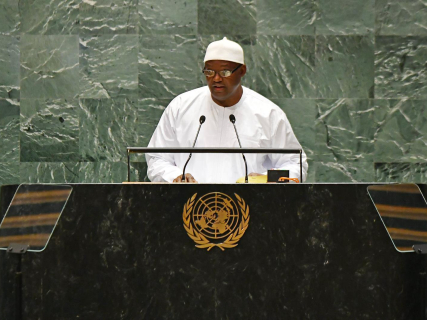

The authorities of Gambia have celebrated the ruling described as “historic” issued by the International Court of Justice (ICJ), which declares Myanmar responsible for genocide against the Rohingya minority, bringing to an end the proceedings opened after the lawsuit filed by the African country itself before the UN’s top court.
“The Government and the people of Gambia welcome with deep satisfaction the judgment handed down by the ICJ in the case concerning the application of the Convention on the Prevention and Punishment of the Crime of Genocide,” the office of the Gambian president, Adama Barrow, said in a statement released on social media, where he stresses that it is “a historic day for international justice”.
The statement highlights that, “for the first time, the main judicial body of the United Nations has declared a State responsible for committing genocide”. “The court has determined that Myanmar committed genocide against the Rohingyas, failing to comply with its obligations under the 1948 Genocide Convention, and has ordered Myanmar to proceed with the payment of reparations,” the Gambian Presidency added.
Barrow recalled that Gambia brought the case before the ICJ in 2019, with the backing of the Organization of Islamic Cooperation (OIC), and insisted that “the obligation to prevent and punish genocide is shared by all the States Parties to the Convention”. “As a nation that has also sought justice after suffering serious abuses, we could not remain with our arms crossed,” he argued.
In this context, the president wished to recognize “the courage of the Rohingya survivors and witnesses, whose testimony made this result possible”. “Their perseverance has been vindicated,” he said, before stressing that “the judgment is final and binding” and urging the Myanmar authorities to “comply with it fully and without delay”.
“We call on the United Nations, the OIC and the international community as a whole to support its full implementation,” Barrow added, who also praised the work of Gambia’s Minister of Justice, Dawa Jallow, of his predecessor, Abubacarr Tambadou, and of the country’s legal team “for their competence and unwavering dedication over the past seven years, filling the entire nation with pride”.
For the head of government, "Gambia maintains its firm commitment to International Law, the peaceful resolution of disputes, and accountability for atrocities, wherever these occur." The ruling of the ICJ holds Myanmar responsible for genocide for the military operations launched in 2017 against the Muslim Rohingya community in the state of Rakhine, an offensive in which around 10,000 people died.
The court considers it proven that thousands of Rohingya civilians were "killed violently during clearance operations" in 2017, as outlined by Judge Yuji Iwasawa, who also recognized attacks by the Arakan Rohingya Salvation Army (ARSA, by its English initials) against military posts and civilians.
"It is reasonable to infer that the forces of Myanmar acted with genocidal intent," the magistrate said, specifying that "the context surrounding the 2017 clearance operations created an environment conducive to the violence perpetrated during those operations by the security forces and constituted the basis of Myanmar's intent to destroy a part of this group."
The decision was adopted with nine votes in favor and six against. The judges also determined that the authorities that were governing the Asian country at the time "violated their obligations to prevent genocide" with respect to the Rohingya at the hands of their Armed Forces, and concluded that the obligation to "punish genocide and other acts set forth in the Convention on the Prevention and Punishment of the Crime of Genocide" was also breached.
The operations examined by the ICJ date back to 2016, when the ARSA carried out several attacks against Myanmar Army border posts. In October of that year, the military launched a first major offensive in northern Rakhine, which prompted United Nations reports of serious violations of Human Rights.
The spiral of violence intensified until, in August 2017, the Armed Forces launched a broad military campaign that left thousands dead and caused about 700,000 people to flee to Bangladesh, where more than 1 million stateless Rohingya refugees currently live across more than three dozen camps in the district of Cox's Bazar.