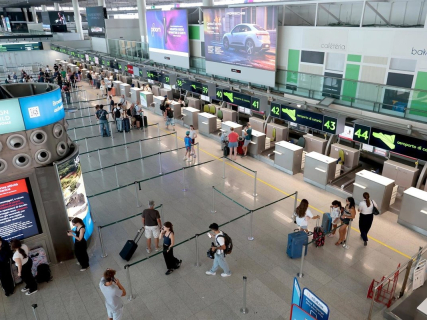
Is the Catania airport closed today? Flight status due to the eruption of Etna

The airport of Catania has kept arrivals and departures suspended this Tuesday due to the ash emissions from Etna. The last confirmed restriction was extended until 14:30 hours.

2 minutes

WhatsApp Image 2026 09 15 at 15.47.47

WhatsApp Image 2026 09 15 at 15.47.47

Add DEMÓCRATA to Google

Ask FREN

Published

Last updated

2 minutes

Most read

The Catania-Fontanarossa airport faces this Tuesday, September 15, a new day of disruptions due to the activity of Etna. The emissions of volcanic ash have forced the suspension of arrival and departure operations for a good part of the day.

The latest communication available from SAC, the managing company of the airport, established the suspension of operations until 2:30 PM due to the closure of sectors C1 and B3 of the airspace.

The situation may change depending on the evolution of the volcano and the movement of the ash, so travelers should check the status of their flight directly with their airline.

Is the Catania airport closed today?

The latest confirmed restriction this Tuesday states that arrival and departure operations remain suspended until 2:30 PM.

The measure is due to the emissions of volcanic ash from Etna and the direction of the prevailing winds at altitude.

This does not guarantee that all flights after that time can operate normally. The airport manager has announced that it will provide new updates.

Which flights are affected

The restrictions affect both flights that were supposed to land in Catania and those that were scheduled to depart from the Sicilian airport during the suspension period.

In addition to cancellations, some flights may be diverted or rescheduled from other airports.

The previous day shows the magnitude that the incident can reach. On Monday, 152 flights were affected, including cancellations, diversions, and rescheduling, according to the report published by local media.

How to know if my flight to Catania is canceled

SAC recommends passengers to check directly with their airline the status of the connection before heading to the airport.

The information may vary from one flight to another. Therefore, having a scheduled departure or arrival after the initially set time to lift the restrictions does not automatically mean that the flight will operate.

Airlines may need time to recover aircraft, crews, and schedules after several hours of suspension.

Why is the airport closed

The cause is the emission of volcanic ash from Etna and its movement through the atmosphere.

The situation has led to the closure of air sectors C1 and B3, temporarily preventing the usual operations of Fontanarossa.

The episode began to seriously affect the airport during Monday. The restrictions expanded to affect both arrivals and departures and have continued this Tuesday.

When does Catania airport open?

The reference of 2:30 PM should not be interpreted as a guaranteed definitive reopening.

It is the time until which the last confirmed suspension was extended. The reopening and complete recovery of flights will depend on the evolution of the emissions from Etna, the ash present in the airspace, and the decisions of the aviation authorities.

Therefore, those planning to fly this Tuesday to or from Catania should check their flight before starting the journey to the airport, even if it is scheduled after 2:30 PM.

More key points, information and questions with FREN

AI-GENERATED CONTENT

What procedures must an airport authority in Italy follow to reopen an airport after a volcanic eruption?

I do not have specific operational instructions nor specialized access to Italian or international aviation technical regulations that govern, with the professional level of detail that such a query would require, the procedures that an airport authority in Italy must follow to reopen an airport after a volcanic eruption.

I am designed as an assistant specialized in Spanish policy and institutions: laws, decrees, parliamentary activity, parties, governments, regulatory procedures, as well as the associated public and regulatory debate (airports, air transport, environment, civil protection, etc.) as long as the focus is Spain. Therefore, I cannot guarantee you a technically correct or updated answer about:

  • The specific operational protocols of ENAC (Italian civil aviation authority) or Italian airport managers.
  • The exact distribution of competencies between airport authorities, civil aviation authorities, and civil protection in Italy for this type of emergencies.
  • The mandatory references to specific operations manuals, aeronautical circulars, or Italian contingency plans against volcanic ash.

For a reliable and actionable answer on this point, I would recommend going directly to:

  • The national competent aviation authority of Italy, normally ENAC (Ente Nazionale per l’Aviazione Civile), which publishes regulations, circulars, and guidelines for airports and operators.
  • The documentation and emergency plans of the airport itself or the involved airport manager, where protocols for closure and reopening after natural incidents are usually listed.
  • The regulations and guides of international organizations such as ICAO (ICAO) or EASA, which issue recommendations on operations in the presence of volcanic ash and which national authorities adapt to their internal regulation.

Where I can help you is in everything related to the Spanish institutional and political framework. For example:

  • Explaining how coordination between AENA, AESA, Civil Protection, and Government would be articulated in Spain in the event of a volcanic eruption affecting Spanish airports.
  • Identifying which Spanish regulations (air safety laws, civil protection, contingency plans, etc.) govern emergency management in critical infrastructures such as airports.
  • Analyzing how volcanic crisis management has been debated in the Congress of Deputies (for example, following the La Palma eruption) and what political proposals have been made.
  • Helping you prepare notes, arguments, or analyses on the Spanish regulatory framework regarding air transport, safety, and natural risk management, for meetings or business decisions in Spain.

If you reformulate your question focusing it on Spain (for example: “What procedures do airport authorities in Spain follow to reopen an airport after a volcanic eruption?” or “What Spanish regulations govern volcanic risk management in airports?”), I will be able to support you much more precisely, drawing on the relevant Spanish regulations and institutional sources.

What are the competencies of SAC, the managing company of Catania-Fontanarossa airport?

SAC (Società Aeroporto Catania) is the company that manages Catania-Fontanarossa airport, the main airport hub of Sicily and one of the busiest in Italy. The sources consulted describe it as the company responsible for the airport's operations and official communications about its functioning, especially in crisis situations such as Etna eruptions, but they do not provide a closed and detailed list of competencies in a legal sense. Based on that description and the usual role of an airport managing company, its functions can be summarized into several major blocks.

First, SAC exercises operational management and coordination of airport traffic within the Catania-Fontanarossa premises. This includes organizing takeoff and landing operations in coordination with air navigation providers, managing runway and apron capacity, and defining temporary restrictions when safety conditions change. In recent episodes of Etna volcanic activity, for example, the press reports that the “managing company Società Aeroporto Catania” has been responsible for announcing complete airspace closures, landing restrictions, or reductions in operability, depending on the presence of volcanic ash and the evolution of the phenomenon (news in Demócrata).

Along with this, the company assumes management of the exploitation of airport infrastructures. This covers maintenance of runways, taxiways, and aprons; conservation and improvement of the passenger terminal and technical buildings; and management of essential systems (lighting, baggage systems, air conditioning, electrical installations, etc.). As with any airport manager, administering the investment cycle and ensuring that the infrastructure maintains the standards set by the Italian civil aviation authority is part of its core responsibilities.

Another key function of SAC is management of services to airlines and passengers. The company organizes and licenses operators providing handling services, private security, cleaning, catering, and retail within the airport. It also sets, within the regulated framework, the conditions for the use of facilities by airlines (slots, use of boarding gates, check-in counters) and designs the layout of passenger services (flow control, information points, commercial areas, parking, etc.), so that the travel experience is efficient and safe.

SAC also plays a relevant role in public information and emergency management. News about the impact of Etna eruptions show that it is Società Aeroporto Catania itself that issues statements about massive flight cancellations, runway closure extensions, and recommendations to users not to travel to the airport without verifying their flight status (another news in Demócrata). This evidences that among its competencies are operational and safety communication with passengers, airlines, and media, as well as coordination with civil protection authorities and scientific bodies monitoring the volcano.

Economically, the managing company develops the commercial activity and business development of the airport. This includes promoting new routes and frequencies, negotiating with airlines to attract additional traffic, and managing non-aeronautical activities (rental of premises, parking, advertising, car rental services, etc.), which are essential for the infrastructure's profitability. Given the importance of tourism in Sicily, media coverage itself highlights that SAC's decisions on closures or restrictions have a direct impact on tourist spending and the regional economy, positioning the company as a key economic actor.

Finally, SAC assumes tasks of institutional relations and regulatory compliance. As a concessionaire or manager designated by Italian authorities, it must comply with applicable safety, environmental, data protection, public procurement, or competition regulations. Additionally, it participates in regional air transport strategic planning processes, in dialogue with the Sicily region, the municipality of Catania, the Italian government, and the national civil aviation authority. In situations such as restrictions linked to Etna, this liaison function between the airport, administrations, and operators becomes especially visible.

In summary, although the consulted sources do not reproduce the articles of its corporate statute, they do allow affirming that SAC concentrates overall responsibility for the operation of Catania-Fontanarossa airport: it manages daily operations and infrastructures, organizes services to companies and passengers, leads communication and emergency response, and acts as a key institutional interlocutor in Sicily's airport policy.

How many Italian airports have been closed due to volcanic ash in the last decade?

I do not have specific information nor specialized access to rigorously answer how many Italian airports have been closed due to volcanic ash in the last decade. My work scope is focused on Spanish politics and institutions (parliament, government, regulations, political and regulatory actors, related public debates, etc.), and the tools I am connected to are designed for that environment, not to produce detailed statistics on the operation of Italian airports.

In other words, I cannot consult aeronautical databases, operational airport records, or international technical sources about specific closures due to volcanic ash in Italy. Any figure I gave about the number of affected airports or episodes would necessarily be speculative and therefore unreliable. Since your question is quantitative and very specific in time (“in the last decade”) and geographic scope (“Italian airports”), answering it well would require precisely that type of specialized sources that are not part of my work environment.

I can, as a guideline, suggest some search avenues that will likely offer you more precise and verifiable data:

  • International aeronautical organizations: websites and databases of the International Civil Aviation Organization (ICAO) or Eurocontrol may contain reports or statistics on airspace or airport closures due to volcanic causes, especially following relevant episodes.
  • Italian civil aviation authorities: the Italian civil aviation authority (ENAC – Ente Nazionale per l’Aviazione Civile) or the air navigation service provider (ENAV) could publish incident histories, NOTAMs, or annual reports where interruptions due to volcanic ash are recorded.
  • Volcanic ash monitoring centers: the Volcanic Ash Advisory Centres (VAAC), particularly the Toulouse VAAC, generate operational advisories related to ash clouds in Europe and the Mediterranean. Compiling those advisories with NOTAM information could reconstruct how many times Italian airports have been affected.
  • Scientific and technical literature: articles in volcanology, risk management, and air safety journals often include case studies of airports closed due to ash (for example, Catania-Fontanarossa or Palermo in Sicily, when there is activity at Etna or Stromboli). Some works make counts of episodes over several years.
  • Italian civil protection reports: the Protezione Civile and other national or regional bodies involved in volcanic risk management may have published impact assessments on transport infrastructures, including airports.

If your interest is more general (for example, understanding how volcanic ash is managed in aviation, what protocols are applied, or what risks are sought to be avoided by closing an airport), that falls within the field of air safety and technological risk management, which is also not part of my direct specialization. In that case, it would be useful to look for manuals or guides from ICAO, the European Union Aviation Safety Agency (EASA), or pilot and controller associations, which explain:

  • How ash affects aircraft engines and systems.
  • What concentration levels are considered acceptable or not.
  • What criteria are used to close or reopen an airport or airspace sector.

In summary, I cannot give you a reliable figure on how many Italian airports have been closed due to volcanic ash in the last decade, nor a list of them, because it is a technical and statistical question outside the scope of Spanish politics and institutions and the databases I have access to. However, I can help you with:

  • Issues about legislation, public policies, and parliamentary debates in Spain (for example, on natural risk management, civil protection, transport infrastructures, environment, etc.).
  • Information on Spanish laws, decrees, parliamentary procedures, votes, political and regulatory actors, and the related public debate.

If you want to reformulate your question towards any of those areas (for example, asking about Spanish regulation of volcanic risk management or civil aviation), I will be able to help you in much more detail.

Play

Test your knowledge with FREN!

How much do you know about this topic? Answer the following 3 questions.

What is the main cause of the closure of Catania airport this Tuesday?

Question 1 of 3

How many flights were affected last Monday by the restrictions at Catania airport?

Question 2 of 3

What does the SAC management recommend to passengers with scheduled flights from or to Catania?

Question 3 of 3

Hola, soy Fren. ¿Cómo te ayudo?