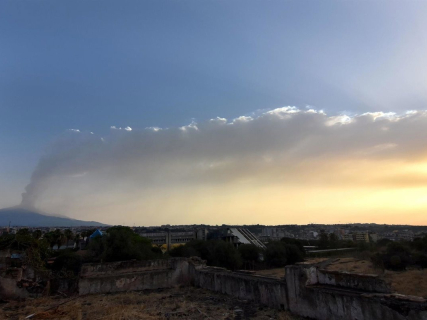
Canceled flights in Catania due to the eruption of Etna: what to do if you have a trip to Sicily

The ash expelled by the volcano has forced the suspension of operations at Catania airport and is causing cancellations and diversions. The manager recommends checking the flight with the airline before going to the airport.

2 minutes

WhatsApp Image 2026 09 15 at 15.50.38

WhatsApp Image 2026 09 15 at 15.50.38

Add DEMÓCRATA to Google

Ask FREN

Published

Last updated

2 minutes

Most read

The new activity of Etna complicates travel to Sicily again. Catania-Fontanarossa airport has kept its operations suspended this Tuesday due to the presence of volcanic ash in the airspace, with canceled flights and connections diverted to other airports.

The latest communication available from the airport manager, SAC, extended until 2:30 PM this Tuesday, September 15 the suspension of both arriving and departing flights due to the closure of air sectors C1 and B3.

The situation may continue to change throughout the day, so passengers with a planned trip to Catania should check directly with their airline the status of their flight before traveling to the airport.

What to do if you have a flight to Catania

The first step is to check the specific status of the flight with the airline. The suspension of operations does not necessarily mean that all passengers will follow the same procedure: a connection may be canceled, delayed, or diverted to another airport.

SAC has expressly requested travelers to not go to the airport without checking their flight beforehand.

The recommendation is particularly important because the situation is evolving based on the ash emissions from Etna and the direction of the winds at altitude.

Cancellations and diverted flights due to ash

The impact on operations began on Monday and has been considerable. During the day of September 14, 152 flights were affected by cancellations, diversions, and rescheduling, according to the report published by local media.

Of these, 82 were canceled and another 70 were diverted or rescheduled. A good number of flights that could not land in Catania were sent to other airports.

Palermo, Comiso, and Trapani were among the airports used to receive diverted connections.

What happens if my flight is diverted to another airport?

If the airline diverts the flight, the passenger must follow the instructions provided by the airline itself to complete the journey.

It is not advisable to immediately purchase a new flight or transportation on one's own without first consulting the alternatives offered by the airline, especially if one intends to claim those expenses later.

Passengers should also keep boarding passes, reservation confirmations, communications from the airline, and receipts for expenses arising from the incident.

Why the eruption of Etna affects airplanes

The problem is not only the volcanic activity on land. The volcanic ash in the atmosphere poses a risk to air navigation, so authorities may restrict sectors of airspace when emissions reach the routes used by airplanes.

In this episode, the combination of ash emission and the direction of high-altitude winds has caused the closure of sectors C1 and B3 linked to the operations of Catania.

The airport already suffered significant disruptions this Monday. The restrictions were expanded throughout the day as the situation of the volcano evolved.

When will Catania airport return to normal operations?

There is currently no time that allows for a definitive return to normalcy.

The latest available update extended the suspension of arrivals and departures until 2:30 PM on Tuesday, but SAC had announced that it would provide new updates as the situation evolved.

Therefore, even passengers with flights scheduled for after that time should check their connection before going to Fontanarossa.

More key points, information and questions with FREN

AI-GENERATED CONTENT

What are the legal procedures and compensation for passengers affected by flight cancellations due to force majeure causes such as volcanic eruptions according to European regulations?

In the European Union, the rights of air passengers affected by cancellations due to force majeure causes, such as a volcanic eruption, are mainly regulated by Regulation (EC) No 261/2004. This regulation clearly distinguishes between the right to assistance and reimbursement/re-routing, which remains even in force majeure cases, and the right to financial compensation, which is usually excluded in such cases.

1. What is considered force majeure or "extraordinary circumstances"?

The Regulation refers to "extraordinary circumstances" that could not have been avoided even if all reasonable measures had been taken. Jurisprudence and European Commission guidelines include, among others:

  • Extreme weather phenomena (severe storms, dense fog, hurricanes, etc.).
  • Volcanic eruptions and volcanic ash affecting flight safety.
  • Airspace closures or restrictions imposed by authorities.
  • Security risks beyond the airline's control.

In these cases, the cancellation is usually considered justified, so the airline does not have to pay fixed financial compensation, but it still has other obligations towards the passenger.

2. Right to assistance (meals, accommodation, communications)

Even when the cancellation is due to force majeure, the airline must provide assistance to affected passengers, depending on the waiting time and flight distance:

  • Sufficient meals and refreshments, usually in the form of vouchers or reimbursement of reasonable expenses.
  • Hotel accommodation if an overnight stay of one or more nights is necessary.
  • Transport between the airport and accommodation.
  • Two free communications (calls, emails, or messages) to reorganize the trip.

This assistance obligation remains even if the event is completely beyond the company's control (for example, a widespread airspace closure due to volcanic ash).

3. Ticket refund or alternative transport

In case of cancellation, regardless of the cause, the passenger has the right to choose between:

  • Full refund of the ticket within a reasonable time, for the part of the journey not made (and for the part already made if the missed flight makes the rest of the journey useless).
  • Transport to the final destination under comparable transport conditions, as soon as possible.
  • Re-routing at a later date, at the passenger's convenience, subject to seat availability.

The option must be clearly offered by the airline, and the choice belongs to the passenger.

4. Financial compensation: when it is excluded

The Regulation provides for fixed financial compensation (250, 400, or 600 euros depending on distance) when:

  • The flight is canceled with little notice, or
  • The passenger arrives very late at their final destination due to the airline's fault.

However, the company can be exempted from paying this compensation if it proves that the cancellation or long delay was due to extraordinary circumstances unavoidable even with all reasonable measures. Volcanic eruptions and airborne ash, when forcing cancellation for safety reasons, normally fall under this assumption.

It is important to differentiate:

  • The right to assistance and reimbursement/re-routing, which remains.
  • The right to fixed financial compensation, which may not apply in force majeure.
5. Claims and legal remedies

The usual procedure is as follows:

  • Claim to the airline: the passenger must first submit a formal claim to the company, providing tickets, boarding passes, and proof of expenses (meals, hotel, transport, etc.).
  • National enforcement body: if the airline's response is unsatisfactory or absent, one can go to the competent body of the Member State where the event occurred or where the flight departed. This body supervises compliance with Regulation 261/2004 and can issue reports and sanction the airline, although it does not always resolve individual compensation.
  • Alternative dispute resolution (ADR) systems or mediation mechanisms, when available for the air sector in the respective country.
  • Judicial action: as a last resort, the passenger can go to civil or commercial courts claiming the rights under the Regulation and reimbursement of justified additional expenses, even if there is no fixed compensation due to force majeure.
6. Practical recommendations
  • Always keep tickets, boarding passes, and proof of all expenses.
  • Request in writing the official cause of the cancellation (force majeure, airspace closure, etc.).
  • First claim directly to the airline and, if applicable, escalate to the competent national body or ADR mechanisms.
  • Consult the European Commission's guides on air passenger rights to understand the interpretation of "extraordinary circumstances".

What powers does the Italian airport authority SAC have in managing air emergencies?

I do not have specific or specialized access regarding the Italian airport authority SAC (for example, Società Aeroporto Catania or similarly named entities in Italy) nor about the detailed regulations of its specific powers in managing air emergencies. My area of expertise is focused on the political, institutional, and regulatory system of Spain, so I cannot provide you with a rigorous, article-by-article description of the legal or regulatory functions assigned to SAC under Italian law.

That said, to provide useful context, I can generally explain how, in Europe, the powers of an airport authority or manager in air emergency matters are usually structured, and how they fit into the system of responsibilities, making clear that the following is a general description and not an exact reflection of SAC's regulation:

1. General framework of responsibilities in air emergencies

In most European countries, emergency management at an airport is built on a combination of:

  • Civil aviation and air navigation authority, which sets operational safety, certification, and coordination rules (for example, ENAC/ENAV in Italy, AESA and Enaire in Spain).
  • Airport manager (public or private concessionaire company), responsible for infrastructure, the emergency plan, and coordinating resources within the airport premises.
  • Public emergency services (civil protection, firefighters, health services, security forces), with their own legal powers in rescue, public order, and protection of people.

The airport authority or managing company is usually the coordination center within the airport premises, while air traffic control manages the "in-flight" phase of the emergency and civil protection services take over the broader disaster management when it exceeds the purely airport scope.

2. Typical powers of the airport manager in emergencies

Although the exact wording depends on Italian laws and regulations, an airport manager like SAC generally has, in abstract, these types of responsibilities:

  • Development and maintenance of the Airport Emergency Plan (PEA or equivalent):
    • Define procedures for aircraft accidents on the runway, maneuvering area, or nearby.
    • Regulate response to incidents involving dangerous goods, terminal fires, bomb threats, or other critical situations.
    • Establish the chain of command, communication channels, and target response times.
  • Internal operational coordination:
    • Activate the airport emergency coordination center.
    • Mobilize airport rescue and firefighting services (SEI/ARFF service) and security and operations personnel.
    • Coordinate with airlines, handling agents, and other airport operators.
  • Interface with external emergency services and authorities:
    • Immediately notify civil protection, municipal or regional firefighters, police, and health services.
    • Facilitate access to the premises, logistical resources, and meeting points for these services.
    • Participate in joint advanced command when national regulations so provide.
  • Management of operational continuity:
    • Decide on total or partial closure of runways, taxiways, or terminals for safety reasons.
    • Reorganize passenger and flight flow, in coordination with airlines and air traffic control.
    • Apply contingency plans for the progressive restoration of normality.
  • Information to passengers and the public:
    • Manage operational communication with airlines for information on affected flights.
    • Coordinate with competent authorities for public communication and press conferences.
3. Training, drills, and prior coordination

Another important aspect of the usual powers of an airport manager consists of:

  • Periodic training of personnel in emergency protocols and equipment use.
  • Comprehensive drills involving all stakeholders (air traffic control, medical services, civil protection, security forces), to verify response times and coordination.
  • Review and update of the plan after real incidents or drills, incorporating lessons learned and regulatory changes.

To know precisely what specific powers SAC has in Italy — which national or regional laws define them, which articles regulate its role in the emergency plan, what formal relationship it maintains with the Italian civil aviation authority and civil protection — I would recommend consulting directly:

  • The official SAC website or the corresponding airport's site, in the section on piano di emergenza or similar.
  • Italian civil aviation and civil protection regulations, as well as documentation from ENAC and national or regional civil protection.

What I can help you with in detail are equivalent topics in the Spanish context: for example, how the powers of Aena, AESA, and civil protection are organized in airport emergencies in Spain, what regulations govern them, and how they articulate with the Spanish political and administrative system. If you are interested in that comparison or the Spanish case, I can develop it in detail.

Could you explain how powers are distributed in Spain among Aena, AESA, and Civil Protection in air emergencies? Can you give me a general comparison between the airport emergency management model in Spain and that usually found in other European countries? What Spanish regulations govern emergency management at airports and how do they relate to the political and institutional system?

What alternative airports are usually used in Sicily when the Catania airport is affected by natural disasters?

I am an assistant specialized in politics and public institutions of Spain, and my work scope is exclusively focused on issues such as laws, decrees, parliamentary activity, parties, political actors, public policies, and the institutional or regulatory dimension related to Spain. Therefore, I am not designed to provide reliable and detailed information about airport operations in other countries, nor about natural disaster management in specific infrastructures outside that context, such as the alternative airports used in Sicily when the Catania airport is affected.

The question you raise falls squarely into the field of international air transport management, route planning, and airport emergency protocols in Italy. This type of information is based on technical and operational decisions by Italian aeronautical authorities, international civil aviation organizations, airlines, and private airport managers. It is not a matter of Spanish politics or regulations, nor of the institutional sphere in which I am trained to research and reason in depth, so any specific answer I would offer about which airports are used as alternatives in Sicily would risk being imprecise, incomplete, or outright wrong.

To ensure rigor and usefulness, my design sets a clear limit: I must not improvise specialized information from other fields that I cannot verify within the framework for which I was created. In your case, the appropriate approach is to consult sources specifically oriented to air transport and airport management, such as:

  • Official websites of Italian civil aviation authorities or airport managers, where it is usually indicated which aerodromes operate as operational alternatives in case of emergencies or temporary closures.
  • Communications or passenger notices from the main airlines operating in Catania, which often detail to which airport they redirect their flights when there are closures due to weather, volcanic, or other emergencies.
  • Specialized aviation portals and sector news, which track flight diversions, runway closures, and contingency plans during natural disaster episodes.
  • Updated recommendations from civil protection bodies or regional Sicilian authorities, which may indicate which transport infrastructures are prioritized in emergency contexts.

On the other hand, where I can add value is in related questions but focused on the Spanish institutional or political field. For example:

  • How civil protection and natural disaster response are organized in Spain, including the role of the General State Administration, autonomous communities, and municipalities.
  • What Spanish regulations govern the security and planning of critical infrastructures (roads, ports, airports, energy networks) against natural or technological risks.
  • What has been debated in the Congress of Deputies or the Senate about climate resilience, emergency planning, or public investments in transport infrastructures.
  • How cooperation between Spain and the European Union is articulated in disaster risk management, European funds for climate-resilient infrastructures, or EU civil protection mechanisms.

If you are interested in connecting your question with the institutional or political approach, we could, for example, analyze:

  • What plans or strategies Spain has to guarantee the continuity of air transport in episodes of volcanic eruptions, strong storms, or other extreme phenomena.
  • How airport closures in other countries (such as Catania) have influenced the European debate on climate change adaptation and safe transport networks.
  • How Spain coordinates with other EU Member States in crisis management affecting European air traffic.

If you reformulate your question oriented towards politics, regulation, or institutional organization related to these topics in Spain or the European framework, I can help you with a deeper analysis, supported by regulations, parliamentary debates, and public policies. Meanwhile, for the specific question about alternative airports in Sicily, I recommend consulting specialized aviation sources and the official Italian channels competent in air transport and emergency management.

Play

Test your knowledge with FREN!

How much do you know about this topic? Answer the following 3 questions.

What was the main reason for the suspension of operations at Catania-Fontanarossa airport?

Question 1 of 3

At what time was the suspension of flights at Catania airport scheduled on Tuesday, September 15?

Question 2 of 3

What is recommended to passengers before going to Catania airport during the suspension of operations?

Question 3 of 3

Hola, soy Fren. ¿Cómo te ayudo?