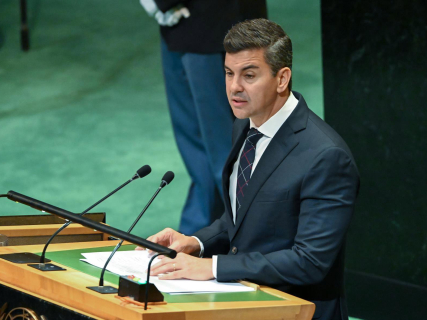

Santiago Peña, who this Thursday has submitted his resignation as president of Paraguay, will remain for the moment in the head of state after Congress failed to achieve the necessary quorum to put his resignation up for a vote, once several lawmakers from the ruling Colorado Party left the chamber.
After nearly two hours of heated parliamentary debate, a group of senators from Peña’s political formation decided to stand up and leave the room, which forced the president of the Senate, Basilio Núñez, to bring the session to an end due to the impossibility of continuing with the process.
This maneuver has taken place despite the fact that from the ruling side it had been anticipated that they would support the resignation of the head of the Executive. In fact, the former president of Paraguay Horacio Cartes, architect of Peña’s political push in the 2023 elections, had said in a statement that from the Partido Colorado "we accompany the impeachment of the president with a view to redirecting the institutional order of the Republic once again."
Núñez has said that he will call the senators again this Friday to continue the impeachment proceedings against Peña, which was approved hours earlier unanimously in the Chamber of Deputies. For the removal to move forward in the Upper House, the favorable vote of 30 of its 45 members is required.
The possible removal would have important political and personal consequences for the head of government. If he were to be removed, he would be barred from assuming the status of life senator and would lose the privileges associated with that role. This would mean that, in the event of possible complaints regarding potential crimes, the records would pass directly to the Public Ministry, the Fiscalía, and the leader would be left with much of his immunity protection removed.
The crisis of Banco Ueno, trigger of the resignation
The resignation submitted by Peña is directly linked to the intervention of Banco Ueno, whose serious liquidity crisis has left, temporarily, millions of clients, including numerous pensioners, unable to access the funds deposited in the institution.