
How to watch La Séptima? This is how you can tune in the new television channel

The arrival of the new network coincides with a reorganization of frequencies that can affect the reception of other channels

la septima como ver

la septima como ver

Add DEMÓCRATA to Google

Ask FREN

Published

Last updated

1 minute

Most read

Elecciones 29N · Encuestas

La media de las encuestas

Media a 4 de noviembre de 2026 · 15 institutos

  • PP31,0 %
  • PSOE26,3 %
  • Vox19,5 %
  • Frente Amplio6,5 %
  • ERC2,5 %
  • Podemos2,2 %
  • SALF2,2 %
01020304050ene 2024jul 2024ene 2025jul 2025ene 2026jul 2026

Media del último estudio de cada instituto en 30 días y su evolución semanal desde el 23J. Partidos con al menos un 2 %.

Todas las encuestas

Elecciones generales del 29 de noviembre · Demócrata

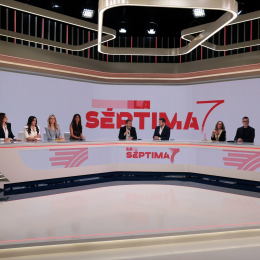
La Séptima begins its broadcasts this Thursday, November 5, at 12.00 p.m.. The new channel joins the open digital terrestrial television (TDT) offering and will initially broadcast in high definition (HD).

To receive the signal on the television, the Ministry for Digital Transformation and Public Function recommends carrying out a new automatic search for channels starting at 08.00. The operation will make it possible to update the list of channels after the technical changes planned for that day.
The procedure consists of accessing the television’s settings menu and locating the section for channels, installation, or tuning. From there, you need to select the automatic search and wait for the device to complete scanning the available signals.

Once the process is finished, La Séptima should appear in the list of channels found. The exact position will depend on the ordering configured on each television, so it should not be assumed that it will necessarily take up number seven on the remote control.

Is it necessary to have a 4K-compatible television?

No. La Séptima will begin broadcasting in HD, so it is not necessary to have an ultra-high-definition (UHD) compatible device to receive the channel.

The premiere coincides with the rollout of DVB-T2 technology in one of the TDT multiplexes, which will allow UHD broadcasts to be added. The Ministry states that televisions that are not compatible with this standard will be able to continue receiving most channels in high definition, although some services could change location or stop being viewable if tuning is not updated.

What to do if 'La Séptima' does not appear

If La Séptima does not appear after the automatic search, it is advisable to repeat the process and check that the television is connected correctly to the antenna. It may also be necessary to review the building’s collective installation if reception problems persist.

The official recommendation is to rescan starting at 08.00 on November 5, once the technical work planned for the reorganization of the TDT has been completed.

More key points, information and questions with FREN

AI-GENERATED CONTENT

What is the parliamentary process for the allocation of new channel licenses in DTT in Spain?

The allocation of new DTT channel licenses does not generally follow a parliamentary procedure, but rather an administrative one. For licenses at the state level, the Council of Ministers calls and resolves the public tender. The Cortes Generales approve the legal rules and oversee the Government, but do not vote on which company obtains each license.

1. The legal framework and competent authority

The central regulation is the Law 13/2022, General Audiovisual Communication Law. Its article 17.2 establishes that television via terrestrial hertzian waves requires a "prior license granted through a tender". Therefore, to broadcast on DTT it is not enough to notify the start of activity, as happens with other audiovisual services.

Article 22 assigns the Council of Ministers the granting of state licenses. For regional and local licenses, article 23 provides that each autonomous community determines the competent authority. The provision of public service has a specific regime and should not be confused with the tender for private operators.

2. The phases of the allocation

  • Availability of radioelectric capacity. First, there must be space for broadcasts within the state spectrum planning, that is, the available frequencies. Technical planning and audiovisual licensing are related but distinct decisions: having technical capacity does not automatically assign a channel to a company.
  • Call and terms. For state licenses, the Council of Ministers approves the specifications and calls the tender. The specifications set the participation conditions, documentation, evaluation criteria, and obligations of the awardee. The call is published in the BOE.
  • Submission and evaluation of offers. Interested companies submit their applications according to the deadline and requirements of the terms. Their admission is verified and proposals are evaluated. The evaluation results in an award proposal.
  • Resolution and obligations. The Council of Ministers awards the state license. The operator is bound by the tender conditions and the commitments of its offer. According to article 21.2, the license entails the granting of exclusive use of the public radioelectric domain reserved for providing the service.

As an example of how these phases work, in 2015 the call for six licenses and the tender resolution were published separately. These are administrative precedents, not parliamentary votes for awarding.

3. When Parliament intervenes

If the law needs to be amended, parliamentary processing does exist. A government bill is published, receives amendments, and goes through committee and commission; then it continues until approval and submission to the Senate. If the Senate introduces changes or vetoes the text, the Congress reconsiders it. This process is regulated in articles 109 to 123 of the Congress Rules. A private member's bill follows its corresponding course.

To oversee the Government, parliamentarians can ask questions and interpellations and request appearances about the call, criteria, or award. They can also promote non-legislative motions: initiatives urging the Government to act, but which do not replace the tender nor grant licenses.

Finally, if a regulatory reform is approved by royal decree-law, Congress must decide on its validation or repeal. This does not turn each award into a matter subject to parliamentary ratification. Nor should a technical planning royal decree be confused with a royal decree-law.

In short: Parliament establishes and oversees the rules; the Administration processes the tender and the competent body awards it. A new law is not necessary for each license if its granting fits within the existing framework.

What are the competencies of the Ministry for Digital Transformation and Public Function regarding broadcasting?

The Ministry for Digital Transformation and Public Function has competencies over the technical dimension of broadcasting —frequencies, installations, and transmissions— and over the regulation of audiovisual communication services. However, it does not concentrate all powers over radio and television: it must act respecting the attributions of other administrations and the National Commission on Markets and Competition (CNMC).

Regulatory framework and organization

The organizational framework is Royal Decree 210/2024, of February 27, amended by Royal Decree 1185/2024, of November 28. This reform is important: it transferred the regulation and promotion of audiovisual communication services to the State Secretariat for Digitization and Artificial Intelligence, which oversees the Directorate General for Regulation of Digitization and Audiovisual Communication Services.

Meanwhile, the State Secretariat for Telecommunications and Digital Infrastructures includes the General Secretariat for Telecommunications, Digital Infrastructures, and Digital Security. Therefore, the regulation of the audiovisual service should not be confused with the technical management of the networks and frequencies that enable its broadcast. See Royal Decree 210/2024 and its 2024 reform.

Technical competencies on broadcasting

In this area, ministerial functions include:

  • Technical regulations: drafting and proposing regulation of broadcasting and television systems, regardless of their technical support.
  • Frequency planning: preparing proposals for the National Frequency Allocation Table and national technical plans for broadcasting and television, as well as developing that planning.
  • Spectrum management: establishing conditions for the use of frequency bands and processing the granting, modification, extinction, or revocation of titles allowing use of the public radioelectric domain.
  • Projects and installations: processing approval of radiocommunication technical projects, inspecting or recognizing installations, and authorizing their commissioning.
  • Emission control: technically verifying emissions, locating and identifying harmful interference and unauthorized emissions, and acting to eliminate them. Also includes controlling exposure levels to radioelectric emissions and protecting the spectrum.
  • Administrative management: managing radioelectric concessions, actions on their secondary market, and the fee for reservation of the public radioelectric domain.

These matters are developed in article 7 of Royal Decree 210/2024, especially in its provisions on technical regulation, planning, management, and radioelectric inspection, which should be read with the subsequent reorganization.

Audiovisual regulation, supervision, and limits

The audiovisual aspect includes drafting and proposing regulation, planning and promoting the sector, liaising with its operators, and cooperating with other administrations. It also covers processing audiovisual enabling titles corresponding to the General State Administration, without extending that attribution to all regional or local services.

The department also exercises control, inspection, and sanction functions within its competence. This does not equate to exclusive competence over content: the ministerial structure itself preserves the attributions of the CNMC and the Ministry of Culture. Coordination with the CNMC is also articulated through the agreement published in November 2025.

Practically, it is always advisable to distinguish two issues: the authorization to provide an audiovisual service and the technical authorization to use frequencies and installations. These are related but different levels, and ministerial intervention depends on the procedure and the territorial scope of the service.

What technical requirements must televisions meet to receive UHD broadcasts according to Spanish regulations?

To receive terrestrial digital television (DTT) in UHD broadcasts, the television must combine a compatible reception system, an appropriate video decoder, and a screen capable of displaying such content. The reference is Royal Decree 250/2025, of March 25, which approves the National Technical Plan for DTT: it is not enough for the device to be commercially advertised as "4K".

Reception, decoding, and image

The requirements derive from the sixth transitional provision and the emission specifications of article 11. It is advisable to distinguish what the receiver must incorporate and what characteristics correspond to the emitted signal:

  • DVB-T and DVB-T2 tuning. Receivers placed on the Spanish market since the entry into force of the royal decree must receive both technologies, according to standards EN 300 744 and EN 302 755, respectively. For the evolution of DTT to UHD, compatibility with DVB-T2 must be expressly verified.
  • H.265/HEVC decoding. This is the video coding system planned for UHD broadcasts. Having only compatibility with H.264/AVC, used for high definition, does not satisfy this specification.
  • UHD resolution. The broadcast must have a vertical resolution equal to or greater than 2160 active lines and an aspect ratio of 16:9. The television must have the appropriate components to receive, decode, and display such content, with the allowed scaling exception for small screens.
Obligations according to television size

The sixth transitional provision establishes two situations for devices placed on the Spanish market:

  • Screens of 40 inches or more —101.6 centimeters of visible diagonal—: from the entry into force of the royal decree, they must incorporate tuner, decoder, and screen suitable for UHD broadcasts of article 11.
  • Screens smaller than 40 inches: twelve months after that entry into force, they must incorporate suitable tuner and decoder, as well as a compatible screen or, alternatively, scaling capability to display the content. Therefore, receiving a UHD signal does not necessarily imply displaying it with native UHD resolution on these models.

These obligations regulate equipment placed on the market; they do not establish a general obligation to replace all televisions that users already own.

Audio, HDR, and interactive services

Article 11 allows stereo, multichannel, or next-generation audio. Its coding must comply with ITU-R BS.1196 and section 6 of ETSI TS 101 154. Normalization to −23.0 LUFS, with a tolerance of ±1.0 LU, is a requirement on the loudness of broadcasts, not an adjustment the viewer must make.

The video signal may incorporate high dynamic range —HDR—, wide color gamut, and high frame rate. The article does not universally impose them nor require, in the consulted text, a specific commercial brand of audio or HDR.

Additionally, receivers of at least 24 inches placed on the market twelve months after the entry into force must have broadband connection and compatibility with HbbTV 2.0.2 or later, according to ETSI TS 102 796 v1.5.1 or later. This obligation corresponds to interactive services.

What information must the manufacturer provide

Article 9 requires clear and detailed information about HD reception with DVB-T and H.264/AVC, UHD reception with DVB-T2 and H.265/HEVC, the HbbTV version, and other functionalities. It also demands open and interoperable interfaces and easy access to services and settings. When purchasing, check these specifications: the "4K" label alone does not certify all the required compatibility.

Play

Test your knowledge with FREN!

How much do you know about this topic? Answer the following 3 questions.

On what date does the channel La Séptima begin its broadcasts?

Question 1 of 3

What broadcast quality will La Séptima initially use?

Question 2 of 3

What is recommended if La Séptima does not appear after the automatic channel search?

Question 3 of 3