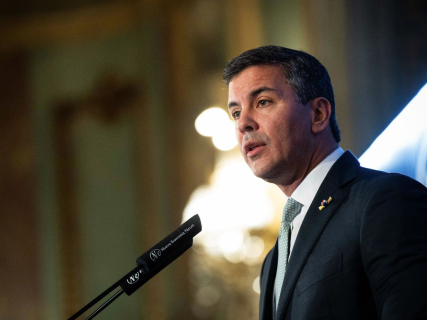

The president of Paraguay, Santiago Peña, has confirmed that he will attend the Senate in order to exercise directly his right to defense in the impeachment trial opened against him over the financial scandal of Ueno Bank. The first hearing of the process concluded late Thursday afternoon, and the head of state has been called to resume the proceedings this Friday at 10:00 a.m. (local time). At the same time, the Executive’s Spokesperson’s Office has pushed back against reports that pointed to a supposed escape by the president.
"Given the continuation of the impeachment trial, I will present myself and exercise my right to defense. I will do so with arguments and evidence, with respect for the Constitution and the institutions of the Republic," Peña said on social media, insisting that he takes on the process not for "personal pride," but for the responsibility of "giving an account and offering explanations to the Paraguayan people." He also reiterated his commitment to fully cooperate with Justice to clarify responsibilities in the banking collapse and emphasized that the payment to the affected savers cannot be left without a response.
At the same time, the spokesperson for the Presidency, Guillermo Grance, appeared before the media to deny rumors about a departure from the country to Argentina after a block on his resignation in Parliament. "The president is in the country, he is in the capital, and he is going to carry out his constitutional duty to defend himself in a timely and proper manner," Grance said, calling for calm among citizens and assuring that the Government continues to operate with complete normality.
The Senate moves forward with the impeachment trial of Peña
Meanwhile, the adjudicating court of the Chamber of Senators has concluded the inaugural session of the constitutional trial, which was activated after the vote on Peña’s resignation got stuck in a bicameral session due to the removal of the chamber of deputies from the ruling Partido Colorado.
Upon leaving the plenary session, the president of Congress, Basilio Núñez, detailed that the court already has formally received the charging brief submitted by the prosecutors and that the president will be granted the legal period provided to present his arguments, either in person or through his legal team.
Núñez has stressed that the Upper House will respect due process and the schedule of five extraordinary sessions established in its internal rules, warning that rushed decisions that could be challenged before the Inter-American Court of Human Rights must be avoided. After the defense intervention scheduled for Friday, the full Senate will continue with the review of the evidence and the final arguments before proceeding to a roll-call vote.
If Peña were to be removed from office —for which the support of 30 of the 45 senators is required—, he would lose his immunity and his status as a life senator, and the Head of State would immediately pass to the Vice President of the Republic, Pedro Alliana, who would assume the position after swearing in before Parliament, in accordance with the order of succession established in the Constitution.
Meanwhile, around the legislative building, hundreds of demonstrators and savers affected by the liquidity crisis of Ueno Bank maintained a peaceful vigil, awaiting the resolution of the impeachment trial in the Senate.