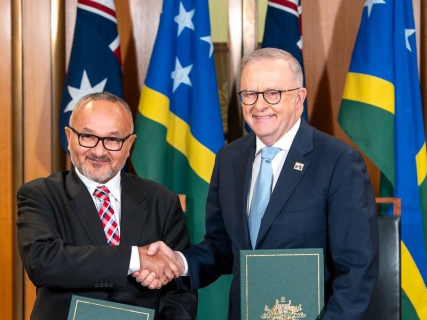










The authorities of Solomon Islands have signed a new pact with Australia under which they undertake to ensure that their critical infrastructure remains free of "militarization and unauthorized access" and that no foreign military base will be allowed to be established on their territory. The agreement comes when about six months remain for the security agreement signed between the Melanesian archipelago and China to expire.
The Australian prime minister, Anthony Albanese, and his counterpart from Solomon Islands, Matthew Wale, have called the treaty "historic" at a remarks session after the signing ceremony held in Canberra, Australia’s capital, which was attended by a broad delegation of Solomon Islands ministers and parliamentarians, as the ABC network reported.
According to the text, Solomon Islands undertakes to ensure that "its sensitive infrastructure remains free of militarization, of any form of foreign interference, or of unauthorized access," and that it will not "allow its territory to be used to host any foreign military or security base."
Although the document does not expressly rule out future security agreements with third countries such as China, it does establish that Solomon Islands "will ensure that security cooperation comes from the members of the Pacific Islands Forum (PIF, by its English-language acronym)." In addition, it states that any further alliance to cover "security needs that cannot be met by the PIF members" must protect regional stability.
In this context, the Solomon Islands prime minister has criticized that, in his view, under the previous Executive, his country had been "a source of uncertainty and doubt in the region," in an indirect reference to the security pact signed by Manasseh Sogavare’s Government with Beijing.
"Those days are already gone, they are behind us," Wale said, underscoring that the new agreement "not only reconfigures" the relationship with Australia, "but elevates it into a lasting link, based on trust and certainty, that places Solomon Islands as a reliable and trusted partner in the region."
Even so, Wale has avoided clarifying whether his Cabinet will walk back the pact with China. "Unfortunately, there is a confidentiality clause in the treaty with China, the security pact and the police agreement. Therefore, I cannot talk about it," he said, though he did confirm that he maintains "ongoing discussions with China."
On the other hand, Albanese has emphasized that the treaty strengthens Canberra’s position that “the priority in cooperation on security matters must come from the members of the Pacific Islands Forum,” and makes clear that “Australia remains the preferred security partner of Solomon Islands.”
By presenting the pact as a “new chapter” in bilateral relations “intended to strengthen our shared prosperity and our security,” the Australian leader has said that his Government will open new migration pathways for Solomon Islanders in sectors such as elderly care and childcare, will expedite visas for its citizens, and will increase funding aimed at key development priorities in the archipelago, including the free education policy, a flagship project of the Solomon Islands prime minister.