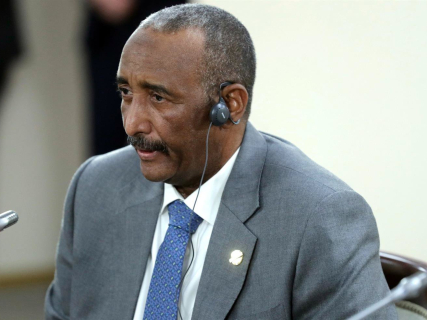










The Sudanese government has “categorically” dismissed this Wednesday the proposal of Ethiopian Prime Minister Abiy Ahmed for Addis Ababa to be the venue of a dialogue process between the warring parties and other Sudanese political actors, with the aim of putting an end to the war that began in April 2023 between the Sudanese Armed Forces and the Rapid Support Forces (RSF).
In a statement released on social media, Khartoum emphasized that “the neutrality of the host nation and its respect for Sudan’s sovereignty are fundamental requirements for accepting any role in this regard” and reiterated its allegations against Ethiopia for supporting the RSF and allowing the use of its territory for the launch of drones.
“In light of these accusations, we consider that the Ethiopian Government does not meet the standard of neutrality necessary to host or facilitate such dialogue,” the Sudanese executive stated, which has once again called for an “independent” investigation into Ethiopia’s role in the conflict and warned that it reserves the right to “take the necessary measures” to defend its sovereignty.
Along these lines, it urged the African Union (AU) and other international actors to “exclude Ethiopia from any agreement intended to host or facilitate Sudanese dialogue,” although it stressed its willingness “to preserve the bonds of good neighborliness between the Sudanese and Ethiopian peoples, based on mutual respect for the sovereignty of both nations.”
For Khartoum, “the decision on the location and agenda of the dialogue, as well as the choice of the party responsible for facilitating it, are rights that belong to the Sudanese people, which must be exercised through their own consensus and free will.” In this regard, it emphasized that “Sudan’s sovereignty and the independence of its national decision-making are not subject to concessions.”
A day earlier, Abiy had issued a “sincere” invitation to “all Sudanese parties, both at the military and political and civil levels” to join a “inclusive dialogue” that will make it possible to reach a pact that ends the war and the severe humanitarian crisis affecting the country.
The Ethiopian leader said that “Ethiopia offers to host and facilitate this process, aimed at creating a serious climate for dialogue, stopping the war, ending the fighting and division, and reaching a national consensus that lays the groundwork for comprehensive and sustainable peace.”
Abiy, awarded the Nobel Peace Prize, argued that “Ethiopia states its willingness to maintain equidistance and to facilitate a platform for dialogue characterized by openness, seriousness and mutual respect,” which, according to him, would allow the Sudanese parties “to discuss their differences and achieve consensus solutions through their independent national will”.
The prime minister clarified that he hopes that this process “will lead to broad political understandings”, including a ceasefire and the implementation of “an inclusive national process” that results in a broadly “accepted” unity government that “works to restore state institutions”, “safeguard the unity and sovereignty of the country” and “rebuild what the war has destroyed”.
“The future of Sudan is an issue that must be decided only by the Sudanese people, and intra-Sudanese dialogue is the most effective path to end the crisis,” explained Abiy, insisting that “the goal is not for one part to triumph over the other”.
The head of state argued that the war “is not only a political and security matter in a neighboring country, but a wound that reaches the heart of the Ethiopian people” and noted that “it is no secret that crises and transformations in both nations have exerted a mutual influence”, while warning of the regional repercussions of the conflict.
“Today, as the war enters its fourth year, we see how its devastating impact has widened and how its humanitarian burden has reached unprecedented levels. It is no longer acceptable for neighboring countries to stand idly by in the face of a tragedy that intensifies day by day,” he stressed.
The RSF and allies back the Ethiopian initiative
While the Sudanese government rejects mediation, the Sudan Founding Alliance (Tasis), a political-military bloc led by the RSF that has announced it would establish a parallel government in the areas it controls, welcomed Abiy’s proposal and the “fraternal spirit” that, in its view, inspires it.
“The alliance believes that the importance of the initiative lies in opening a path for Sudanese forces to take part in a dialogue that addresses the roots of this historical crisis, matters concerning the pillars of the Sudanese state, and the drafting of a new Magna Carta,” the coalition said.
In this line, he expressed his willingness to maintain "positive interactions" and to engage in a process that "leads to the end of the wars in Sudan, addresses the causes of the crisis, and builds an equality-based state, justice, sustainable peace, progress, and unity on fair and solid foundations".
This support was joined by the Civil Democratic Alliance of the Revolutionary Forces (Sumud), headed by former Prime Minister Abdalá Hamdok, who highlighted "the interest shown by the Ethiopian leadership in bringing an end to the war in Sudan".
"We particularly emphasize the emphasis of the statement on the importance of dialogue, the need to respect the will of the Sudanese people and their right to determine their own future, as well as the prioritization of Sudan's and its people's interests over the parties' own calculations of the conflict," Sumud said.
The alliance also valued "the role that Ethiopia has played in supporting the aspirations of the Sudanese people to achieve peace and a democratic transition" and said that it "views favorably" any "sincere effort aimed at ending the war and achieving peace".
In its statement, it also stressed: "We underline the importance of integrating and coordinating regional and international efforts to improve the prospects of stopping the war and initiating a comprehensive peace process, led and managed by the Sudanese themselves".
New RSF attacks worsen the crisis
The diplomatic clash occurs while fighting on the ground continues, with about two dozen civilians killed in an attack attributed to the RSF against the city of Damazin, capital of the state of Blue Nile, on the border with Ethiopia, and another attack against the strategic Roseires dam.
The civil organization Emergency Lawyers reported that 19 people died and 15 were injured in the bombing over Damazin, and that another five were injured in the offensive against the dam, an action that "threatens to disrupt the electricity supply in the region and damage the national power grid".
The group recalled that both Damazin and Roseires "currently host a large number of displaced people" and called on the RSF to stop its attacks against the civilian population and respect International Humanitarian Law, a demand it also extended to the Sudanese Armed Forces.
The civil war broke out in April 2023 due to tensions surrounding the integration plan of the paramilitary group into the Armed Forces, which derailed the open transition following the 2019 overthrow of Omar Hasán al Bashir, already seriously damaged by the 2021 coup that removed Hamdok from power.
The conflict, in which various countries are participating by supporting the opposing sides, has placed Sudan in one of the worst humanitarian crises in the world, with millions of people displaced or refugees and a growing international alarm over the spread of diseases and the destruction of essential infrastructure.