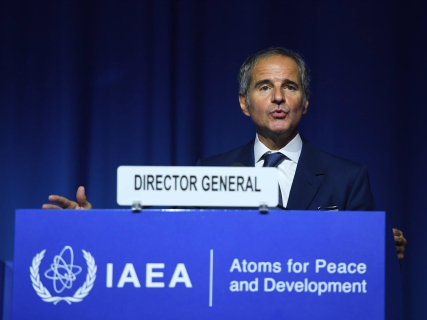

The Iranian Ministry of Foreign Affairs has criticized this Wednesday the Director General of the International Atomic Energy Agency (IAEA), Rafael Mariano Grossi, for saying that it does not involve a “double standard” when applying different criteria to Iran and Israel, referring to the fact that the latter has not signed the Treaty on the Non-Proliferation of Nuclear Weapons (NPT). For the Foreign Affairs spokesperson, Esmaeil Baqaei, that explanation “confuses formal legal status with institutional responsibility and impartiality.”
At a press conference after his intervention before the IAEA board of governors, Grossi defended that “there are countries that are parties to the NPT and others that are not; Israel, for example, is not. Therefore, in this sense, there is no double standard. If Israel were a State Party to the NPT and I treated Iran and Israel differently, then yes there would be a double standard,” before emphasizing that this “does not mean that I would not like Israel and all the countries in the world to join the NPT.”
At that same appearance, the top official of the UN nuclear agency stated that “the idea of a double standard is misleading or perhaps based on not knowing what the obligations are” that emanate from the treaty and what the scope of its jurisdiction is over each State.
From Tehran, the Iranian diplomacy spokesperson responded that “the IAEA cannot invoke this formal distinction to evade questions about the failure of the NPT to achieve universality and the resulting inequality in nuclear security in the region,” and he stressed that “if membership in the NPT is the basis for demanding responsibility from Iran, then the fact that Israel is not a party to the Treaty should not serve as a permanent shield against demands that it adhere to it and accept broad safeguards.”
Baqaei insisted that “the real issue is why an occupying and genocidal entity, which has a nuclear arsenal, remains outside the broad safeguards regime, and how this inequality can be reconciled with the declared objectives of the non-proliferation regime.” In his view, “impartiality cannot be measured solely by the way in which the Agency enforces obligations on Member States, while remaining silent about the fact that other actors remain outside the regime.”
On this line, he reproached Grossi, saying that "it appears to have overlooked the historic 1995 resolution on the Middle East," which called on all countries in the region to join the NPT and place all of their nuclear facilities under the IAEA’s broad safeguards. Baqaei also recalled that "the 2000 NPT Review Conference specifically reaffirmed the importance of Israel joining the Treaty and accepting those safeguards."
Accusations over his stance on Zaporizhzhia and attacks on Iranian facilities
The Foreign representative expanded his accusations of "double standards" against the Director General of the IAEA for his actions in the context of the war between Russia and Ukraine and for the episodes surrounding the Ukrainian nuclear power plant of Zaporizhzhia, under the control of Russian forces.
In particular, Baqaei reproached the person in charge of the IAEA —also an aspirant for the position of UN Secretary-General— for having firmly condemned the violence at the Zaporizhzhia plant and in its vicinity, while "after the bombings by the United States and Israel of Iran’s nuclear facilities, he limited himself to stating, in general terms, that nuclear facilities should not be the target of attacks, refraining from explicitly condemning those responsible."
"When the expression 'I condemn' is used in one case and, in the other, carefully nuanced language is resorted to, the double standard is unmistakable," the spokesperson said, warning that "this undermines the credibility of the Agency and weakens the foundations of the non-proliferation regime."