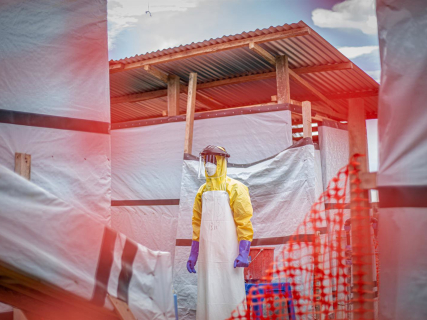

The Ebola outbreak declared almost six months ago in the east of the Democratic Republic of the Congo (DRC) has already surpassed 11,100 infections and 5,400 deaths, according to the Congolese authorities, in a context of geographic expansion and of growing international warnings about the risk that the virus is overwhelming containment measures.
The National Institute of Public Health (INSP) has detailed in its latest epidemiological report that to date 11,114 infections and 5,433 deaths have been recorded, including 72 new cases and 46 deaths in the last 24 hours, which places the overall case fatality rate at 48.9%.
The agency has also specified that at this time 981 people remain hospitalized or in isolation, while more than 3,000 patients have managed to overcome the disease and have been discharged. Contact follow-up remains at 85.5%.
The province of Ituri, one of the eight affected—along with North Kivu, South Kivu, Tshopo, Upper Uélé, Lower Uélé, North Ubangi and South Ubangi—continues to be the main focus of the outbreak, accounting for 69.5% of the infections. However, this percentage has fallen in recent weeks due both to the spread of the virus to other areas and to the control actions deployed in this region.
Meanwhile, Kenya’s Ministry of Health confirmed on Wednesday that the last patient admitted for Ebola and the contacts who remained in isolation—all of them linked to a case imported from the DRC—have completed the observation period, so this Thursday the count of the 42 days needed to declare the country Ebola-free begins.
The Director-General of the World Health Organization (WHO), Tedros Adhanom Ghebreyesus, welcomed the news and conveyed his recognition to health professionals and to the Kenyan authorities for their “rapid response” and “ongoing surveillance,” according to a message shared on social media. The outbreak has left nine cases and two deaths in the country.
The current outbreak in the DRC is already the deadliest recorded in Congolese territory, after surpassing the one declared between 2018 and 2020. Projections indicate that it could even exceed that of West Africa between 2014 and 2016, which caused 28,616 infections and 11,325 deaths in Guinea, Liberia and Sierra Leone, according to WHO figures.
In the last few weeks, additional infections have also been detected in Kenya and Nigeria —later declared Ebola-free after evacuating to Switzerland the only patient— associated with the outbreak in the DRC, caused by the Bundibugyo strain —which has no treatment and no approved vaccine—, after Uganda announced on July 28 that it was free of the virus after counting two deaths and 20 cases.