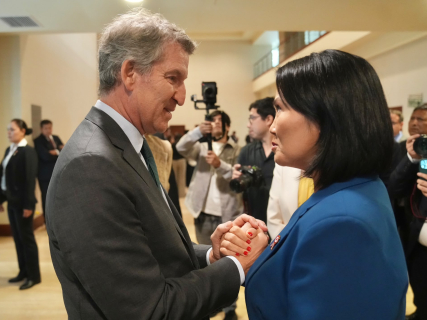

Alberto Núñez Feijóo travels this Tuesday to Lima to attend the inauguration of Keiko Fujimori as president of Peru. It is his first trip to Latin America since he became president of the Popular Party and his first attendance at the inauguration of a foreign leader as head of the opposition. Feijóo will not be part of the official Spanish delegation, led by Felipe VI and completed, representing the Government, by the Secretary of State for International Cooperation, Eva Granados. However, the leader of the PP attends the meeting at the express invitation of Fujimori and as president of his party.
This trip is the most visible movement of a broader strategy: to build a conservative Ibero-American network that allows the PP to relate directly to the new right-wing governments, to strengthen Feijóo's role as a potential interlocutor of those Executives before the European Union and to occupy a space in which Vox has been taking positions for years.
Feijóo travels to Peru after having asked for the vote for Fujimori
Feijóo's presence in Lima culminates the support that the PP provided to Fujimori during the Peruvian electoral campaign. The popular leader recorded a video addressed to the Peruvian community residing in Spain in which he asked for the vote for the candidate of Fuerza Popular. After her victory, Feijóo stated that it had been "an honor to be able to help" and affirmed that from Spain they would continue "working with the family of Peru". He also praised Fujimori's "capability and commitment" to defend "the freedom, democracy, and prosperity of all Peruvians".
The relationship has been reciprocated by the elected president. Fujimori participated remotely on July 15 in the Libertas forum organized in Madrid by the Spanish delegation of the European People's Party and subsequently specifically invited Feijóo to her inauguration. The Peruvian Foreign Ministry has officially included him, with his name and condition as president of the Spanish PP, in the list of international guests for the transfer of command.
Dolors Montserrat strengthens the bridge with the European People's Party
The popular deployment in Lima also includes Dolors Montserrat, Secretary General of the European People's Party and one of the leaders who promotes the new approach of the PP towards Ibero-America.
Montserrat participates in a meeting of the Business Council Alliance for Ibero-America, CEAPI, chaired by Fujimori. Her presence introduces a European dimension in the relationship: the PP wants to present itself as a bridge between the conservative Latin American governments and the community institutions.
That was one of the objectives of the Libertas forum held in Madrid, in which European and Ibero-American leaders participated. During his speech at that meeting, Feijóo asked that the European Union consider Ibero-America a strategic priority and claimed the political change experienced by several countries in the region.
"Numerous Ibero-American countries have bet on political alternatives that advocate for democratic institutions, stability, and freedom," said the popular leader, who specifically mentioned Ecuador, Argentina, Chile, Peru, and Colombia.
The Latin American space that the PP competes with Vox
This strategy also responds to the competition between the PP and Vox to relate to the new Latin American rights. Vox arrived first: through the Disenso Foundation, the Madrid Charter, and the meetings organized by Santiago Abascal, the party has established links with leaders such as Javier Milei, José Antonio Kast, Nayib Bukele, as well as with representatives from the environment of María Corina Machado. The PP now wants to regain ground through a network with a greater institutional and European component.
Its proposal consists of using its membership in the European People's Party to offer Latin American leaders a way of dialogue with Brussels that Vox cannot provide.
The difficulty is that a good part of the new rights in the region do not fit into the traditional conservatism represented by the PP. Some of their references are closer to radical populism or Vox's positions than to European center-right.
The PP itself acknowledges these differences. "The territory of Milei, of Abelardo de la Espriella or of Bukele is not ours," a popular leader told El País, although he defended the convenience of establishing relationships and using those contacts as a possible "lever to moderate them."
A network to reach Moncloa with already established relationships
The Ibero-American offensive allows Feijóo to work simultaneously on his internal and external image. Within Spain, the trip to Peru reinforces his profile as a candidate for the Presidency and contrasts with the absence of the Minister of Foreign Affairs, José Manuel Albares, who will not accompany the king due to the celebration of the last Council of Ministers before the summer break.
Outside of Spain, the PP intends to establish relationships before, hypothetically, reaching the Government. If Feijóo were to reach the Moncloa, he wants to do so with open channels with the presidents of the region and with the capacity to present himself as an interlocutor between the new conservative Latin American axis and the European Union.
Peru offers the first scenario to put that strategy into practice. Feijóo will share the investiture with Felipe VI, with numerous Latin American leaders and with a president whom he supported during the campaign, although not officially representing Spain, but rather the Popular Party and the Ibero-American political network he intends to build.
Latin American candidates expressly supported by the PP
The PP has not intervened in the same way in all recent electoral processes in Latin America. In some cases, it has directly asked for votes or participated in campaigns; in others, it has limited itself to supporting the democratic opposition or recognizing the winner.
Among the clearest electoral supports in recent processes are:
Edmundo González Urrutia in Venezuela
The PP supported the candidacy of Edmundo González Urrutia against Nicolás Maduro in the Venezuelan elections of July 2024. A delegation from the party traveled to Caracas invited by the opposition to accompany the electoral day, but its members were not authorized to enter the country and were returned to Spain.
After the elections, the PP promoted in Congress and the Senate the recognition of González as the elected president of Venezuela. Feijóo has subsequently held several meetings with him and with María Corina Machado.
Daniel Noboa in Ecuador
The support for Daniel Noboa in the Ecuadorian presidential elections of 2025 was especially explicit. The president of the Community of Madrid, Isabel Díaz Ayuso, traveled to Ecuador during the second round, participated in the campaign closing, and asked for votes for Noboa against the correísta candidate Luisa González.
After the victory, Feijóo interpreted the result as "a support from the Ecuadorian people for stability, security, and development."
Keiko Fujimori in Peru
Feijóo directly asked for votes for Fujimori in the second round of the Peruvian elections of 2026. The PP disseminated a video directed at the Peruvian community in Spain in which its president requested support for the conservative candidate. After her narrow victory against Roberto Sánchez, Feijóo acknowledged that he had helped her campaign. His presence at the inauguration confirms that the relationship will continue during Fujimori's presidency.
The conservative winners congratulated by Feijóo
Along with direct supports, Feijóo has used his messages after the elections to approach other right-wing leaders. In these cases, the congratulations do not necessarily imply that the PP previously supported their candidacy.
Javier Milei in Argentina
Feijóo congratulated Javier Milei after his victory in the Argentine presidential elections of 2023, and the PP has subsequently approached his Government. The party did not expressly ask for votes for Milei during that campaign. Its political relations were closer to the space of the center-right candidate Patricia Bullrich, later integrated into the Executive of the libertarian leader.
Daniel Noboa in Ecuador
In addition to the electoral support provided by Ayuso, Feijóo publicly congratulated Noboa for his reelection in April 2025. The popular leader presented the result as a bet by Ecuadorians for stability and defended the strengthening of relations between Spain and Ecuador.
Rodrigo Paz in Bolivia
The PP welcomed Rodrigo Paz's victory in the Bolivian elections of 2025, which ended two decades of political dominance by the Movement for Socialism. However, there is no record of a public vote request from Feijóo during the campaign comparable to those made in Ecuador or Peru.
José Antonio Kast in Chile
Feijóo congratulated José Antonio Kast after his victory in the Chilean presidential elections of 2025 and has pointed to Chile as one of the leading countries in the political shift of the region. The PP seeks to relate to his Government, although Kast's Republican Party maintains positions closer to Vox on different ideological issues.
Nasry Asfura in Honduras
Feijóo congratulated Nasry Asfura after he was proclaimed president-elect of Honduras. The president of the PP publicly recalled a previous conversation held with the Honduran leader in Madrid, but there is no record of a direct intervention by the Spanish party in his campaign.
Laura Fernández in Costa Rica
The popular leader also congratulated Laura Fernández for her victory in the presidential elections of Costa Rica in February 2026. Feijóo described the elections as "exemplary" and wished her success during her term. The message came after the result was known and did not constitute a prior electoral support.
Abelardo de la Espriella in Colombia
Feijóo has included Abelardo de la Espriella's victory in Colombia within the advance of new right-wing alternatives in the region and has directed political winks at him. The approach is significant because De la Espriella represents a more radical right.