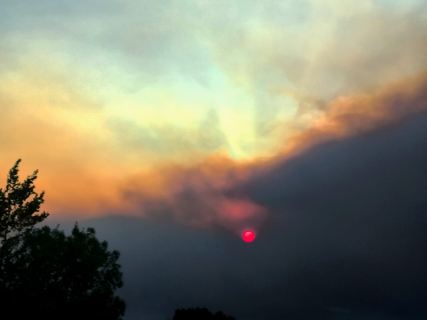

Wildfires are once again testing the response capacity of emergency services and also reopening an old debate about forest management. This weekend, Spain has experienced one of the largest emergencies of the summer with major fires in Madrid, Ávila, Toledo, and Castellón, while France maintains a critical situation in Gironde and Les Landes, with hundreds of thousands of people evacuated.
Only in Spain, the fires have forced the evacuation or confinement of more than 116,000 people. The fire that started between Madrid and Ávila has spread towards Toledo, forcing the Ministry of the Interior to expand the declaration of emergency of national interest, while in Castellón the fire declared in the Vall d'Uixó was classified by firefighters as "beyond extinguishing capacity," an expression reserved for fires with extreme behavior.
Every time an emergency of this magnitude occurs, the same questions arise. Is it prohibited to clean the forest? Does the 2030 Agenda prevent clearing the forests? Do environmental laws hinder prevention? The answer, according to state and regional legislation, is no.
Major fires reopen a debate that repeats every summer
This is not the first time it has happened. After the Sierra Bermeja fires, the wave of fires in Zamora, the major fires in Tenerife, or the one in Los Gallardos, social networks were filled with messages claiming that "they do not allow cleaning the forest" or that environmental regulations prevent preventive work.
Now, with the fires in Madrid, Ávila, Toledo, and Castellón making headlines, those messages are being spread strongly again.
However, reviewing the legislation allows us to verify that many of those statements mix different concepts or are directly false.
The Forest Law does not prohibit cleaning the forest
The Forest Law does not establish any general prohibition for carrying out forest cleaning work. In fact, it does exactly the opposite.
Article 48 requires autonomous communities to develop prevention plans, surveillance, and extinguishing of wildfires that include silvicultural treatments, firebreaks, maintenance of forest tracks, water points, and other actions aimed at reducing the risk of fire.
Within those silvicultural treatments, there are usual actions such as clearing, pruning, thinning, or cleaning of vegetation, precisely the tasks that seek to reduce the accumulation of biomass and decrease the intensity of fires when they occur.
So, why are there sometimes permits or limitations?
A large part of the confusion arises because not all forestry actions have the same legal regime.
The preventive cleaning of the forest is not prohibited, but certain activities do require administrative authorization. This is the case, for example, of the burning of plant residues, some work during the peak fire risk season, or actions that affect protected areas.
In addition, each autonomous community develops its own forestry regulations. Andalucía, Galicia, Castilla y León, Asturias, or Extremadura regulate these works with different procedures, but all contemplate silvicultural treatments and preventive actions against fires.
Does the 2030 Agenda prohibit cleaning forests?
It is another of the messages that reappears every summer and does not correspond to the content of that document.
The 2030 Agenda is not a law nor does it create prohibitions on forest management. It is an international commitment approved by the United Nations that sets general sustainable development goals.
Among them is Sustainable Development Goal number 15, dedicated to the protection of terrestrial ecosystems and the sustainable management of forests. The text talks about conserving, restoring, and sustainably managing forest ecosystems, but it does not prohibit clearing or fire prevention work.
Experts remind us that preventing a large fire depends on many factors
Forest management specialists insist that large fires cannot be explained by a single cause.
The accumulation of plant fuel, the abandonment of rural areas, the continuity of the forest, the lack of management for decades, heat waves, drought, or the so-called new generation fires are part of a much more complex problem.
Preventive work helps reduce risk and facilitate the work of firefighting teams, but it does not eliminate the possibility of large intensity fires occurring when extreme weather conditions coincide.
For that reason, while Spain continues to fight against the fires in Madrid, Ávila, Toledo, and Castellón, the current regulations maintain forest prevention as an obligation of the administrations and of the owners of the mountains, not as a prohibited activity.