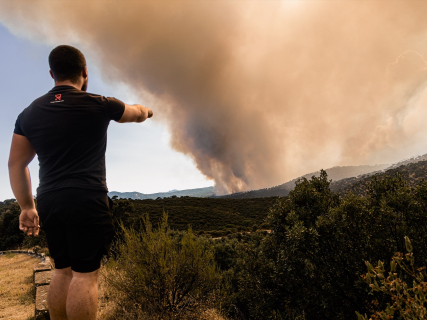

The wildfires affecting the Community of Madrid maintain an exceptional situation in the Sierra Oeste, one of the areas hardest hit by the fire in this emergency. The fires in Villa del Prado, San Martín de Valdeiglesias, and the one originating in Almorox, in the province of Toledo, ended up merging into a single fire, officially called Sierra Oeste forest fire.
The magnitude of the emergency has forced the activation of extraordinary civil protection measures, including evacuations, confinements, road closures, suspension of transport lines, and reception devices spread across different municipalities. According to the update published this Sunday by the Community of Madrid, more than 55,000 people have been evacuated or confined and more than 3,000 remain in reception points.
Level 3 of the INFOMA and state direction of the emergency
The operational situation 3 of the Special Civil Protection Emergency Plan for Forest Fires of the Community of Madrid, the INFOMA, remains activated. This level corresponds to a declared emergency of national interest, which places the direction of the response in the hands of the General State Administration.
The efforts are focused on containing the active fronts, preventing new outbreaks, and avoiding that flames from Ávila penetrate forcefully into Madrid territory again. The deployment includes regional firefighters, forest firefighters, forest agents, state resources, personnel from the Military Emergency Unit, and resources arriving from other autonomous communities.
Which municipalities in Madrid remain evacuated
The Community of Madrid maintains evacuations in Zarzalejo, Cenicientos, Navalagamella, Robledo de Chavela, Cadalso de los Vidrios, Chapinería, Colmenar del Arroyo, Fresnedillas de la Oliva, Rozas de Puerto Real, Aldea del Fresno, and Navas del Rey.
The evacuation implies that the population cannot return to their homes until those responsible for the emergency consider that the access routes, the urban environment, and essential services meet sufficient safety conditions. It is not enough that the flames are no longer visible near the urban area, because teams must check for the existence of hidden hotspots, unstable trees, damaged power lines, smoke accumulations, and roads that still need to remain reserved for firefighting vehicles.
Why one should not return on their own
The authorities insist that no one should attempt to return on their own initiative to an evacuated municipality. Early access can block the routes used by firefighters, ambulances, buses, and security forces, in addition to placing the neighbor in an area where the fire can still reactivate or where smoke and damage to infrastructure continue to pose a risk.
Return will only be authorized when indicated by the emergency officials. Until then, the recommendation is to remain in reception points or safe accommodations, stay informed through official channels, and not spread unverified notices about supposed reopenings of access or lifting of evacuations.
Established reception points
The established reception points to assist displaced neighbors are located in Villaviciosa de Odón, Móstoles, Alcalá de Henares, Brunete, Leganés, Villanueva de la Cañada, Villamantilla, Villanueva de Perales, Getafe, Villamanta, Alcobendas, Las Rozas, Alcorcón, Navalcarnero and Sevilla la Nueva.
These spaces serve to temporarily house evacuated people, provide information, coordinate basic assistance, and address urgent needs while the emergency is maintained. In such situations, the priority is to ensure that neighbors have a safe place to stay until they can return to their homes with authorization.
Which localities remain confined
The municipalities of San Martín de Valdeiglesias, Pelayos de la Presa, Villa del Prado and Valdemaqueda remain confined due to the evolution of the fire and the presence of smoke in the area.
The confinement requires staying inside the homes, closing doors and windows, and avoiding any movement that has not been authorized by the emergency services. The measure seeks to reduce exposure to smoke and keep roads clear for the passage of ambulances, buses, firefighters, extinguishing vehicles, and security forces.
What to do during confinement
Homes near the affected areas should securely close doors and windows and turn off air conditioning systems that bring in outside air. It is also advisable to avoid using extractors or ventilation that could draw smoke inside, especially in homes close to forest masses, affected roads, or areas where a strong smell of burning is perceived.
People with respiratory diseases, allergies, cardiovascular pathologies, or chronic illnesses should avoid any outdoor physical activity and wear a mask if they need to go out due to an official indication. In case of intense respiratory difficulty, dizziness, chest pain, or rapid worsening of a previous illness, one should call 112.
Restrictions and mobility
The situation in the Sierra Oeste maintains significant mobility restrictions. The roads affected by the fire may remain closed even if the fire seems distant, because the teams need to ensure the passage of emergency services, check for damage to the pavement, verify the stability of slopes, and remove obstacles, branches, burned trees, or damaged lines.
The authorities ask to avoid unnecessary travel to the affected areas, not to approach to see the fire, and not to use secondary roads or forest paths to try to evade controls. These behaviors can put those traveling at risk and hinder firefighting efforts at a time when every access must remain clear for operational teams.
An emergency still open
The forest fire in Sierra Oeste continues to affect the lives of thousands of residents and keeps active firefighting, shelter, healthcare, transportation, and security devices. Although some fronts may be contained, the emergency will not be considered overcome until technicians confirm that there is no risk to the population and that basic infrastructures allow for a safe return.
The main recommendation for evacuees and those confined remains the same: to only follow official indications, not to return without authorization, avoid travel, and call 112 in case of any health emergency or dangerous situation.