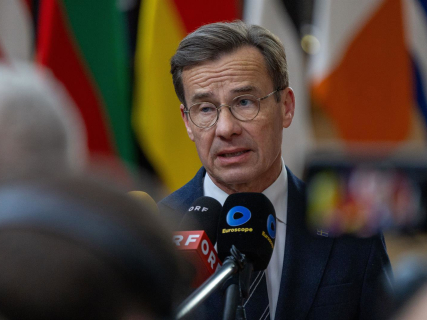

The prime minister of Sweden, Ulf Kristersson, has received this Tuesday the assignment to try to put together a new Government after the elections held last September 13, elections in which the Social Democrats won in votes but without achieving a sufficient majority in Parliament to allow a clear change in the Executive.
After the failed attempts by the leader of the Swedish Social Democratic Party, Magdalena Andersson, and by the president of the Centre Party, Elisabeth Ringqvist, the turn has fallen to Kristersson, who now faces the challenge of reaching the 175 seats needed to secure a majority in the Riksdag.
The process has been formalized after the Chamber rejected this Tuesday a cabinet headed by the centrist leader, which has led the president of Parliament, Andreas Norlén, to pass the assignment on to the current head of Government. "He has confirmed what he said last week: that he wants to assign me that exploratory mission. I have accepted it," Kristersson said in statements collected by the newspaper Aftonbladet.
Even so, the conservative leader has admitted the complexity of the negotiations, while he has advanced that he will examine "whether the current non-socialist coalition could form a government". "I will keep holding talks with other parties. Those talks will take place with relative discretion. It will be difficult. Even very difficult," he acknowledged.
Kristersson has underscored that he does not intend to force a new date with the ballot boxes, although he has reiterated that "I am fully prepared" for that outcome. "My party is in good shape and in a good mood for a campaign," he said, while reproaching the Social Democrats for celebrating their electoral victory without being able to set up an Executive.
The option of renewing the current Government is especially arduous for Kristersson, since he would have to reach agreements with Christian Democrats and Liberals and again ensure the support in the Riksdag of the far-right Sweden Democrats. Even so, the total would fall two seats short of an absolute majority, which would leave an eventual cabinet with a very limited margin for parliamentary maneuver.
For his part, Andersson, who started with greater numerical possibilities of coming closer to the majority, failed in his attempt to govern alone when talks with the Left Party broke down. The trigger was the election of the conservative Norlén as President of the Riksdag, supported precisely by the leftist formation, which definitively strained the relationship between the two parties.