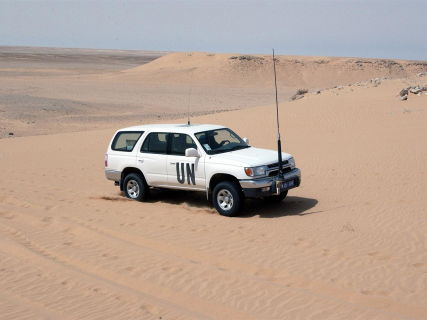

The United Nations Mission for the Referendum in Western Sahara (MINURSO) will end its presence on the ground on January 31, 2027. This has been confirmed by the person responsible for the drawdown of the international contingent, Alexander Ivanko, after the UN Security Council failed to renew the mandate of the operation.
In an interview granted to the Moroccan channel Medi1 TV, Ivanko explained that the drawdown has already begun with the gradual departure of staff deployed on both sides of the separation wall built by Rabat in the occupied area of Western Sahara and in the “buffer zone”.
“We expect that January 31 will be our last day here,” he said, emphasizing that on that day the United Nations flag will be lowered. At the same time, he highlighted the “excellent” cooperation with the Moroccan authorities throughout the withdrawal process of the “blue helmets”.
“I maintain constant communication with the person in charge of the Moroccan delegation responsible for the liquidation process (of MINURSO),” Ivanko added, thanking Rabat for this “excellent cooperation” and for “having provided everything necessary so that the departure takes place under adequate conditions”.
Ivanko’s statements came after the departure of an initial military contingent of the mission from the city of El Aaiún to Casablanca, a move that he himself oversaw from the airport of the administrative capital of the territory.
The non-renewal of the MINURSO mandate occurred after Russia vetoed on October 30 a draft resolution promoted by the United States that supported Morocco’s autonomy plan for Western Sahara, considering that the text departed from the principle of self-determination of the Sahrawi people. Moscow, in turn, submitted an alternative proposal to extend the mission without mentioning Rabat’s initiative, but Washington blocked it with another veto.
After the failure of both initiatives, the UN Secretary-General, António Guterres, reiterated that the withdrawal of the international contingent — deployed since the creation of MINURSO in 1991 — in no way implies the loss of the rights of the Sahrawi people, defending in particular their right to self-determination.
Accusations by the Polisario Front against Morocco
In this scenario, the representative of the Frente Polisario before the United Nations, Sidi Mohamed Omar, sent a letter to the president of the Security Council, Sanita Pavluta-Deslandres, in which he accuses Morocco and its allies of "undermining" the mandate of MINURSO. "The Moroccan occupying State, with the support of certain members of the Security Council, did everything possible to obstruct and undermine the mandate of MINURSO since its creation," he denounced.
"Consequently, the occupying State and its allies assume full responsibility for having undermined the mandate of MINURSO and for the consequences that may arise from the interruption of the mission’s operations in Western Sahara," he stated in his letter, as the SPS Sahrawi news agency reported.
Omar argued that "the main cause" of the blocking of the renewal of the mandate "was the draft resolution presented by the United States, which fully reflected the national position of the U.S. Government, as well as the position of the Moroccan occupying State," a "blockade" which, in his view, "was exacerbated by a small number of member States that, through their positions, showed support for Moroccan expansionist policy."
He also took the opportunity to accuse Rabat of "obstructing" a referendum that it had accepted "formally," a process which, he said, was frustrated "without any accountability being demanded of it and without any punishment being imposed." In this regard, he insisted that the consultation "was not held not because it was 'inviable' in itself, as some claim, but because the Moroccan occupying State feared the outcome of the referendum."
The Sahrawi representative stated that the Moroccan autonomy plan "is nothing more than a farce and a typical colonial attempt to give legitimacy to the illegal Moroccan occupation of Western Sahara" and reiterated that "States that truly commit themselves to International Law and democratic values should not associate with the Moroccan regime or support its expansionist policies, based on imposing faits accomplis in the occupied Western Sahara."
Debate on human rights and the situation of refugees
In the same letter, Omar rejected Rabat’s argument about the need to look for “lasting solutions” for Sahrawi refugees settled in camps in Algeria and noted that these people “did not become refugees due to natural or environmental circumstances, nor as a result of a civil war,” but rather as a result of “the Moroccan military invasion” of 1975.
“No amount of misinformation can conceal the harsh truth that the occupying Moroccan State is witness to situations in which millions of Moroccans suffer extreme poverty and severe misery, and conditions that strip them of their human dignity,” he said.
“Instead of pretending ‘concern’ for Sahrawi refugees, and urging others to adopt the same stance, the Moroccan regime should provide the minimum conditions for a life worthy of human beings to its people, before attempting to give lessons to others on International Humanitarian Law, a right that this same regime has devoted itself to violating in the occupied Western Sahara,” he added.
In recent years, the Frente Polisario has suffered several diplomatic setbacks due to support from different countries, including Spain, for the Moroccan autonomy plan, a formula that the Sahrawi Arab Democratic Republic (RASD) rejects outright, within the framework of its demand to complete the decolonization of the territory and secure its right to independence.
The former Spanish colony of Western Sahara was occupied by Morocco in 1975 despite resistance from the Frente Polisario, with which it remained at war until 1991. That year both sides signed a ceasefire with the goal of organizing a self-determination referendum, but discrepancies over the census and over whether or not to include Moroccan settlers have prevented it from being held to date.