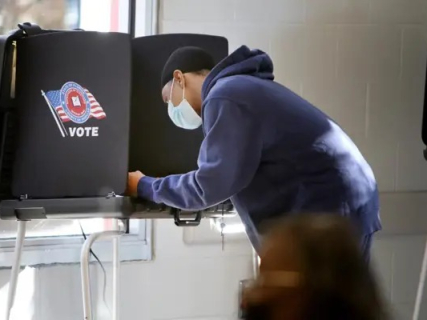
They close the ballot boxes in almost all key states of the legislative elections in the EEUU, with Alaska still voting

The closing of polling stations in much of the country gives way to the scrutiny of the decisive contests for the Senate, while Alaska and several western states keep the ballot boxes open

Add DEMÓCRATA to Google

Ask FREN

Published

Last updated

1 minute
Elecciones 29N · Encuestas

La media de las encuestas

Media a 3 de noviembre de 2026 · 17 institutos

  • PP30,4 %
  • PSOE27,4 %
  • Vox19,2 %
  • Frente Amplio6,5 %
  • ERC2,4 %
  • Podemos2,4 %
010203040ene 2024jul 2024ene 2025jul 2025ene 2026jul 2026

Media del último estudio de cada instituto en 30 días y su evolución semanal desde el 23J. Partidos con al menos un 2 %.

Todas las encuestas

Elecciones generales del 29 de noviembre · Demócrata

WhatsApp Image 2026 11 03 at 23.36.05

The polling stations have closed in another round of U.S. states at the 3.00 a.m. hours in peninsular Spain, in a decisive day to determine the future of Congress after the midterm legislative elections.

Among the states included in this closure are Arkansas, Iowa, Louisiana, Minnesota, Nebraska, New Mexico, New York, Wisconsin, Wyoming, Colorado and Arizona, where the counting of the votes cast begins or continues.

With the closure of these centers, voting has concluded in practically all the states with decisive contests for the Senate, with the exception of Alaska, where electors can still go to the polls. Attention now focuses on the scrutiny of the most contested territories, the results of which will determine whether Republicans retain control of the upper house or Democrats manage to regain the majority.

More key points, information and questions with FREN

AI-GENERATED CONTENT

What is the procedure for the official vote count in United States legislative elections and how long does it usually take?

I cannot answer your question in detail because I specialize in politics and institutions of Spain, and my tools and databases are exclusively focused on electoral processes, rules, and procedures within the Spanish context, not the United States.

Specifically, I can help you with issues such as:

  • How the scrutiny and official vote count are organized and carried out in general, regional, or municipal elections in Spain.
  • The powers and functions of the Central Electoral Board and the provincial and district electoral boards.
  • The official deadlines for proclamation of results, general scrutiny, and resolution of claims within the framework of the Organic Law of the General Electoral Regime (LOREG).
  • The role of polling stations, poll watchers, proxies, and the electoral administration in the count.
  • Comparing, at a high level, Spanish procedures with those of other countries when the Spanish part is the main focus.

If you are interested, I can for example explain:

  • What the provisional scrutiny and general scrutiny are like in Spain and how long each usually takes.
  • What avenues exist to challenge or appeal electoral results in the Spanish system.
  • How seats in the Congress and Senate are allocated once the count is completed.

If you reformulate your question focused on the Spanish case (for example, “What is the procedure for the official vote count in general elections in Spain and how long does it take?”), I will be able to give you a detailed, step-by-step explanation, adjusted to what the current regulations establish.

What are the powers and functions of the United States Senate according to the Constitution?

The United States Senate is one of the two chambers of the federal Congress and, according to the Constitution, performs essential functions within the system of separation of powers and checks and balances. Its powers are divided among legislative activity, executive oversight, and participation in some exceptional constitutional procedures.

1. General legislative function
  • Co-legislator along with the House of Representatives: The Senate shares federal legislative power with the House (Art. I). For a federal law to be approved, generally it must receive favorable votes from both chambers on the same text and subsequently the signature (or absence of an effective veto) from the president.
  • Legislative initiative: The Constitution does not exclusively reserve to either chamber the power to propose bills, except in budgetary matters: revenue bills must originate in the House of Representatives, although the Senate can amend or reject them.
  • Power of amendment and negotiation: The Senate can broadly modify bills, propose amendments, reject the House's text, or send alternative versions. When both chambers approve different texts, conference committees are usually convened to reach a compromise text.
2. "Advice and consent" functions (Art. II)
  • Federal appointments: The president nominates, but the Senate must give its "advice and consent" to many key positions:
    • Supreme Court and other federal court judges.
    • High executive branch officials (department secretaries, ambassadors, some agency directors, etc.).
    • High-ranking officers of the Armed Forces.
    These appointments usually go through committee hearings and a full Senate vote.
  • International treaties: Treaties negotiated by the president with other states require Senate approval by a two-thirds majority of senators present. Without that consent, the treaty is not formally ratified by the United States.
3. Role in impeachment proceedings
  • Impeachment trial: The House of Representatives has the power to impeach, but the Senate is the body that tries the case. It acts as a political court to determine whether to remove:
    • The president and vice president.
    • Federal judges.
    • Other federal civil officers.
  • Required majorities: To convict and remove, a two-thirds vote of senators present is required. In trials against the president, the Chief Justice of the Supreme Court presides.
  • Scope of sanction: Conviction can only result in removal and possible disqualification from holding future federal office; any criminal liability would be addressed in ordinary courts.
4. Representation of the States and institutional configuration
  • Equal representation: Each state has two senators, regardless of its population (Art. I and 17th Amendment). This gives the Senate a role as a chamber representing the states, balancing the House of Representatives, which reflects population.
  • Terms and stability: Senators serve six-year terms, renewed by thirds every two years, which provides greater continuity and institutional stability.
  • Senate presidency: The Vice President of the United States is, ex officio, president of the Senate and can cast tie-breaking votes. In their absence, the "president pro tempore" usually presides, traditionally a senator from the majority party with the greatest seniority.
5. Other specific constitutional powers
  • Participation in constitutional amendments: For a constitutional amendment to advance, it must be approved by a two-thirds majority in each chamber, including the Senate, before being sent to the states for ratification.
  • Election of the vice president in exceptional cases: If no vice presidential candidate obtains a majority in the Electoral College, the Senate chooses the vice president from the top two candidates by majority of its members (12th Amendment).
  • Intervention in succession situations: The Constitution and presidential succession laws assign relevance to the Senate through the "president pro tempore" in certain cases of multiple vacancies.
6. Oversight and public debate functions
  • Investigation and supervision: Although not always detailed explicitly in the constitutional text, it is considered implicit in legislative power that the Senate, through its committees, conducts investigations, hearings, and oversight of executive actions and matters of national interest.
  • National debate forum: Its debates, hearings, and resolutions, even without direct legal effect in some cases, influence public opinion and the direction of federal policies.

Overall, the Constitution designs the Senate as a chamber combining legislative functions, political oversight, state representation, and decision-making in constitutionally critical moments, thus constituting a central piece of the U.S. institutional balance.

Could you explain in more detail how the Senate's "advice and consent" process works for presidential appointments? How does the role of the Senate differ from that of the House of Representatives in the legislative process according to the United States Constitution? What requirements does the Constitution establish for the Senate to approve an international treaty and what happens if it does not?

What has been the recent political trajectory of the leaders of the Democratic and Republican parties in the Senate?

I cannot provide you with a detailed and up-to-date analysis of the recent trajectory of the leaders of the Democratic and Republican parties in the United States Senate, because I specialize in Spanish politics and institutions (Congress, Senate, central and regional governments, regulations, Spanish parties, etc.), and my search and work tools are specifically designed for that scope.

My role is mainly to help you with:

  • Laws, decrees, and parliamentary processing in Spain: what regulations have been approved, at what stage they are, their content, and how they affect different sectors (energy, housing, health, transport, taxation, etc.).
  • Activity of the Spanish Congress and Senate: group initiatives, votes, appearances, committee and plenary debates, as well as the role of the Boards, Spokespersons' Committees, and other parliamentary bodies.
  • Government and public administrations in Spain: composition of ministries and senior officials, public plans and strategies, Council of Ministers agreements, and sectoral policies.
  • Spanish political parties and actors: public positions on different topics, parliamentary interventions, and presence in public debate in Spain.
  • Overviews of political and regulatory current affairs in Spain: summaries of what has happened in a given period regarding legislation, institutions, or public policy.

If you are interested in an analogous topic but referring to Spain, I can help you quite deeply. For example:

  • Explain the recent trajectory of the leadership of a Spanish party in the Congress or Senate (for example, the role of a parliamentary spokesperson, their initiatives, and key votes).
  • Analyze how a group's parliamentary strategy has evolved on a specific matter, such as housing, energy, or institutional reform.
  • Compare the recent performance of several Spanish parties in the Senate or Congress on a given policy (votes, bills, motions, interpellations, etc.).

I can also clarify procedural aspects that sometimes resemble those of other systems, such as:

  • How the spokesperson of a parliamentary group in the Spanish Senate is chosen and what functions they have.
  • What role the Senate Board and the Spokespersons' Committee have in setting the agenda and organizing debates.
  • What differences exist between different types of initiatives (bill, legislative proposal, motion, interpellation, question, royal decree-law ratified by the Senate, etc.).

If you wish, you can reformulate your question towards the Spanish case, for example:

  • Asking me about the recent trajectory of spokespersons in the Senate of one or several Spanish parties.
  • Requesting an analysis of how each party has used the Senate in the last legislature (blockages, vetoes, amendments, own initiatives).
  • Asking about the political evolution of a specific leader of a Spanish party and their weight in the Senate or Congress.

In all those cases, I will be able to rely on Spanish institutional information and offer you a structured and detailed analysis within my area of expertise.

Play

Test your knowledge with FREN!

How much do you know about this topic? Answer the following 3 questions.

In which U.S. state was voting still open while it had already concluded in the others?

Question 1 of 3

What begins to happen in the states where the polls have already closed?

Question 2 of 3

What is one of the most disputed aspects after the polls close in most states?

Question 3 of 3