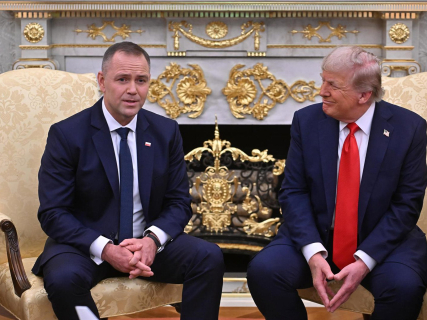
Trump announces progress to install a permanent military base in Poland: "The location will be announced very soon"

The American president assures that Washington and Warsaw have made "great progress" in a negotiation that has been open for months. Poland already hosts thousands of American soldiers, but demands to convert part of that presence into permanent to reinforce NATO's eastern flank.

3 minutes

fotonoticia 20260917200757 1920

fotonoticia 20260917200757 1920

Add DEMÓCRATA to Google

Ask FREN

Published

Last updated

3 minutes

Most read

The President of the United States, Donald Trump, announced this Thursday that Washington and Warsaw are moving towards the establishment of a permanent base of the U.S. Army in Poland, an old aspiration of the Polish Government that would acquire special relevance for NATO's military deployment against Russia.

"Great news!" Trump proclaimed on his social network Truth Social. The president assured that "great progress" is being made to establish a U.S. Army base on Polish territory and attributed the progress to the leadership of the President of Poland, Karol Nawrocki.

However, Trump introduced an important caution: the agreement is still not formally closed. "If this happens, the location will be announced very soon," he noted, before describing the eventual establishment of the base as a "historic step" for the alliance between the United States and Poland.

The statement represents the clearest political advance so far of a negotiation that Warsaw formally initiated several months ago and that has accelerated during the summer.

Poland formally requested a permanent base in May

The Polish Government officially conveyed its proposal to Washington on May 29. The Minister of Defense and Deputy Prime Minister, Władysław Kosiniak-Kamysz, asked the Pentagon to establish a permanent U.S. military base in the country.

The response came in June. After meeting with the Pentagon official, Pete Hegseth, Kosiniak-Kamysz announced that the United States had responded "positively" to the proposal, although the conditions for the future deployment remained to be specified.

The Polish Presidency has also made the project a priority. During the NATO summit held in Ankara in July, Nawrocki stated that his goal was to achieve "a permanent presence of U.S. soldiers in Poland in the form of a permanent base" and considered that the political path to achieve it was open.

Negotiations have accelerated in September

The talks have continued over the past few weeks. On September 10, a U.S. delegation led by Deputy Assistant Secretary of Defense William Cappelletti met in Poland with representatives of the Ministry of Defense and the Armed Forces of the country.

According to the official report from the Polish Ministry of Defense, both parties addressed the conditions to reinforce the U.S. military presence, agreed on a general timeline to continue consultations, and decided to establish working groups to negotiate the details. The U.S. delegation also planned to visit the facilities in Powidz and Poznań, where there is already a U.S. military presence.

The negotiation is based on the Enhanced Defense Cooperation Agreement signed between Washington and Warsaw in 2020, which regulates a large part of the U.S. deployment on Polish territory.

Trump did not reveal this Thursday which of the studied locations would host the new base nor did he detail how many military personnel would be permanently assigned to it.

The U.S. already has thousands of military personnel in Poland

The importance of the announcement lies precisely in the difference between the existing U.S. presence and the new facility that both governments are negotiating.

Poland has been hosting U.S. troops for years, a presence particularly reinforced since the Russian invasion of Ukraine. In September 2025, Nawrocki estimated around 10,000 U.S. soldiers deployed on Polish territory.

The United States also has had a permanent Army garrison in Poznań since 2023, which serves as the forward headquarters of the V Corps. But a large part of the forces deployed in the country maintain a rotational character.

What Warsaw seeks now is to take an additional step: a permanent U.S. military base, accompanied by agreed capabilities and infrastructure between both countries.

The aspiration is not new either. Already in 2019, Washington and Warsaw agreed to increase the then presence of approximately 4,500 rotating U.S. military personnel with around another 1,000 troops and new infrastructures.

The move comes as Washington reviews its troops in Europe

Trump's announcement also comes at a particularly sensitive moment for European security. The Pentagon is conducting an assessment of the U.S. military presence in Europe, where there are currently around 80,000 personnel, and among the possibilities being studied is a reduction of part of the contingent.

The review has generated concern among some European allies about the possibility that Washington will shift resources to other strategic priorities. Poland has followed a different strategy: trying to consolidate itself as one of the main pillars of the American presence on NATO's eastern flank.

The security context also weighs on the negotiation. This Thursday, Poland has mobilized aircraft in response to a new Russian wave of missiles and drones against Ukraine, although Polish authorities have not reported violations of its airspace.

Warsaw has been demanding a reinforcement of the defense of Eastern Europe for months in light of the war in Ukraine and the hybrid threats it attributes to Moscow. Nawrocki argued at the last NATO summit that a greater American presence would serve to strengthen the security of the Alliance's eastern flank.

More key points, information and questions with FREN

AI-GENERATED CONTENT

What is the parliamentary status of the procedures for the final approval of the permanent U.S. military base in Poland?

Based on the information available from the sources consulted, there is no record of a formal parliamentary procedure in the Polish Sejm or Senate specifically aimed at definitively approving a permanent U.S. military base in Poland. What does appear is a political and governmental proposal in a phase of bilateral negotiation with the United States, still pending to be formalized in a legal agreement that, if applicable, could later be subject to parliamentary control or ratification.

News from the newspaper Demócrata help reconstruct the recent context. On June 3, 2026, the Deputy Prime Minister and Minister of Defense of Poland, Władysław Kosiniak-Kamysz, made public that Warsaw had officially presented to the United States a proposal to create a new permanent U.S. military base on Polish territory. According to that information, the minister conveyed the proposal to U.S. Secretary of Defense Pete Hegseth, emphasizing the importance of a “secure” Poland, with a strong Army and solid alliances, framing the initiative within President Donald Trump's announcement to send 5,000 additional troops to Poland.

Subsequently, on June 16 and 18, 2026, Demócrata reports that the Polish Government is promoting measures to host that permanent base and that the U.S. Department of Defense is “receptive” to the idea. Specifically, the article titled Poland assures that the U.S. looks favorably on a permanent military base on its territory explains that:

  • Washington has given an official response to the letter sent by Kosiniak-Kamysz at the end of May with the formal proposal.
  • The minister emphasizes that the final decision “will depend on the details of an agreement” that both governments still need to finalize.
  • Neither the specific location nor the legal terms of the potential agreement have been made public.
  • It is warned that the project would be several years away and would require investments worth several billion, which Poland is willing to assume.

That is, the available information presents the project in a phase of executive and diplomatic negotiation: the Polish Government has made the offer, the Pentagon has responded positively in political terms, and both parties are working on the design of the agreement. At no point do these reports mention that a treaty or bill has already been registered before the Sejm or Senate for ratification.

Other articles from the same outlet about the redistribution of U.S. troops in Europe and the sending of 5,000 more troops to Poland (Trump orders sending 5,000 more troops to Poland after Germany's withdrawal, as well as pieces on NATO and the Pentagon) confirm the increase in U.S. military presence and tensions around deployments, but continue to treat it as defense policy decisions and agreements between governments. There is also no mention of a specific parliamentary file on the permanent base.

Based on these sources, what can reasonably be stated today is the following:

  • The permanent base is for now an official proposal from the Polish Executive, which has been politically well received by the U.S. Department of Defense.
  • The process is in the phase of bilateral negotiation of the agreement that should set location, legal regime, cost sharing, and operational implications.
  • No law, treaty, or resolution submitted to a vote in the Sejm or Senate specifically to authorize that base has been identified in the sources consulted.
  • Consequently, the “parliamentary status” of the matter, as of today, can be described as absence of a known formal ratification procedure: the dossier is still moving at the governmental and NATO level.

When the text of the eventual agreement is definitively closed between Warsaw and Washington, the usual practice in this type of defense commitments is to consider its fit within the Constitution and internal Polish legislation, which may or may not require specific parliamentary authorization depending on its legal nature and the Executive's powers. However, in the absence of a concrete document and a public record of processing in the Sejm or Senate, it is not possible to go beyond this general description.

In summary: there is no evidence, for now, that the Polish Parliament is already voting on the final approval of that permanent base; the project remains anchored in political and military negotiation between governments, in a context of strengthening NATO's eastern flank and reconfiguring the U.S. deployment in Europe.

What are the powers and functions of the President of Poland according to the Polish Constitution?

I specialize in the politics and institutions of Spain, and in the parliamentary and governmental activity of Spain. The question you raise refers to the Constitution of Poland and the powers of the Polish president, that is, the constitutional organization of another country, which is outside the scope for which I am designed.

For that reason, I cannot offer you a detailed, reliable, and updated list of the powers and functions of the President of Poland according to its Constitution. For such a specific question of comparative constitutional law, the safest is to go directly to:

  • The Constitution of the Republic of Poland itself, available on the official website of the Polish Parliament (Sejm) or in official resources of the Polish State.
  • Manuals or materials on comparative constitutional law that analyze the Polish political system and describe the role of the president, government, and Parliament.
  • International legal or institutional databases (for example, compilations of constitutions of the world) prepared by universities, international organizations, or research institutions.

I can guide you, at a very general and abstract level, about the type of powers that heads of state usually have in semi-presidential or parliamentary systems, but without entering into the specific normative detail of Poland nor precisely attributing each function to its president, because that would require directly dealing with the Polish constitutional text:

  • Representative functions, such as representing the State abroad and at official acts.
  • Certain powers regarding government formation (for example, commissioning the formation of a cabinet to a prime minister), whose specific distribution always depends on each Constitution.
  • Possible faculties related to Parliament, such as promulgating laws, vetoing, or referring norms to constitutional review, and in some systems the ability to dissolve the chamber in limited cases.
  • Tasks in foreign policy and defense, which can range from a mainly symbolic function to certain formal decisions, always in coordination with the government as established by each legal system.
  • Functions of constitutional guarantee, which in some systems include the possibility of addressing constitutional judicial bodies or calling referendums under conditions set by the Constitution itself.

But I insist: the specific detail of exactly what the President of Poland does, in which articles of its Constitution those powers are set out, what limits they have, and how they coordinate with the Polish government and Parliament exceeds my area of expertise. Any attempt to give you a detailed list of powers would be speculative and could be misleading.

On the other hand, if you are interested in the functioning of Spanish institutions (Government, Cortes Generales, Autonomous Communities, legislative procedures, types of norms, composition of bodies, etc.), or political and regulatory activity in Spain, I can help you with detailed explanations, analysis of Spanish norms, processing statuses, parliamentary votes, involved political actors, and media and social context.

What laws and international agreements currently regulate the presence of foreign troops in Poland?

The presence of foreign troops in Poland is supported by a combined framework of Polish internal regulations, multilateral treaties (mainly NATO), and bilateral agreements, particularly with the United States. There is no single “big law,” but several overlapping levels that determine who can authorize deployment, under what conditions it occurs, and what the legal status of foreign military personnel is.

1. Constitutional framework and Polish internal laws

Domestically, the starting point is the Constitution of the Republic of Poland, which establishes two key ideas:

  • The deployment of Polish Armed Forces abroad and the entry or stationing of foreign armed forces on Polish territory can only be authorized by the highest State authorities (President, Government) and, in certain situations, with the participation of Parliament (Sejm and Senate).
  • Any lasting foreign military presence rests, in practice, on ratified international treaties, which according to the Constitution itself have a higher force than ordinary law once published.

Alongside the Constitution, Poland has ordinary laws that develop this framework and regulate more technically:

  • The conditions for the stay of foreign troops on Polish territory and their transit (types of missions, who requests entry, which body gives consent, time limits, possibility of use of force, etc.).
  • The rules for the use of the Polish Armed Forces outside national territory, which are usually closely coordinated with participation in NATO, EU, or ad hoc coalition operations.

These internal regulations are those that ultimately “open the legal door” for multilateral or bilateral decisions to translate into forces on the ground in Poland.

2. NATO multilateral treaties

The fundamental external pillar is the legal framework of NATO, of which Poland has been a member since 1999. Three elements are especially relevant:

  • The North Atlantic Treaty, which creates the Alliance and establishes collective defense (Article 5). Although it does not detail specific bases, it legitimizes the planning and deployment of allied forces on the territory of member States when they accept it.
  • The Agreement on the Status of NATO Forces (NATO SOFA), which sets the basic legal regime for troops of an allied State stationed in the territory of another (criminal jurisdiction, tax and customs regime, carrying weapons, driving permits, etc.). Poland, as an ally, is subject to this framework for allied forces entering its territory.
  • NATO complementary agreements on headquarters and command structures, which detail the status of multinational units, command headquarters, and other permanent elements deployed in Eastern flank States, including the enhanced forward presence battle group in Poland decided after the annexation of Crimea.

In addition to these classic treaties, NATO summit decisions (such as those in Wales, Warsaw, or Madrid) have shaped, at political and operational levels, the increase of allied deployment in Poland, although their legal translation always passes through the aforementioned instruments and Polish internal law.

3. Bilateral agreements with the United States

Since the bulk of foreign troops in Poland are American, there is an additional layer of Poland–United States bilateral agreements that specify and expand what NATO establishes:

  • A specific agreement on the status of U.S. forces on Polish territory (a bilateral SOFA), which details sensitive issues such as criminal jurisdiction over U.S. military personnel, procedures for handover in case of crimes, exemption from certain taxes and fees, and the use of infrastructure and training areas.
  • A enhanced defense cooperation agreement, signed and updated in recent years, which regulates the expansion of permanent or rotational deployment of U.S. forces, joint use of Polish bases and facilities, funding for infrastructure improvements, and prepositioning of military equipment.

Recent press reports show how, based on these frameworks, Washington has adjusted the number and composition of its brigades in Europe, including delays or reinforcements in deployments in Poland, but always within the legal umbrella already established between both countries and NATO.

4. Practical functioning of the system

In practice, the presence of foreign troops in Poland requires a double consent:

  • At the international level, through NATO decisions or bilateral agreements that set the type of mission, force volume, and status.
  • At the internal level, through Polish constitutional and legal procedures to authorize the stay of such troops.

The result is a system in which the presence of allied forces, far from being “automatic” by mere NATO membership, always depends on a combination of specific international treaties and sovereign decisions by Polish authorities according to its Constitution and implementing laws.

Play

Test your knowledge with FREN!

How much do you know about this topic? Answer the following 3 questions.

What has Donald Trump announced regarding the US military presence in Poland?

Question 1 of 3

Under which regulatory framework are the negotiations for the new US military base in Poland being developed?

Question 2 of 3

What is the main difference between the current US military presence in Poland and the base being negotiated by both governments?

Question 3 of 3

Hola, soy Fren. ¿Cómo te ayudo?