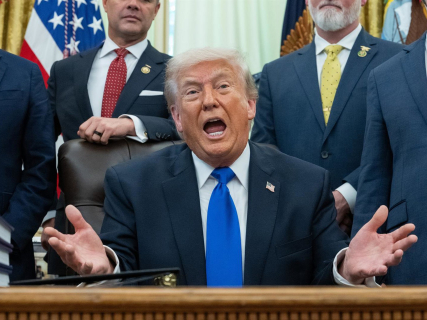

The White House has communicated to the United States Congress that hostilities with Iran "have ended", just as the legal deadline was expiring, which obliged Donald Trump to request legislative authorization to continue the military campaign. The declaration arrives at a key moment: the war began on February 28 with American and Israeli attacks against Iran and this May 1 marked the 60-day limit provided for by the War Powers Act of 1973.
Trump sent letters to the Speaker of the House of Representatives, Mike Johnson, and the President pro tempore of the Senate, Chuck Grassley, in which he maintained that there has been no exchange of fire between US and Iranian forces since April 7 and that, therefore, the hostilities initiated on February 28 have been "terminated".
The White House tries to shut down Congress's clock
The movement has an immediate legal reading. The War Powers Resolution, approved in 1973 after the Vietnam War, limits the president's ability to maintain military operations without congressional authorization. In general terms, it allows the president to deploy forces for 60 days without legislative approval, with a possible 30-day extension for withdrawal.
The Trump Administration maintains that the ceasefire of early April stopped or closed that deadline because there are no longer active “hostilities” between the United States and Iran. The White House's thesis is clear: if there has been no crossfire since April 7, there is no obligation to ask Congress for authorization to continue a war that, according to Trump, has already ended.
Democrats question the maneuver
The Democratic opposition rejects that interpretation. Their argument is that a ceasefire does not automatically erase the obligations of the War Powers Act, especially if the United States maintains deployed forces in the region, naval blockades, or the capacity to resume military operations. Reuters reports that Democrats maintain that there is no clear clause that allows "pausing" the legal clock for a temporary cessation of hostilities.
The clash is not minor. If Trump's thesis prevails, the president avoids asking for formal authorization from Congress. If the opposition manages to impose its reading, the White House would have to submit the continuation of the campaign or future operations against Iran to legislative control.
The war does not disappear entirely
The White House statement does not necessarily mean the crisis is over. Reuters points out that the United States maintains an active military presence in the region and that the situation remains marked by surveillance, the blocking of Iranian exports, and the risk of new attacks if the ceasefire is broken.
That is the most delicate political point: Trump declares hostilities terminated for legal purposes, but the military and diplomatic architecture of the crisis remains alive. In other words: the direct fire phase may have ended, but not necessarily the strategic confrontation with Iran.
The April 7 ceasefire, the centerpiece
The White House bases its argument on the ceasefire that began in early April. Trump had already announced a two-week truce at the time and argued that the United States had achieved its military objectives. At that time, spokesperson Karoline Leavitt presented it as an American victory and an opening towards a diplomatic solution.
Now that same ceasefire becomes the central legal piece to circumvent the 60-day limit. The Administration not only presents it as a military pause, but as the end of hostilities for legal purposes.
A decision with high political impact
The communication to Congress comes after weeks of Democratic pressure to limit Trump's authority on the Iran war. The Senate, controlled by Republicans, blocked in mid-April a Democratic initiative that sought to curb the military campaign until there was express authorization from Congress.
The White House is now trying to close that front before the debate turns into a major constitutional crisis. The Iran war had already opened a rift between the Executive and the Capitol over who really decides when the United States enters, maintains, or ends a war.
What does “hostilities ended” mean
The expression is key. Trump is not simply saying that there is definitive peace with Iran. He is using a legal formula: "the hostilities have ended." That phrase allows the Administration to argue that the time limit that would require asking Congress for authorization no longer applies.
But the problem is that the border between ceasefire, end of hostilities and real end of a war is not always clear. If the United States maintains naval operations, regional deployments or threats of new attacks, Democrats can argue that the war is not really over, but suspended.