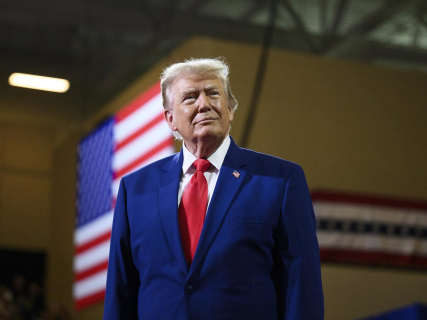

The president of the United States, Donald Trump, appeared again before the White House Correspondents' Association three months after the episode that forced the original meeting to be suspended.
The meeting was held under heavy security measures after what The Washington Post described as “an apparent assassination attempt” that occurred on April 25 at the Washington Hilton hotel.
During the event, Trump publicly acknowledged the work of the Secret Service for protecting him that night. The man accused of shooting, Cole Allen, has pleaded not guilty to the charge of attempted murder of a public official.
“The second time is always better”
Trump opened his remarks with one of those comments that mixes joke, provocation, and political message. “Just like my presidency, the second time is always better, and the third will be even better… I’m just joking,” he said to the attendees.
The phrase fueled the debate about his insistence on hinting at the idea of a third term, despite the fact that the Constitution of the United States limits the presidency to two terms. In Trump’s language, the joke is rarely just a joke. It often serves as a probe, challenge, or wink to his political base.
“The show must go on”
The president also resumed a phrase he had already used after the attack: “The show must go on”.
Upon entering the hall, he launched his first irony against the journalists present: “This is the largest gathering of people with Trump Derangement Syndrome.”
The comment set the tone for the night. Trump alternated moments of recognition towards the press with direct attacks on media and reporters whom he again accused of spreading “fake news” against his administration.
A message about political violence
Referring to what happened in April, Trump stated that in the United States differences should be resolved “not with bullets, but with arguments.”
The president also praised several members of his team, including Pete Hegseth, Steve Miller and Tom Holman, whom he attributed “bravery” during the incident.
The scene had an evident symbolic value: a president returning to the press after an attack, claiming his security services, and presenting his continuity as a form of political resistance.
Attacks on journalists, Democrats, and celebrities
The cordiality lasted little. According to Reuters, Trump later launched personal attacks against journalists like Don Lemon and Lawrence O’Donnell, against politicians like Chris Christie and Adam Schiff, and against celebrities like Bruce Springsteen and Jane Fonda.
He also targeted the Democratic governor of California, Gavin Newsom, and the Democratic leader in the Senate, Chuck Schumer.
The intervention once again showed the president's usual style: a mix of aggressive humor, settling scores, and direct confrontation with his political and media adversaries.
The tension with the press
The dinner came at a time of strong tension between the White House and the media. Organizations defending press freedom have criticized the Trump Administration for its lawsuits against media, the restrictions on access to certain journalists, and the threats of measures against broadcasters.
Trump seemed to respond to those criticisms with a partial acknowledgment: “There are many people I like. Some I don’t like at all, but I respect most. I must say they do an excellent job, an incredible job, and it’s an honor.” The message, however, was surrounded by reproaches, mockery, and personal attacks.
A smaller gala with more security
The White House Correspondents' Association dinner has been held for over a century, but this edition had a more contained format.
The event moved to the Waldorf Astoria, a hotel that once was part of Trump's business empire, and took place with a smaller turnout than expected.
The change of venue, the increased security, and the memory of the April attack marked a night that was less festive and more political than in other editions.
Awards for investigations on Epstein
Before Trump's intervention, several journalists were awarded for their investigations into the links between the president and financier Jeffrey Epstein.
Among those recognized was the team from The Wall Street Journal, which had published revelations about that relationship.
The choice of those awards added another layer of tension to the night: Trump spoke before a room that had just honored uncomfortable journalistic work for his political environment.
The defense of journalism
The outgoing president of the White House Correspondents' Association, Weijia Jiang, championed the role of journalism in a democratic society.
“It doesn't matter how complicated or tense the relationship between the press and the presidency is, what we share is much more important than anything else and that is our duty: to serve the American people,” he stated.
His message contrasted with Trump's combative tone, but also summarized the historical sense of the gala: to remember that the relationship between power and the press can be uncomfortable, but not dispensable.
A night between tribute and confrontation
Trump's reappearance before the correspondents left two simultaneous images.
On one hand, that of a president who thanks the Secret Service for their actions after an attack and defends that politics should not be resolved with violence. On the other, that of a leader who again uses the institutional stage to ridicule journalists, attack rivals, and slip messages that strain constitutional limits.
The dinner was supposed to close an open wound from April. It ended up showing that, in the relationship between Trump and the press, confrontation remains a central part of the spectacle.