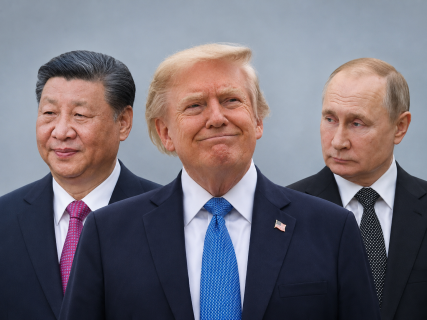

The presidents of the United States, Donald Trump; China, Xi Jinping; and Russia, Vladímir Putin, will hold their first trilateral meeting this Thursday in the Chinese city of Shenzhen, with the future of nuclear weapons control as the main item for negotiation. The meeting will take place during the Asia-Pacific Economic Cooperation Forum (APEC) summit, which begins this Wednesday and will bring together the leaders of some of the world’s largest economies amid an escalation of geopolitical and trade tensions.
The meeting, described by Beijing as “unprecedented,” will for the first time seat the three heads of state at the same table, although Washington has already lowered expectations regarding the possibility of reaching an immediate agreement. The war in Ukraine, the conflict with Iran, and differences over control of nuclear arsenals will shape talks in which North Korean leader Kim Jong-un could also participate, through parallel meetings.
In addition to the international security agenda, the summit will serve to address economic and technological rivalry between the United States and China, especially in artificial intelligence, semiconductors, and strategic minerals. Trump and Xi are scheduled to hold a bilateral meeting to negotiate the future of the tariff truce that both countries have in force and whose continuity depends on new talks.
Trump, Xi and Putin, in an unprecedented nuclear negotiation
The Thursday meeting will be the first joint meeting of Trump, Xi, and Putin, who until now had maintained bilateral contacts, but never a three-way conversation. The appointment takes on special significance due to the international situation and due to the difficulties in establishing new arms control commitments among the main nuclear powers.
From Moscow, Kremlin spokesperson Dmitri Peskov has defended the political importance of the meeting. In his view, the three leaders will send an international signal about the possibility of resolving the main security problems through dialogue.
Despite the expectations generated, the U.S. Administration has warned that it does not expect immediate results. Strategic differences among the three countries, especially regarding the war in Ukraine and U.S. security policy in Asia, make it difficult to close concrete commitments during the meeting.
For Putin, the summit also represents a diplomatic opportunity. It will be his first appearance at a major multilateral gathering with Western presence since 2019, in a context shaped by the arrest order issued against him by the International Criminal Court for alleged war crimes related to Ukraine.
Kim Jong-un could join the diplomatic contacts
The possible presence of the leader of North Korea, Kim Jong-un, adds an element of uncertainty to the summit. Although his country is not part of APEC, Trump has opened the door to holding a meeting with him during his stay in China.
"He might come. I don't know. It depends on President Xi," the U.S. president said on Tuesday. For now, Beijing has not confirmed that Kim will travel to Shenzhen.
If the meeting finally takes place, Trump and Kim would see each other again for the first time since June 2019, when they held a meeting at the border between the two Koreas. That meeting did not allow the negotiations on North Korea's denuclearization to be unlocked.
During his first term, Trump held three meetings with Kim, in an attempt to negotiate limits on Pyongyang's nuclear program. The eventual resumption of contacts would now occur in a more complex international scenario, with North Korea closely linked to Russia.
The United States and China negotiate the future of their trade truce
Beyond nuclear armament, the economic relationship between Washington and Beijing will take up a large part of the discussions. Trump and Xi will meet privately to examine the continuation of the trade truce, which allowed new U.S. tariff measures to be suspended and stopped Chinese restrictions on the export of rare earths and other critical minerals.
The current understanding has January as its horizon, so both administrations will have to decide whether they extend their commitments or toughen their respective trade policies again.
The negotiation is especially relevant for technology companies and industries that depend on strategic materials controlled by China. Beijing plays a key role in the processing of rare earths, while the United States maintains a dominant position in certain segments of the advanced semiconductor industry.
Before traveling to Shenzhen, Trump met in Manila with the leaders of the Quad, the strategic cooperation forum made up of the United States, Japan, India, and Australia, whose activities are closely related to the balance of power in the Indo-Pacific.
Artificial intelligence, another focus of tension between Washington and Beijing
The choice of Shenzhen as the venue for the summit has an important technological dimension. Known as “China’s Silicon Valley,” the city concentrates some of the country’s main technology companies and has become one of Asia’s most relevant innovation centers.
Artificial intelligence will again occupy a prominent place on the agenda, at a time of growing competition for the development of advanced chips, data centers, and processing systems.
The debate is also taking place amid the controversy affecting Nvidia and its former top executive, Jensen Huang, who is being investigated for his alleged ties to a woman connected to Chinese intelligence services. Suspicions about possible transfers of sensitive technology have added pressure to relations between the two powers.
Mexico, Chile, and Peru seek prominence at the summit
Latin American participation will be especially important in this edition. The presidents of Mexico, Chile, and Peru will travel to Shenzhen with an agenda focused on commercial relations with Asia and the search for new investment opportunities.
The Mexican president, Claudia Sheinbaum, will make her first visit to China with the aim of promoting, among other projects, the Tehuantepec Isthmus railway, conceived as a logistical alternative for the international transport of goods in competition with the Panama Canal.
Mexico will also be the host of APEC in 2028, after Vietnam, which will organize the 2027 edition. Sheinbaum also plans to hold a brief meeting with Trump during her stay in China.
For her part, Peru’s president, Keiko Fujimori, has maintained contacts with Xi Jinping, while Chile’s president, José Antonio Kast, will also take part in the meetings.
Canadian prime minister Mark Carney has also taken advantage of the occasion to move forward in his trade negotiations with Beijing. The two governments have agreed to reduce certain tariffs on Canadian exports, including pork and fish products, and to improve the conditions of access to the Chinese market.
What is APEC and how much weight does it have in the global economy
Founded in 1989, the Asia-Pacific Economic Cooperation Forum brings together 21 economies with the goal of facilitating trade, investment, and regional economic cooperation.
Its members concentrate approximately 60% of the world’s gross domestic product and nearly 40% of the planet’s population, which makes their annual meetings one of the main international economic appointments.
Among its members are the United States, China, Russia, Japan, Canada, Mexico, Chile, Peru, Australia, South Korea, and various economies in Southeast Asia.
Unlike other international organizations, APEC operates through cooperation commitments and consensus, without imposing legally binding obligations on its members. Its next edition will be held in Vietnam in 2027.