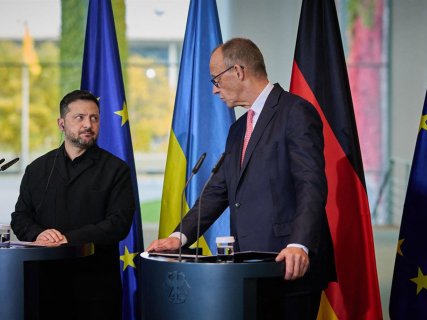

The President of Ukraine, Volodimir Zelenski, advanced this Tuesday that security guarantees and initiatives for the economic recovery of his country will be the priority matters in the new three-way round of contacts with Russia and the United States, which will take place next week in Abu Dhabi, the capital of the United Arab Emirates.
"The American side has already sent signals that it wants to talk about security guarantees for Ukraine and about a package for the recovery of our state," Zelenski said during a joint press conference with the German foreign minister, Friedrich Merz, on the occasion of his unexpected visit to Berlin.
Zelenski specified that one of the objectives of this round of talks, scheduled for November 10 and 11, is to agree on a ceasefire that will protect energy facilities and other critical infrastructure against the arrival of winter, as well as to move forward in unblocking the Black Sea.
At this point, he underlined that "not only Ukraine" is interested in this matter, but that Russia also is, but also "other countries in Africa and Asia," as well as "various partners," in reference to the impact that the increase in attacks in the Black Sea is having on food exports to dozens of countries.
At the same time, the Ukrainian head of state defended the need to continue pushing for, and even expanding, prisoner exchanges, one of the few areas in which the parties have reached partial understandings in previous rounds.
Europe’s role in the talks
Zelenski wanted to highlight the role of the European states in this process and indicated that he expects to have their representation at a future meeting at the level of heads of State and Government, whose preparation should begin already at the meeting that Abu Dhabi will host.
"There can be no stable, lasting peace if Europe does not take part in the negotiations in one way or another," Zelenski emphasized, according to the Ukrinform news agency.
For his part, the German chancellor expressed reservations about Moscow’s real willingness and recalled that, until now, Russia has not offered sufficient signs of wanting to end the conflict. "So far I don't see that happening," Merz played down expectations.
Merz agreed on the need for Europe to be present in these talks and stressed that there are issues that "can only be resolved" with its direct involvement.
On this line, he has announced a meeting in Berlin on the next 19 November of the so-called 'coalition of volunteers', in which Ukraine’s allies expect to define the scope of the following support package, "mainly military", scheduled for the year 2027.
Europe seeks its place in the negotiations
In the last few hours, the special envoy of the United States, Steve Witkoff, has confirmed a new round of talks for 10 and 11 November in Abu Dhabi, a setting for previous meetings in which the deep disagreements that still separate Moscow and Kyiv were made clear.
Witkoff has also advanced that U.S. authorities will hold this week meetings with representatives of several European countries, including France, Germany and the United Kingdom, as well as with delegations from NATO and the EU.
Kyiv’s European partners have insisted since the start of the process on having a seat at the negotiating table, arguing that the continent’s security architecture is at stake, its role as the main supplier of armaments to Ukraine, and the aspirations of this country to integrate in the future into the EU. However, both Washington and Moscow choose to postpone that incorporation.
After the Abu Dhabi talks, three summits of relevance are expected, including that of the G20, which will be held in mid-December in Florida, where speculation is that the Russian president, Vladimir Putin, may attend, invited by his U.S. counterpart, Donald Trump.
Before that, Putin, Trump and the Chinese president, Xi Jinping, could coincide on the margins of the Asia-Pacific Economic Cooperation Forum (APEC), which will be held in the Chinese city of Shenzhen on 18 and 19 November, a meeting that has generated concern at the possibility that questions related to Ukraine are addressed behind closed doors.