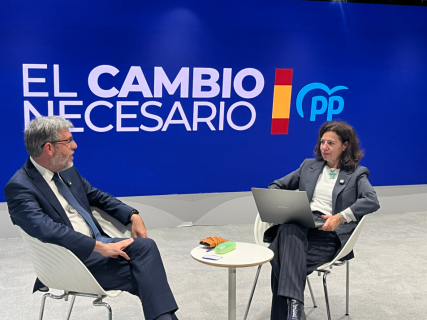










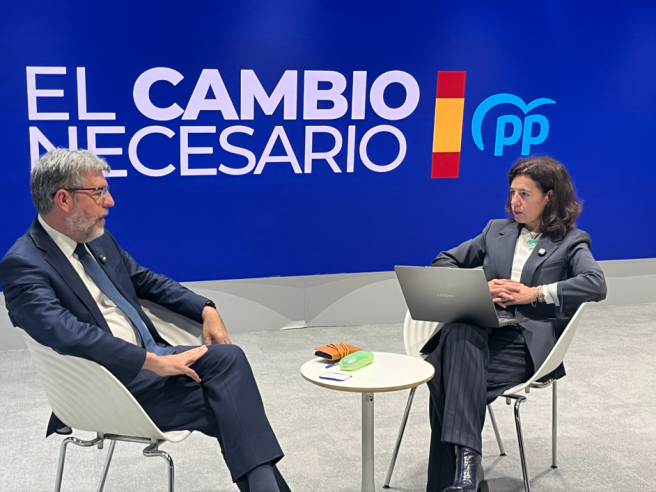
For the second consecutive time, Alberto Nadal welcomes DEMÓCRATA at the national headquarters of the Partido Popular, on Madrid’s Genova Street. A Commercial Technician, and currently deputy secretary for Economy of the PP, Nadal attends to us cordially, in an election campaign that grants no truce to anyone. "A good campaign," he assures us, as he describes the hustle of a few days that keeps the entire party busy.
In the office of his chief of staff, Santiago Sánchez López, who is finalizing the details of another appearance, one of his major concerns comes to the surface: the Government poses as ecologist while, according to the complaint, it uses renewable energy which, in the end, and in order to avoid a blackout, paradoxically ends up making the electricity bill more expensive, due to the need for other energy, by more than 5,000 million euros, with the added inability to be able to provide service to neither more homes nor more companies.
The conversation anticipates an intense interview, in which number five of the people for Madrid shies away from no matter.
We talk about wages, pensions, budgets, taxes, investment, productivity, housing, energy, data centers, and bureaucracy. Nadal lays out the first economic decisions that a Feijóo Government would take, with harsh criticism of Pedro Sánchez and a conviction that runs through the entire conversation: Spain needs to recover its capacity to grow.
Wages and pensions
QUESTION: Mr. Nadal, thank you very much for opening the doors of your home to us. This is the second time that we interview you here. Next time we want you to come to DEMÓCRATA. You are invited.
RESPONSE: Thank you very much. We’ll go, for sure.
QUESTION: The Government has just approved an increase to the Minimum Interprofessional Wage, as well as the salary of civil servants. It did so in a Council of Ministers without social dialogue, without budgets and in the middle of an election campaign. Does this measure seem responsible to you?
RESPONSE: Let’s see. First are the forms. The decision to raise the Minimum Interprofessional Wage is an agreement of the Council of Ministers, which is usually made in the month of December, when all the inflation that has occurred during the current year is already known. And the increase in pensions and the increase in the salary of public employees should go in the Law on the General State Budgets.
But, of course, we are talking about a Law on the General State Budget that they have not submitted even once in the last four years. The socialist Government already has us used to this.
And it’s even worse: these increases have been made through royal decree-law, which is a constitutional instrument for emergency situations, but this Government has used it and abused it, and in fact it keeps it in place permanently.
Furthermore, on this occasion, it does so as well when the chambers of the Congress and the Senate are already dissolved, and there is a different majority in the Permanent Deputation than there was in the Plenary Session of the Congress of Deputies.
So there is no way to take hold of it. Neither from the constitutional point of view nor from the point of view of respect for democratic institutions and respect for Parliament.
The next thing is: was it the moment to do it? Well, you should have done it with a new Law on the General State Budget. Now then, also pensioners and public employees do not have to pay because this Government has not submitted budgets even once and has dissolved the Cortes without having fixed the public accounts.
Therefore, we will do what is necessary so that those who do not have to pay do not end up paying for Pedro Sánchez’s lack of coherence.
What happens is that all budget items have to form part of a coherent budget policy, that is financeable and that both promotes economic growth and, at the same time, establishes the appropriate remuneration, both for pensioners and for public employees. And, in the case of pensioners, then their purchasing power should be maintained clearly.
But that has to be done with an orderly budget policy.
QUESTION: Can people rest easy, because I imagine that if you win on 29N, these increases in pensions and the salaries of civil servants are not going to be touched?
RESPONSE: No, no, that won’t be touched. But it would have been desirable for those increases to have been made in another way.
Budgets
P: If Alberto Núñez Feijóo manages to form a Government after 29N, what would be the first economic decisions you would make, since I understand that you will be a minister, even without counting at that time on new budgets?
R: Alberto Núñez Feijóo, if he has the trust of the Spanish people, will form a Government and by forming that Government, which will include the people he deems appropriate, it has a series of tasks that are unavoidable and that have to be seen very clearly in the first Meetings of Ministers.
The first of these is an audit of public accounts. We need to know how we are.
We don’t know how we are, because we’ve gone four years without budgets, as I said earlier. We don’t know how we are because there is a lack of transparency about part of public procurement -and the example is the investigations that the judicial branch is continually carrying out into contractual activities by the Government-.
There is also a lack of transparency about efficiency in management. There is a lack of transparency about the full set of budgetary changes that have been made. That is why we need to look at where we stand before we can make decisions.
The second is that we have to start drawing up some General Budgets, because Spain has been without Budgets for four years. And the first ones have to be presented before the first quarter of 2027 ends so that they become effective throughout 2027. And then, our General State Budgets will have to be presented before September 30, 2027, for 2028.
That is, we will return to constitutional normality, which will now become news. And, returning to Alberto Núñez Feijóo, he will do it.
The third is that through the General State Budgets we have to start returning to Spanish families, especially families with children, part of the strong and brutal increase in taxation that has been generated by the Government of Sánchez, especially through the failure to update the Personal Income Tax, which particularly harms families with children.
Because families with children are those who had more deductions for the number of children, but, since the deductions have not been updated, it turns out that the more children you have, the more damage they do to them with the tax increase.
In this sense, a tax cut for families has to be noticeable.
P: Can that cut be made before the Budgets?
R: No, it would have to go with the Budgets. But, in addition, in those Budgets we would also have to update the IRPF so that taxes do not continue to be increased through this channel.
If the inflation situation persists, it is also important to carry out VAT cuts, for those essential foods, and which are the ones that have risen the most within the grocery basket. That can be done before the Budgets.
And, then, we need to put measures in motion from day one. I would focus especially on two. One of them involves starting the process of deregulating housing so that the boost to housing arises from day one.
And, second, a shock plan in the energy system, because the lack of access to the grid and the lack of control of the tension of the grid access have become true bottlenecks for the expansion of the Spanish economy, the industrial sector, and even for the delivery of housing.
P: Then we can talk about this, because I know it will give us information in this regard and it will surprise us, because it is money that is taken away from Spaniards
R: That’s right. We are talking about what the blackout is costing Spaniards.
P: One of the problems that many companies encounter when it comes to investing is the need to coordinate different administrations and agencies. How would you like the next Government to organize things to speed up industrial and environmental authorizations, the electrical connection? Who would have to assume that responsibility?
R: The autonomous communities governed by the PP isrán creating instruments that facilitate rapid routes for those projects that have a special positive impact on the economy of the autonomous community, through job creation, through added value, and through exports.
Many of our autonomous communities are doing this and with success.
But at the same time, the Government, in these royal decrees that it is accustomed to approving, has made a similar figure, only with one enormous difference, and it is, that it is not coordinated by the autonomous communities. Thus, it is the Executive that politically decides which projects must be included and which ones not. Let’s say that it is a kind of all-encompassing power to decide ideologically which projects it supports and which projects it does not.
Well, from the PP, what we think is that the projects that are supported at the national level can be coordinated with those of the autonomous communities. Therefore, we can make objective the criteria by which this fast track is granted to those projects and, also thinking that they are essential projects, in key sectors for our autonomous communities, because they create jobs, have an important driving effect, and are capable of generating technology.
What it is about is to facilitate for those projects the fast track so that they can overcome a large part of the bureaucratic difficulties or access to the electricity system, which otherwise they would not be able to overcome, except with a timeline of years.
But fundamentally, these are the urgent measures. What we have to aspire to for real is that all investment projects in Spain can be carried out in time and in proper form without bureaucracy being the fundamental obstacle.
And that’s where real estate companies and housing projects have to take a primary place.
Q: If electoral results force the PP to negotiate agreements to form a government, what would be the fundamental guidelines of the economic policy you would want to preserve?
A: The Partido Popular has always put forward some basic principles of economics. Some fundamental principles that are the basis of Spanish growth and prosperity in Spain.
We believe in the market economy and in the right to property, and this has to be respected, as a foundation, as principles. No nation is prosperous without private property, without a market economy, and without contracts being fulfilled.
Secondly, we have to ensure that public money is spent efficiently, and therefore we have to look at every euro that is collected from the Spanish people, and know what it is spent on and look at its efficiency.
Thirdly, if we are efficient in spending, we can have good services. We can have more investment, and at the same time have lower taxes. So any government program that we reach an agreement on will include that.
We also believe that regulation has to be fair and necessary exclusively to order society. We can’t take ideology to the Boletín Oficial del Estado. Therefore, we have to reduce both the regulatory burden and make our judicial system much more agile.
And then, we have to be efficient in those areas that are essential for the economy, such as, for example, digitalisation or energy. We also believe in a Spain that is integrated into Europe, integrated into the euro and open to the outside world, but of course, provided that the rules are common to everyone.
On these foundations that have always been in place—macroeconomic stability, looking at the productive sector as an ally and not as a milking cow from which to squeeze taxes, and efficient management of public resources—well, as I was saying to you, on that basis we can build an electoral programme with whoever is necessary, if indeed that is necessary.
The three questions that each rule has to answer
Q: Brussels has just raised its growth forecast for Spain in 2026 to 2.6% even though it anticipates a moderation of this growth to 2.1% in 2027 and to 1.9% for 2028, coinciding among other factors with the loss of momentum of the Recovery Plan, whose impact of the funds we still do not know. Where does the Partido Popular believe the new growth engines of the Spanish economy should be in the coming years?
A: Well, let’s take it step by step. Regarding the statement about the funds, I’ll tell you right away what the European funds have been used for. The European funds have been used so that Pedro Sánchez remains in La Moncloa without General State Budgets.
That is the only real impact they have had… In short, the funds have given him flexibility, and they have allowed him to keep moving budget items around, as he has been doing since the pandemic. And he has done it, normally, by skipping, overstepping, every basic principle, both in terms of respect for Parliament and of budget legislation.
But well, in addition to that, since those European funds were made flexible to move between budget items, what he has done is to play with them, to finance what he wants. But, at the same time, he has been modifying budget items one after another—up to nine modifications with Brussels—to both lower the objectives that were initially planned with the EU and to change the budget items.
So, the final result, is that neither Spanish productivity has grown nor Spanish investment has grown. However, Pedro Sánchez has remained in La Moncloa without General State Budgets.
With which, Next Generation funds have served Sánchez as a band-aid to be able to get around the absence of budgets.
As for economic growth, it is true that Spain is the country that grows the most, but it grows based on immigration and on public spending. And proof of that, and that it hasn’t done it based on investment and productivity, is that we are also the champions in inflation among the major economies of the eurozone.
The question we have to ask ourselves is, are we dealing with the same energy crisis as the rest of the countries, because the Ormuz crisis is the same for everyone, why is inflation in Spain much higher than in the rest of the countries around us? And the answer is because our growth is sick growth, a growth that is not based on investment or on productivity.
Then, what would therefore be the growth drivers in the future? Well, everything that raises our productive capacity.
Then, each regulation that is approved—and we have to review all the regulations from the past as well under these same parameters—has to answer three questions. 1) Does what we are doing increase employment? 2) Does what we are doing increase productivity? 3) Does what we are doing increase the competitiveness of exports?
If the answer is 'no' to all three questions, that regulation has to be modified or repealed.
Now, if we shift public spending toward investment, if we make it more efficient, if we lower taxes, if we carry out a sensible—not ideologized—energy policy that avoids blackouts and reduces costs, if we make Vocational Training attractive for young people and genuinely involved with the world of work, if we improve our universities, if we reduce bureaucracy, if we do all this at the same time…
If, in addition, we attract new technologies, if we do all this at the same time, not overnight, but little by little, it seems evident that productivity in the Spanish economy will improve and we will move closer to the countries around us, because that growth may ultimately raise the levels of income and wages of Spaniards.
P: You are mentioning three criteria that should prevail when it comes to shaping new regulations, and I understand that when it comes to repealing existing regulations. And, could you tell us some of those regulations that already exist and are harmful to the Spanish economy?
R: We have, both in Europe and in Spain, a great number of them. I’m going to give some examples, because we have dozens.
P: Tell us three
R: The volume of regulation and the overlapping bodies we have in Europe regarding the financial sector is causing the transmission of credit and the financing of small and medium-sized enterprises and investment projects to be lower than it is in other parts of the world.
In terms of new technologies, the Royal Decree that this Government has approved, which in practice pushes data centers out of Spain, does not exist in any other country in the world.
That our farmers cannot use certain plant protection products to protect their crops, which are nevertheless produced and used normally in other OECD countries, is half the time a European problem, the other half of the time, a Spanish problem that goes much further than what is being asked for in Europe.
The current legislation we have on packaging recycling goes much further than our European objectives and goes much further than what any other European country is going to do, both in the content and in the timelines to implement it.
We have to wage a battle in Europe with our main friends in Europe, and Alberto is going to have very good friends in Europe, so that the European legislation, which is necessary, is appropriate, is simplified and is reduced. And, in Spain we have to do the same so that self-employed workers and SMEs can be able to work without having to spend all day looking at the Official State Gazette, or, looking at what new tax they are going to raise on us.
And, on the other hand, we need to raise the consideration of what constitutes a small and medium-sized company in order to eliminate a large part of the bureaucratic burden that they place on it.
Q: The Airef is warning about the difficulties of reconciling the evolution of public spending with the European fiscal commitments. And beyond a possible audit of the public accounts, which you have already mentioned, what criteria would the PP follow to review spending priorities and determine where it is necessary to introduce changes?
A: The first thing that must be remembered is that the objective of the new European legislation, as it cannot be otherwise, on fiscal discipline, is for countries to reduce their indebtedness.
What makes you vulnerable is not having a very high deficit in one year, which may be justified, for example during a pandemic. What makes you vulnerable is maintaining a very high deficit for a long time, which accumulates a lot of debt for you, and when bad times come, then it turns out that having a certain amount of debt normally makes you vulnerable, because if interest rates rise, all public spending will be paid in interest on the debt.
Q: Well, this issue is not minor, because what citizens should know is that when a Government begins to pay public spending, the first bill is the payment of the debt
R: First of all. Constitutionally, the first order is payment of the debt. I always say that a budget is made in the following way: the first line consists of paying the interest on the debt. And the next one is to pay pensions.
But the first, without a doubt, is payment of the interest on the debt, because everyone understands it. If Spain did not pay today the interest on the debt it has borrowed, they would not lend us again, and then the State would immediately collapse.
During the history of the euro we have had quite a few episodes of countries that could end up in that situation. And, we see what happens. And it is that, among other things, they force you to lower pensions.
So, and taking up your question from AIReF, the fiscal rules, as I was saying, have an objective. And, to achieve that objective, every time there are general elections, the states have to negotiate with Europe what your spending rule is. That is to say, how much your spending is going to increase over the next four years.
And, in this sense, I think that what is essential is to recover Spain’s credibility again. That our European partners and European authorities have in Spain a reliable partner; that the fiscal path that we are going to draw, the path that we are going to agree on, will be strictly complied with.
But it also has to be a fiscal path compatible with the situation of the Spanish economy, which is nothing other than the absence of budgets for four years, as well as the failures that have occurred in the past. That is why I insist that we do not know exactly what we are going to find.
Infrastructure and the vulnerability of the Spanish electricity grid
P: You have spoken about mobilizing 300 billion for infrastructure in collaboration with the sectors involved. How do you imagine the division of efforts can be between public investment and private investment?
R: In reality, everything is public investment, but it is financed in different ways. I’m going to give examples. Some of those 300 billion will have to go to reinforcing the electricity grid.
In the Spanish electricity grid, investment has not been made. Or, we can say that it hasn’t been invested enough and the result we have is a system that is structurally vulnerable, and proof of that is that we have blackouts. And, to avoid new blackouts, we are forced into high costs.
But we also have the problem of network access. So both generation and demand cannot get in. Today there are homes and industrial and new technology projects that cannot get in because they do not have network access.
Does that have to be financed from the General State Budgets? No. That has to go through regulation, because it is the companies that manage the electricity grid, the transmission network and the distribution companies that are going to obtain those resources and that are going to carry them out. But what they need is adequate regulation so they can see it through.
In ports and airports, these infrastructures are usually self-financed investments. Because their resources come from what airlines and shipping companies pay. That allows them to recover the investment.
In water and roads. Well, here, however, there is more spending from the General State Budgets. But we have to see what public-private collaboration formula we can put in place to carry them out.
In any case and, depending on which area, some have their own cost recovery regime, and in others there is more participation from the General State Budgets.
But since we have already lost the European funds, and this is spilled milk—basically, because they have not been used and they have not served to change the Spanish economy, but they are already behind us—so now we will have to rely on private financing in order to carry out this modernization program, a 10-year modernization of infrastructures.
P: The Minister of the Body asked in an economic debate: where are you going to get the money from?, because otherwise, he noted, your promises look like a wish chest
R: Let’s see. That’s not the case. If the country can manage to attract investment, of course it can be obtained. That is to say, Mr. Cuerpo, Spain is exporting savings to the rest of the world. And that Spanish savings is enough to finance its public deficit, which is higher than it should be in order to finance Spain’s internal investment and to finance investment abroad. And this happens because they can’t find investment projects in Spain that are sufficiently attractive.
The people have to know that there is Spanish financing that is financing Germany, Canada, and the United States. And what’s logical is that the opposite should be happening.
If you are a country, like Spain, which has 90% of European income—that is, it doesn’t reach 100%—and, therefore, you are behind European income, there should be more investment opportunities here, because it is supposed that the one who is behind has more facilities to catch up with the one who is ahead, the one at the top.
However, and far from attracting the savings of the rest of the world toward Spain, we are expelling Spain’s savings to the rest of the world and fundamentally to richer countries than ours. With which, something we are doing wrong, when we don’t create the conditions for public and private investment, to bring that capital from the rest of the world.
Lower taxes for families and the productive sector
P: One of the issues that worries the business fabric is how to precisely incentivize investment. What new developments could a company find if it wants to reinvest its profits, for example in machinery, in technology, or in research?
R: The first difficulty that an investor will encounter, and we speak with all the productive sectors, is regulatory. Investors face obstacles, slowness in bureaucracy, lack of permits, and excessive requirements. We think, on the contrary, that by relaxing simplification, investment increases. Pay attention, relaxing simplification and also deregulation, because it will be necessary to repeal.
And then, second, we need the investment’s fiscal financial profitability to be as high as possible in order to attract more investment. That is to say, fewer taxes.
In the case of companies, there has to be fewer taxes aimed fundamentally at investment projects and at the acquisition of technologies.
Can we do everything all at once? No. Why? Because we start from very high spending levels and from excessively high deficit levels at the moment.
But all the governments of the Partido Popular, both that of Aznar and that of Rajoy, have a trademark. And it is that the populares make spending grow much more slowly than the economy grows. The economy, if it grows in nominal terms at 5 or 6%, spending grows at 4%.
Given this, all of this allows you to spend more on public services, maintain their real spending, even increase it in those areas where it is needed. In such a way that, if you do not have as policy, raising spending—which is what the Socialist Government has been doing—but raising it only where it is most needed and with the appropriate priorities, and seeing what is efficient and what is not, the result is that you are gradually gaining room to lower taxes.
And where do you have to lower them? Certainly for families, who have been heavily punished.
And at the same time, we also have to lower taxes on those who are going to invest, who are going to attract talent, and who are going to carry out technologies.
Help self-employed workers and reduce the cost of energy
Q: If a small business wanted to expand its activity or open a second factory, what practical differences would Mr. Nadal like to find with a Partido Popular government?
A: The first thing we have to do is raise the definition of small and medium-sized business from 50 workers to 250—that is, to postpone certain legal and administrative obligations that are currently triggered when a company reaches 50 workers, so that some are not enforceable until it reaches 250 employees—with which, all at once, we are going to eliminate an immense amount of bureaucracy.
The second thing we will do is to support companies in creating jobs. And the third is that, if these companies reinvest their profits, and bet on making the company grow, their taxes will be lower.
Q: In relation to a proposal to make electrical connections easier—of what we talked about earlier—what criteria would the Partido Popular Government use to give priority precisely to different business projects? Do they, for example, consider increasing or improving transparency about the available capacity of the grid and the access timelines?
A: Little by little, the catastrophic situation of the grids is becoming known, where the nodes are exhausted and the appropriate investments have not been made in the last eight years.
Q: This doesn’t happen in any country?
A: No, this doesn’t happen in any country. At the level that is happening in Spain, it doesn’t happen in any OECD country. Having to wait months for them to tell you whether you can have access or not, and that 40% of access requests are rejected—this doesn’t happen anywhere in development.
Because, in addition, the Electricity Law establishes neutrality for everyone who wants to access the grid as one of the principles of the law, as it cannot be any other way.
There is no family that doesn’t consume electricity and there is no company that doesn’t use electricity. It doesn’t exist.
It is impossible to carry out any type of activity or consumption—private consumption, domestic consumption, productive activity or public activity, a foundation, or whatever you want—without using electricity. Therefore, denying someone access to the electricity grid is denying them the ability to belong to society and to the economy.
And that is what is happening at this moment. And it is happening even with real-estate projects that are finished and the houses cannot be delivered because there is no access to the electricity grid.
That said, the solution goes, as I said earlier, through an emergency investment plan to address both the problem of lack of control of the electricity grid, which is costing a fortune to Spaniards. This year about 5.800 million euros. This is what we were talking about earlier.
P: Why are the Spanish paying 5,800 million more for the electricity supply?
R: Because when Sánchez arrived in the Moncloa, this cost about 600 million and, so that you get an idea, that spending has multiplied by almost 10.
The reason is that, on the supply and demand side of the economy, which is set in the market daily, the generation units say, well, I’m willing to sell electricity at this price. Well, and depending on the demand there is, a price is established and so on, and the generation units initially that are the cheapest enter.
But the cheapest don’t guarantee voltage control in the system, because many of them cannot have voltage control capacity. It’s not their fault. The problem is that growth in renewable energy has been allowed for them, without establishing regulation.
So then, they make the offer and, of course, they have complied with the legislation. But the thing is that the Government has not adapted the system or the legislation so that there is voltage control.
As after the blackout, the Government is afraid of once again losing voltage control of the system, because ultimately it finds itself under the obligation to call other generation units, which do have voltage control, and which are combined-cycle plants, but they are infinitely more expensive.
In other words, with the current system, we are throwing away renewable energy to avoid the blackout and we are replacing it with electricity produced by gas, which is much more expensive. And this is done by a government called ecologist.
But at the same time, this is also increasing the energy cost, while increasing the carbon footprint of generation. And all of this is due to lack of investment.
In addition, we have renewable supply that would like to enter the system, because we have demand from homes, industry, and new technologies that want to enter. But, since we don’t have the physical connection to link them, then the projects are stopped.
That is to say, and given this scenario, it is clear that we have to make an emergency plan to invest in the grid in a maximum of 12-18 months, and thus resolve, at least, the most important issues of the problem.
Look, this Government is now making the electricity planning, with a two-year delay. And it presents it to the Permanent Deputation with the Courts already dissolved.
And that new planning already has a 40% failure rate in implementation compared to previous planning.
What is it that has to be done? Well, it seems imperative that we look at what critical infrastructures are in the planning of the investment plans of the distributors. Give priority to those.
We have to use all the weapons that the legislation gives you to eliminate bureaucracy and, within a record timeframe, with the appropriate incentives that are in the system, so that fundamental problems we have at the nodes are resolved, which prevent the new generation, and prevent new demand from coming in.
By the way, if new demand comes in, the fixed costs of the system are also distributed among more, and, thus, the electricity bill becomes cheaper.
The opportunity of data centers
Q: With this scenario, a challenge arises: data centers. This government is not very supportive of data centers, and it is putting obstacles in the way of their development. Do data centers create jobs, do they add value?
A: The first thing I want to highlight is that the Government is doing this because it has created the problem of rationing network access. Since it has not invested in the network and there is no access, then they have to throw somebody out so that it is noticed less that they have created a lack-of-access problem. And, how do they throw them out? And, who do they throw out? Well, they throw out whoever they think ideologically they want to throw out.
Q: Do they throw them out so that they don’t bother it?
A: They throw them out so that they don’t bother them. And, by the way, they are so aware that the requirements they are putting in place are throwing them out, that the Government is exempting data centers from the requirements, but only those that have to do with national security, with defense, and with gigafactories.
By the way, data centers are used for everything. They are used for the financial system, for when you consult the browser, for telecommunications companies. Data centers are used by all countries and they are everywhere.
Of course, Spain has a number of positive characteristics to be a country where data centers are wanted to be installed. We have renewable energy, which is demanded by them. We have space and we have good digital infrastructure.
And, therefore, there are many companies that want to place their data centers in Spain.
Well, what is it that we have to do with data centers? Expel them, as the Government wants? No. We will have to see which of them can enter and at what pace. In other words, to put them in order.
But we have to leave the doors open, and also take advantage of it, so that—since these companies need basic infrastructure for the new artificial intelligence technologies in Spain—besides coming here with their data centers, they also come with all the activities and with the entire ecosystem that artificial intelligence brings.
By the way, what are the autonomous communities governed by the PP doing, if they want to install data centers.
I like to give an example from the automobile sector. Spain had not a single car-manufacturing company, but then they came to Spain.
When they came to Spain, they came for reasons similar to those of data centers. Back then, we had a number of advantages. And when they came, they began to demand products and services from small workshops and factories that were around them, which started learning how to interact with multinational companies.
And some were so successful that they became multinational companies themselves, creating an automobile ecosystem that goes far beyond the central vehicle-manufacturing company.
Well, then, 21st-century manufacturing are information factories.
In addition to the factories of the 19th and 20th centuries, which make things, we have those of the 21st century, which what they do are services associated with information. And what needs to be done is to seize the opportunity, since we have good conditions for our future base, that this serves as a lever to participate in that new technology, in that new economy that is emerging.
P: The Government says, in this case, the Partido Socialista says that data centers consume a lot of water
R: No. Water is no longer a problem, at least in our latitudes, since they already do it with a closed cycle. It is true that they do consume energy, and therefore they cannot be installed just anywhere. But again, it is not a question of having only data centers, but of taking advantage of it as an opportunity and to jump to new technologies.
Spain has always been a country that receives technologies, not a producer of technologies. Technologies are produced in other, more advanced countries than ours, and they were absorbed by the Spanish or those technologies were used to manufacture in Spain.
Our involvement in the creation of global technology is relatively low. It has improved over time, but it is still relatively low.
In part, that is so because of our geographical position. The center of Europe is very far from us, and new ideas, new technologies that emerge in the 19th century and in the 20th century with the industrial revolution, well, they take time to reach Spain.
The areas best connected with Europe have always had more income than those worst connected with Europe.
But physical distance in the 21st century no longer matters and is no longer an obstacle, since information is transmitted instantly. And besides, we have the best-prepared generation of young people in our history. Girls and boys who are very well prepared, who are at the forefront of technology.
They are more globalized. They know what is happening anywhere in the world. They have knowledge of languages, they travel. And we have renewable energy, we have space, and we have a digital structure and an enviable geographical position.
We have everything to take part in the new process, which for the first time since 1808, to put a date, with the beginning of the war of independence, Spain can take part from the start in a technological revolution, seeking its market niche.
Does this mean that it doesn’t have to follow any kind of regulation? No. Like every new technology, it has its dangers. But those dangers cannot make us prevent those new technologies.
And what has to be done is the other way around. Take advantage of them so that Spain and the Spanish economy, once and for all, and for the first time in centuries, make the definitive leap to the income of the most advanced countries.
P: Are we therefore facing a great opportunity?
R: It is a great opportunity. And both from the Government and from the Socialist Party they only see its threats. And I tell them, why don’t they try to see what opportunities the growth in productivity, in jobs, in wages offers us, the possibility of creating our own cluster of Spanish companies, with Spanish entrepreneurs who look for their niches and who are capable, even, of creating multinationals in Spain, from the new technologies, and at the same time, putting a cap on the risks that this entails?
Look, the Nobel Prizes are awarded by a foundation of a man who got rich with dynamite. He got rich with dynamite, because dynamite made it possible to advance and make public works and mining much safer and much more effective.
But also the day dynamite is invented, terrorism with dynamite is invented. Well, but what has to be done is to take measures so that there is no terrorism with dynamite, not to ban dynamite.
Housing and work, and absenteeism
Q: The European Commission has warned that difficulties in accessing housing can limit labor mobility and economic growth. Should we incorporate housing more strongly into the debate about the competitiveness of our economy?
A: It is essential. It is immensely essential. Geographical mobility is to an enormous extent limited by the lack of housing. And at the same time the possibility of making certain decisions and taking certain risks based on your professional career is limited by housing.
If you are a young couple, you are paying a mortgage, and that mortgage consumes part of your salary, and you have to be very sure that you are going to have that salary in order to be able to pay the mortgage, because it represents a very high percentage of your income, or, if you have an idea for entrepreneurship, the mortgage ties you down. You do not have any real possibility to take risks, to set up a company, because, in effect, you run the serious risk of not being able to pay the mortgage if things do not go well for us.
So, it is evident that, in addition to being a social problem, it is an economic problem. Imagine that you have an opportunity in a big Spanish city. If that were the case, the first thing that comes to mind is, how much does it cost me?
Therefore, we have to solve the housing problem. And the housing problem is solved with more housing, not with more regulation, but with less regulation.
Another thing is that young people and families with more modest incomes have to be created with specific support systems, but what we fundamentally need is to build more housing.
It is a physical principle, because if there are more people who want to live in the number of homes that there are, either you build more homes, or, there is always someone who is going to be left out.
So, once you increase supply, once you limit obstacles to building housing, then prices begin to normalize.
Q: Labor absenteeism is a big problem for the labor market, something that I do not know if in any way we can relate it to the VET that there is right now in Spain. Does our VET need some changes?
A: Yes, VET? Well, but absenteeism has nothing to do with VET.
P: I don’t want to tell you that the large volume of absenteeism comes from FP; I only want to relate it in a certain sense. We see that many young people start working in companies and end up getting tired of the job and leaving it. I don’t know whether it’s that there is no connection between what they have studied and learned and the needs of companies
R: Well, yes, but these are two different things. The problem of absenteeism. First of all, what I want to say is that the vast majority of Spaniards are extremely conscientious about their work.
Secondly, that the vast majority of sick leaves are justified.
But the figures show you that there is an increase in abuse. And therefore what you have to do is control that abuse.
P: Well, we are referring to that absenteeism
R: We are referring to that absenteeism. That is what we are talking about.
At the moment, not all the necessary means are being used so that the approvals and the sick leaves occur with the appropriate propriety; that is, so that doctors have sufficient resources and sufficient guidelines.
It seems clear that not all the resources that the system has are being used, such as, for example, using the joint insurance schemes much more intensively for the pathologies in which they are specialized, or to carry out diagnostic tests.
We can also think about another situation, and that is that not all sick leaves have to be a total sick leave. There are activities that, if you have an activity in an office, and you have an ankle problem, then maybe you can be at home teleworking and, therefore, in this way, it is possible to try to reduce the burden of those sick leaves.
Likewise, there is a disconnect between the administration that pays, which is Social Security, and the administration that is responsible for the approvals and sick leaves, which are the health systems of the autonomous communities.
But, as I tell you, there are many measures that can be taken so that those who really need the sick leave, who are the majority, are even better protected, because a worker of very long duration, with a severe and recurring illness, is worse protected than the one who abuses it with many sick leaves in the short term. We need the guarantee that the control system works so that no further abuses occur.
Excuse me, and I lack Vocational Training, which is something else. Our education system has to look much more at the labor market and be much more embedded with the company, and from the very beginning, to already have internships in the company, and to facilitate dual training, both university and Vocational Training, and to enhance the status of Vocational Training.
We have to give Vocational Training the appropriate resources. And, of course, that Spaniards see it again as one of the preferred options for a large part of the population. This is one of the objectives of the training policy of the Partido Popular.
What three economic results does he want for Spain
Q: I would like you to look a little beyond the elections to reach a conclusion. If Alberto Núñez Feijóo wins next November 29 and manages to govern for the next four years, what are the three economic results you would like the Spanish people to be able to assess from your management?
A: Without a doubt, that the housing problem is seen to have changed. Solving it in one legislature is difficult, but we have to give it momentum to demonstrate that we are already on the right path to get it resolved.
Also, there should be no doubt, that another of the results is that Spaniards feel safe again in our infrastructures.
And, lastly, that all salaries go up. And not only the minimum wage, so that therefore Spain’s average wage is higher at the end of the legislature than at the beginning.
Q: Mr. Nadal, well, thank you very much and good luck
A: Thank you very much.
***The interview unfolds with an uncommon naturalness when the campaign tightens. Nadal is critical, but also thorough in his explanations, and he knows how to pause at a figure until he makes it understandable. With the cameras off, we still have time to talk about what comes next. He confides that he approaches the final stretch with enthusiasm and that he sees Feijóo “plugged in,” very prepared and aware of the challenge involved in governing Spain.
But Génova does not rest and the road calls them back again. There are events, trips, and provinces left to cover. Not a vote to be disputed can be considered lost, it comes to say to us. And with that determination we say goodbye. On 29N, another chapter of History can be written, he predicts.