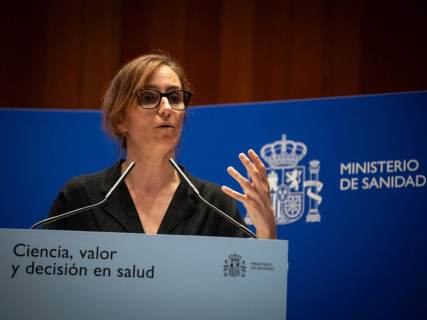

The Minister of Health, Mónica García, inaugurated this morning the presentation event of the new royal decree on health technology assessments, titled ‘Science, Value, and Decision in Health’. “It is one of the most relevant reforms in pharmaceutical policy in recent years and will allow the incorporation of innovation into the National Health System with criteria of greater scientific rigor, transparency, and participation,” she stressed.
García emphasized the work involved in implementing the measure, also acknowledging the eminently technical nature of the regulation. Furthermore, she highlighted its political significance in addressing a central issue for the healthcare system: how to decide which innovations should be incorporated into the public portfolio of services.
“Innovation does not consist of incorporating everything new, but rather that which brings real value to people's health,” stated the minister, who argued that health technology assessment should serve to identify those therapies and products that truly improve patients' quality of life, while ensuring the equity and sustainability of the system.
One of the main advances of the royal decree, as she explained, is the separation between the scientific evaluation phase and the decision-making on financing and incorporation into the system. In her opinion, this differentiation will strengthen the independence of the processes, standardize valuation criteria, and provide greater predictability to all stakeholders involved, without becoming an obstacle to access to innovation.
The minister also highlighted the formal inclusion of patients and healthcare professionals in the evaluation process. According to her, this participation is not only a democratic principle but also an essential element for improving the quality of decisions, by combining scientific evidence with the experience of those who live daily with diseases and clinical practice.
Another focus of the speech was the adaptation of the Spanish system to the European Regulation on Health Technology Assessment. García argued that the new model will allow for the utilization of joint assessments carried out in the European Union, reduce administrative duplication, incorporate evidence from real clinical practice, and improve the early identification of emerging technologies.
Before handing over the floor to the technical managers of the project, the minister wanted to vindicate the spirit of the reform. Beyond the articles, she maintained, the royal decree reflects the will to consolidate a National Health System capable of continuing to incorporate the best biomedical innovation with clear rules, scientific rigor, transparency, and responsibility. "It is magnificent news for public health and, above all, for patients," she concluded.
Independent evaluation to improve decisions on drug financing
The new royal decree on health technology evaluation constitutes the missing piece to provide Spain with a stable architecture on which to build a system of access to innovation that is more transparent, participatory, and based on scientific evidence. That was the main conclusion of the dialogue held between César Hernández, general director of the Common Portfolio of Services of the National Health System and Pharmacy, and María Jesús Lamas, director of the Spanish Agency of Medicines and Medical Devices (AEMPS).
Both officials reviewed the process of drafting the regulation and agreed that the publication of the royal decree represents much more than a procedural change. Hernández recalled that the regulation is part of a broader set of pharmaceutical policy reforms and stressed that, for the first time, Spain has a specific governance structure for the evaluation of health technologies. In his opinion, the objective is to move towards more agile decisions based on scientific knowledge, within a system of continuous improvement.
Lamas placed the reform in the context of the new European Regulation on Health Technology Assessment, whose purpose is to promote both innovation and more equitable access to medicines among member states. She explained that the new Spanish model will take advantage of the joint clinical evaluations carried out in Europe and will complete them with a national assessment of the added clinical value of each technology.
One of the main axes of the dialogue was the differentiation between scientific evaluation and decision-making. Hernández argued that evaluation should serve as the basis for financing decisions, but without replacing them, since these incorporate additional considerations related to the management of public resources. The key, he pointed out, is to ensure the coherence and transparency of the entire process.
For his part, Lamas insisted that independence constitutes one of the fundamental principles of the new system. In this regard, he explained that the institutional design of the royal decree, along with the participation of experts and conflict of interest management policies, seeks to ensure that evaluations respond exclusively to the available scientific evidence.
Both also agreed that utility will be the true criterion by which the success of the new model will be judged. For the director of the AEMPS, evaluations should not aim to become academic publications, but rather practical tools that allow the best possible decision to be made with the information available at any given time. Hernández added that the challenge now will be to develop this structure through methodological guides, governance mechanisms, and permanent collaboration between administrations, evaluators, professionals, and patients.
Reconciling access, sustainability, and the promotion of pharmaceutical innovation
The future Governance Council of the health technology assessment system must become the space where the needs of patients, professionals, administrations, and industry converge to ensure more agile access to innovation without compromising the sustainability of the National Health System. This was the main message of the first panel discussion, titled The new governance model: setting the course through dialogue.
Cristina González del Hierro, deputy director of the Service Portfolio of the National Health System, argued that improving access does not mean incorporating all technologies immediately, but rather ensuring the financing of those that have scientifically demonstrated real value. In the field of non-pharmacological technologies, she advocated for orienting innovation towards unmet healthcare needs and strengthening the planning and early detection of new technologies.
From the Federation of Scientific Medical Associations of Spain (FACME), Cristina Avendaño stressed that the participation of healthcare professionals will reinforce both the quality of the evaluations and the acceptance of funding decisions. Furthermore, she argued that the new model will allow research to be better oriented towards the real needs of the healthcare system and patients.
The Director General of Pharmacy of the Generalitat Valenciana, Elena Gras, insisted that access and sustainability must advance in a balanced way. She called for reports that facilitate homogeneous decisions throughout the territory, clear criteria for the re-evaluation of technologies, and greater predictability for both administrations and developers.
For her part, Lourdes Gil, head of the Pharmaceutical Technologies area of the Ministry of Industry and Tourism, considered that the new system will contribute to strengthening the industrial fabric by providing greater legal certainty, transparency, and stability to evaluation processes. In her opinion, these conditions will favor investment, innovation, and competitiveness in the Spanish pharmaceutical sector.
Representing patients, David Trigos, coordinator of the National Platform of the European Patients' Academy (EUPATI), advocated for the effective incorporation of patients' experience throughout the evaluation process through specific methodologies that allow generating useful evidence for decision-making. He also called for avoiding administrative duplications and improving coordination between evaluation, financing, and effective access.
Throughout the debate, participants agreed that the new Governance Council should provide shared strategic guidance, establish clear rules for evaluation and uncertainty management, and foster stable collaboration among administrations, professionals, patients, and industry. The consensus was that a more transparent, predictable, and participatory system will not only improve access to health innovations but also strengthen Spain's scientific and industrial capacity in a context of increasing international competition.
More agile, transparent, and useful evaluations
The implementation of the new health technology assessment system will require combining scientific rigor with agility, strengthening coordination among institutions, and providing sufficient resources to evaluation bodies. That was the message shared by the participants in the second round table, titled Development of the health technology assessment system: charting the path from practice.
Ana López de la Rica, deputy head of the Department of Human Use Medicines of the Spanish Agency of Medicines and Medical Devices (AEMPS), defended that the new model will be based on an organized structure and strict deadlines to offer useful reports for decision-making. She explained that the adaptation of European joint clinical evaluations will reduce duplication, speed up procedures, and focus national reports on the added clinical value of each technology, always incorporating the perspective of patients and professionals.
For her part, Blanca Novella, president of the Spanish Network of Health Technology Assessment Agencies, considered that the royal decree places evaluation "at the center" of decision-making, although she warned that the real challenge will be to integrate the so-called non-clinical domains, such as organizational, social, or budgetary impact, within the planned deadlines. To this end, she advocated for structured methodologies that combine quantitative and qualitative evidence.
From the Advisory Committee on Pharmaceutical Provision, Ana Ortega advocated for systematizing evaluations through methodological guides that allow distinguishing when it is necessary to carry out complete economic analyses and when simpler procedures are sufficient. She also proposed provisional financing mechanisms for innovations with clearly demonstrated clinical benefit.
The president of the Spanish Society of Hospital Pharmacy, Cecilia Martínez, underlined the need to accelerate access when the evidence is solid and concentrate evaluation efforts on technologies that present greater uncertainty. She also highlighted that the new system formalizes the incorporation of aspects that were already implicitly taken into account, such as patients' quality of life or organizational impact.
Finally, Pilar Pinilla, director of methods, research, and economic evaluation at the British NICE, defended that evaluations must be useful, robust, and, above all, flexible, adapting to the life cycle of each technology and assuming that decisions will continue to be made in a context of uncertainty.
In conclusion, the participants agreed that the success of the new model will depend on developing clear methodological guidelines, meeting demanding deadlines without sacrificing scientific rigor, and applying evaluations proportionate to each case. They also called for effectively incorporating the patient and professional perspective, developing new non-clinical domains with homogeneous criteria, and providing the system with the necessary resources to make the reform a reality during the coming year.
Close collaboration
The Secretary of State for Industry, Jordi García Brustenga, highlighted in his conclusion the close collaboration between the Ministries of Industry and Health in the development of pharmaceutical policy and advocated for a shared vision to strengthen the sector in Spain. The joint presence of both departments "reflects the growing degree of institutional coordination in an increasingly strategic area."
García Brustenga considered that the pharmaceutical industry represents a "key" sector due to its capacity to generate innovation, qualified employment, and added value, which is why he advocated for promoting policies that favor both patient access to medicines and industrial competitiveness.
He also highlighted initiatives such as the Profarma program and argued that collaboration between administrations, companies, and the healthcare system will be essential to face the challenges of innovation and consolidate the leadership of the Spanish pharmaceutical sector.
More resources
The Secretary of State for Health, Javier Padilla, defended in his conclusion the new royal decree on health technology assessment as a step to reinforce a system "more based on science, the best available knowledge, and transparency," although he stressed that the evaluation of medicines in Spain does not begin with this regulation, but rather relies on the work developed over years by professionals and institutions.
In addition, he thanked the Spanish Agency of Medicines and Medical Devices, the General Directorate of Portfolio and Pharmacy, the Ministry of Science, and the Health Technology Assessment Network for their work, and highlighted the collaboration between different ministries as a key element to address the growing complexity of pharmaceutical policy.
The Secretary of State rejected the criticisms that question that the evaluation reports are not binding for funding decisions. In his opinion, transferring that responsibility exclusively to the evaluators would be a mistake, since the final decision must incorporate other elements besides scientific evidence. In this regard, he defended that the decree more clearly separates the evaluation and decision-making phases, delimits the competencies of each actor, and expands the participation of new agents.
Padilla pointed out that the main challenge will be to provide the system with the necessary human and financial resources for the new model to work. In this regard, he assured that the reform will require stable professionals, specialized training, and sufficient funding to consolidate evaluation capabilities and strengthen collaboration with universities and other institutions.
Finally, he expressed his confidence that during the next year the practical application of the new framework can begin through the development of methodological guides, and maintained that the evolution of the debate on this reform shows that the health system is advancing.