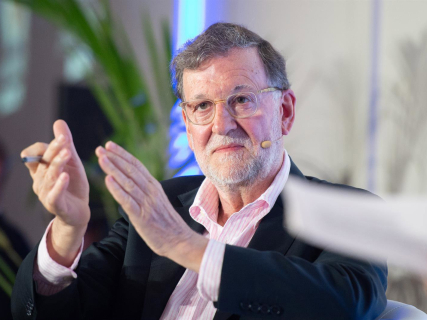

The former Presidents of the Government José María Aznar and Mariano Rajoy warned this Thursday that populism constitutes the “greatest enemy” faced today by liberal democracies. Both emphasized the importance of the capacity for self-regulation of institutions and alternation in power as essential elements to preserve freedom and stability in the democratic system.
The two former heads of government agreed at Casa América in Madrid during the presentation of the book "Sebastián Piñera en 50 voces globales", a group work in which different figures from the political and social spheres pay tribute to Chile’s former president, who died in a helicopter accident in 2024.
Aznar said that the main strength of liberal democracy rests on its “corrective” and institutional “elements” against “bad practices,” a capacity for correction and amendment which, in his view, democracies such as the Spanish, the American or the Chilean share. “When countries forget that, they can get into trouble and Spain has gotten into those troubles, although I’m convinced that we will sort them out on November 29 next.”
In this context, he made a clear rejection of any populist drift. “I am not a populist and I will never aspire to be a populist, and I will do what I can so that populism does not succeed,” he said.
For his part, Rajoy endorsed Aznar’s diagnosis by citing Ortega y Gasset, recalling that “the ignored reality always prepares its revenge,” and he argued that the general interest must be placed above party strategies and doctrines.
He also criticized the temptation to reduce democracy to the mere act of going to the polls, insisting that a truly democratic regime requires respect for the law, guarantees of freedoms, protection of individual rights, separation of powers, and judicial independence.
Remembering Sebastián Piñera
In his tribute speech to the Chilean former head of state, Aznar evoked the process of the Partido Popular’s refoundation in the nineties and its integration into the Partido Popular Europeo. In that context, he recounted how he decided to publicly support Piñera’s candidacy in the 2010 presidential election, despite his “personal friendship” with his “rival,” Eduardo Frei, by considering that alternation in the Government was key to bringing the consolidation of the democratic transition in Chile to completion.
For his part, Rajoy placed emphasis on Piñera’s closeness and speed in personal dealings, recalling that he was the first international leader who called him after his 2011 electoral victory, as well as his constant involvement during the Ibero-American Summit in Cádiz in 2012 to “ratify democratic values”.