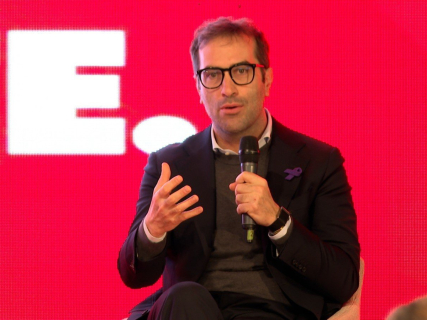










The first vice president of the Government and minister of Economy, Trade and Enterprise, Carlos Cuerpo, has urged this Wednesday to go to the polls "with enthusiasm" to back the socialist project, which he has said "does a lot of good for people" and which looks at the citizen "from below".
Cuerpo delivered this message during his speech at the breakfast organized by the PSOE under the title 'Present and future of the Spanish economy', where he supported the PSOE’s top candidate for Toledo to the Congress of Deputies, Milagros Tolón.
"It gives me a lot of enthusiasm to be able to keep going with a project that I believe does a lot of good for people. A project that focuses on and is centered on progress, but always looking at the citizen from below," he said, stressing that there are still "many measures" to be applied and "many" achievements to be reached.
Therefore, he defended that it is worth continuing to support the socialist proposal. "I am doing it and I hope that the citizens will do it on the 29th so that we can keep facing the challenges and so that they trust that we can help them to manage everything that comes and to continue making progress and improving, which is what we want."
Along these lines, he claimed that "we have a project that can provide peace of mind and that can manage to provide opportunities with enough confidence and optimism in people". As he explained, in his travels around the country he perceives "a lot of enthusiasm, a lot of optimism and a lot of desire" that he takes from each place he visits, so he considers that "on the 29th, yes, it can be done".
"There’s no comparison" between models
At another point in his speech, the minister called for the need to confront political models, assuring that "there is no comparison" between one and the other, and lamenting the "noise" that, in his view, dominates Spanish political life. He said that "citizens are concerned about employment, housing, well-being and public services and, however, in Congress these issues were not asked about and were not discussed".
"In the end we all have to think about why it wasn’t of interest to talk about this kind of things, which are about day-to-day living, but it did interest people the continuous noise," he said, defending that "the answer is clear" because when policies aimed at improving the day-to-day lives of citizens are addressed, it is essential to compare models, and "when we start contrasting models there is no comparison".
For this reason, the first vice president of the Government and head of the Ministry of Economy considers that this is the debate that must be entered into because it is, “undoubtedly, a winning discussion” for the PSOE.
The action of the Government and pensions
Body has contrasted the socialist approach with that of the opposition on matters such as inflation and the use of public resources, defending that the Executive is managing to bring economic growth to the population. However, it has admitted that “we have not reached the point where we want to be and it is necessary to keep betting on a policies agenda that what it is achieving is to keep growing and protecting.”
When referring to the pension system and public services, he has stressed that this is “an essential issue” in which “two very different models” can be seen. Regarding pensions, he has recalled that the Government promoted in 2021 and 2023 the reforms necessary to guarantee their sustainability “and so that we can continue updating pensions with prices, which is what we are going to do again when we know the specific reference,” scheduled for this Friday.
“Beyond the fact that they have brought the discussion about the system, we do not know what the other model proposes regarding pensions, except for some brushstrokes that they would then withdraw, for example the possible privatization of part of the system or the so-called mixed systems, where in the end there is a part that is savings by the worker themselves, beyond the public part,” he added.
As for public services, he has highlighted that the increase in the State’s revenues ends up affecting the autonomous communities, while he has criticized that some of them devote those resources to lowering taxes in a regressive manner instead of using them to strengthen public healthcare, reduce waiting lists, or bolster public education.
Impact of immigration on the economy
Finally, he has focused on the migration issue to argue that immigration has a positive effect on the Spanish economy. As he has recalled, the data from the Bank of Spain indicate that it accounts for between one third and one quarter of the country’s per capita product, in addition to contributing to improving tax collection, “since most of the immigrants who come are working practically from day one.”