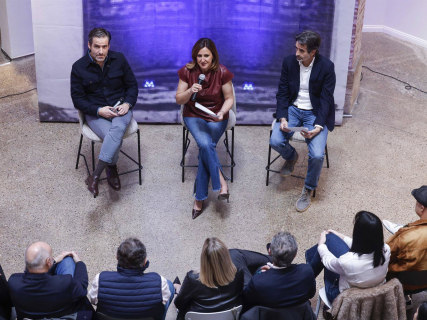

The vice secretary of Culture and spokesman of the PP, Borja Sémper, has reiterated that he does not share the existence of bans “in anything, for nothing and never, in any area of life and even less in politics,” and has defended the need to “widen the spaces of freedom” in the cultural sphere, in all directions, “to the left and to the right.” “Culture has to discomfort,” he stressed.
The “popular” leader made these statements to the media after taking part this Monday in València in a meeting with representatives of the cultural sector, a date which, according to the PP, brought together more than 70 professionals “from all areas.” The meeting was also attended by the mayor of València and head of the PP’s list for the Congress for the province, María José Catalá, and other party officials, in a context marked by debate over Vox’s ideological veto in aid for cinema.
Sémper explained that the PP proposes a conception of culture that “can be combined in many subjects, but above all in many ways.” In his view, “it is about playing in terms of freedom and transgression. Culture has to discomfort. Cultural institutions have to discomfort, mind you, to the left and to the right. Here an unspoken clause does not work among certain left-wing policies that accept culture as long as it gives me the reason. No, no, freedom. And widen the spaces of freedom.”
Asked whether the PP would be willing to cede the Ministry of Culture to Vox after the elections if it needed a pact to govern, the vice secretary of Culture has appealed to “humility” and “prudence,” and has asked to wait “for the Spanish to vote on November 29 before distributing ministries.”
He has reiterated that “I do not give up, I don’t have to do it and I’m not going to do it here, in the ambition that the PP has an absolute majority or has an extraordinary result that allows us to govern alone. Now, they will also understand that I also reject that rule by virtue of which the Partido Popular can only govern when it has an absolute majority.”
On this line, Sémper has insisted that the 'popular' party aims for "a sufficient majority that allows us to govern on our own", although he has clarified that, "evidently", they are not "condemned to govern only with an absolute majority". He has recalled that "we will have to reach agreements with other political formations, as happens in other places in Spain where we have offered stability and good governance".
The PP moves its cultural program to the sector
Regarding the meeting with cultural agents, the PP's deputy secretary for Culture has said that the election campaign "has its best and worst moments and this is one of those very nice ones because talking about culture is talking about something very positive that we all need". He has admitted that "I know there is people, I don't know if many, who despise cultural policies", and he has replied: "Probably, if something is important in a country, besides the economy, industry, education, security, it is culture."
"Today we have come to share this with cultural sectors, with the heterogeneity of the cultural sectors there are in the city of València and with the enormous drive that culture has in València. And it is something we want to exemplify as well in order to talk about the change we need in Spain, which has to do with the substance and has to do with the form", he indicated.
In this sense, he has set as a goal "to get Spain to work again" and that public policies "are useful for citizens". "We have to make sure that politics becomes something that citizens feel reassured and recognized by again," Sémper highlighted, lamenting that in recent years "unfortunately this does not happen". To reverse this situation, he has defended the need to "change the style and the way we speak and address people".
He has claimed that "we have to start talking with respect again and make sure people feel respected. Politics has to talk to people and not to voters", and he has assured: "The cultural revolution we propose for Spain is to have a Government president who governs for everyone". Therefore, "with all humility, but with all determination", he has requested the vote "so that the substance of the policies and the form changes".
Sémper has guaranteed that the PP will offer citizens, "in addition to good managers, people who dedicate themselves to a good destination of public money" and a president like Alberto Núñez Feijóo who will govern "for everyone, for those who have voted for him and for those who have not" and who is going to "bring Spaniards together again." He added that "we are not condemned to live at odds and permanently angry."
"We have the right for politics to stop being a problem. We are not condemned by any divine curse to have politicians, when they go up to the podium, insult those who have not voted for them. And this is the great revolution that we propose, in depth and in form," he defended, encouraging support for Catalá to "open a new stage in Spain, bright and one of hope." In his view, "we have to talk about hope and joy, not so much about how we hit it off with one another."
Commitment to Valencian culture
For her part, the mayor of València and head of the PP list for Congress for the province, María José Catalá, has defined the meeting with cultural representatives as a "statement of intent": "We want Spain to move from fights to admiring art, culture, and to think of culture as a fundamental element of progress in our country."
Among the "key lines" of the PP's electoral programme in cultural matters, she has cited taxation, the reform of the patronage law, and the development of a "better" law on historical heritage. She has also mentioned the intention to reach "all areas" of cinema, "not only to help with creation, but also even to promote diffusion," as well as boosting the musical sphere "as something fundamental to our Valencian culture."
With regard to art, she has denounced the "grievance that we Valencians feel" when the General State Budgets assign to the Palau de Les Arts de València, "the third opera center in this country," barely 2.5 million euros, while the Teatro Real in Madrid exceeds 11.5 million, a difference that she has described as "so abyssal." She also recalled that the city "only" has a headquarters for a state museum, the Museo Nacional de Cerámica.
"That distance between the Ministry of Culture and the culture of this land makes us stand up and, obviously, commit ourselves to ensure that the next Government of Spain, which for us should be the PP, highlights Valencian culture as a fundamental element and, above all, bets on improving the support, coordination and momentum in Valencian culture", she has stated.
As a result, Catalá has advanced that the PP has committed to carrying out a forthcoming evaluation with the cultural sector and has taken note of the demands that were put forward to the 'popular' representatives during the meeting. "Cultural policy is built hand in hand with the sectors", she has stressed.
Catalá, focused on the Mayoralty of València
In another vein, when asked about Sémper's words, who described her as a "magnificent" Minister of Culture in a hypothetical Feijóo Government, Catalá has reiterated that her goal is still the City Council of València. She has recalled that she has said "always" that she wants to be mayor of València: "I will stand for election in May to continue and I am delighted to be mayor of València".
However, she has underlined that at this meeting she has committed with the Valencian cultural sector to "assert and demand" its position "in the ministries that I hope the PP governs and, above all, before the Government of Spain, because I believe Valencian culture deserves to take a step and a leap in quality".