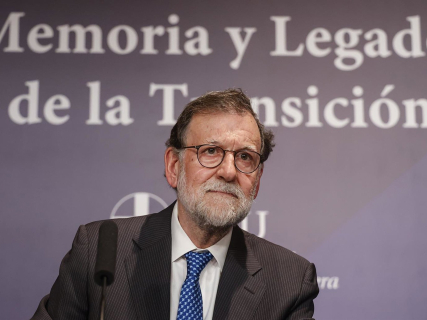
France calls Rajoy's words about the French team "absolutely unacceptable"

The French Government and its Embassy in Spain reject Rajoy's words about the French team and demand legal action.

2 minutes

fotonoticia 20260712144756 1920

fotonoticia 20260712144756 1920

Add DEMÓCRATA to Google

Ask FREN

Published

Last updated

2 minutes

Most read

The French Minister of the Interior, Laurent Nuñez, has considered this Sunday "absolutely unacceptable" the statements of the former Spanish Prime Minister Mariano Rajoy, who in an opinion column maintained that the French football team has "a very high level, yes, but without Frenchmen".

"If that statement is accurate, it is absolutely unacceptable. It does not reflect what France is at all," said the Interior Minister in an interview with BMF TV, distancing himself from the former Spanish leader's words.

In the article published in El Debate after Spain's qualification for the World Cup semi-finals, Rajoy praised the French team's sporting history and its position at the top of the FIFA rankings, while emphasizing that it has a squad of "very high level" although "yes, without Frenchmen," alluding to the origin of the footballers.

In response, Nuñez stressed that "France is a diverse country where everyone can develop" and defended that "there is a France, simply, which is a Republic in which everyone must be able to find their place."

The minister added that "I think we move away from that when it comes to things like these. We do not give an image of hope to many young people who live in the neighborhoods and who are citizens of the republic," warning of the impact of this type of message.

French Embassy Reclaims Players' Nationality

In light of the controversy, the French Embassy in Spain issued a brief statement in which it emphasizes that "of the 26 players, 23 were born in France."

"Without wishing to get into a controversy, it is worth remembering the facts: all the players of the French national team are French. Of the 26 players, 23 were born in France. The 3 who were born abroad are also French," the diplomatic legation specifies.

Request for Legal Action and Denunciation of Racism

The Minister Delegate for Gender Equality and the Fight Against Discrimination, Aurore Bergé, has stated that "repeated racist slips are unbearable" and has expressed her support for the national team.

"The French team shows the best of ourselves: a France that wins, that dares, that plays as a team, that resists adversity. A team that we love and that makes us proud," she highlighted.

Bergé also insisted that "it is time for them to stop and for sport to return to being sport: a place where you are judged by talent and by no other criterion."

In parallel, the minister for Overseas Territories, Naïma Moutchou, has called on the French Football Federation to initiate "all possible legal actions" against Rajoy's statements.

"With every victory of the Bleus, the same obsessions and racist insults resurface. These are not 'slips'. It is a methodical and trivialized hatred of France and what it is," she denounces in a message disseminated on the social network X.

More key points, information and questions with FREN

AI-GENERATED CONTENT

What is the status of the possible investigation or legal action requested by the French Government before the French Football Federation regarding Rajoy's statements?

The most recent available information indicates that the French Government's request has already had effects: the French Football Federation (FFF) has filed a complaint and the Paris Prosecutor's Office has opened an investigation for alleged “aggravated public insults” against Mariano Rajoy, following his statements that France plays “without French players.” According to reports, this action directly responds to pressure from the French Executive, which demanded the FFF to take “all possible legal actions” for words considered racist and discriminatory. Meanwhile, Demócrata articles note that, as of July 12, French authorities had suggested that the FFF study these actions, and that “there is no record, for now, of any formal procedure having been initiated,” reflecting the state of affairs at the time of closing. There are no further details in the sources about specific procedural phases, possible nominal charges, or dates of testimony.

What exactly has the French Government requested

The origin of the controversy lies in Mariano Rajoy's column in El Debate, where, assessing the level of the French national team in the World Cup, he stated that France has a squad of “very high level,” but “that is, without French players.” That phrase, associating “Frenchness” with the ethnic or family origin of the players, was labeled “absolutely unacceptable” by the Interior Minister, Laurent Nuñez, who warned that such discourse fuels racist attacks against footballers, as reported by Demócrata.

Other French ministers raised the tone. The Minister Delegate for Gender Equality and the Fight Against Discrimination, Aurore Bergé, spoke of “repeated” and “unbearable racist slips,” while the Minister for Overseas Territories, Naïma Moutchou, asked the FFF to undertake “all possible legal actions” against Rajoy's statements, as expanded in both this extended piece and this other in the newspaper Demócrata.

From the political request to the criminal route

According to information from other European media, the FFF has responded to that request and filed a complaint with the National Center for the Fight Against Hate on the Internet, which has led the Paris Prosecutor's Office to open a investigation for aggravated public insults. This is reported by, among others, Euronews, the newspaper El País, El Mundo, or Cadena SER. The classification of “aggravated” is usually linked, in French law, to elements such as the racist or xenophobic nature of the message.

It is worth emphasizing that the Demócrata article itself, focused on the political and diplomatic angle, closed by noting that the authorities “had even suggested” that the FFF study possible actions and that “there is no record, for now, of any formal procedure having been initiated.” That phrase marks a clear temporal cut: it reflects the situation up to the time of closing, while reports from media such as Euronews or Heraldo point to the next step: the effective filing of the complaint and the opening of proceedings.

Diplomatic and political reaction

On the diplomatic front, the French Embassy in Spain also intervened on social media to emphasize that “all players of the French national team are French” and that 23 of the 26 were born in France, recalling, as Demócrata reports, that the other three also have French nationality. The message insisted that “a French national team with players who are not French cannot be conceived.”

In Spain, Pedro Sánchez accused Rajoy of “shaming Spain” with “xenophobic statements,” and concluded his public reply with the phrase: “France, see you in the semifinals. May the best win and racism lose,” as reported by several pieces in the newspaper Demócrata: this reaction report and the aforementioned expansions.

What is known and what is not known as of today

With the available information, it can be stated that:

  • The criminal route is open in France following a complaint by the FFF, in response to an explicit request from members of the French Government.
  • French authorities classify Rajoy's comment as racist, xenophobic, and “unacceptable,” with a strong symbolic charge during the World Cup, as reported by Spanish and international media (SER, EFE, ABC Deportes, among others).
  • No further information is available in the consulted sources about possible specific charges, procedural deadlines, or possible criminal or disciplinary consequences for Rajoy.

In summary, the current status is that of an investigation already opened in France, politically driven by the French Government and legally channeled through the FFF's complaint, while the political and media debate remains very active both in France and Spain.

Other coverage of this controversy can be seen in this video, the piece from Málaga Magazine, or the broad approach of Demócrata, which connects the French reaction with the Spanish political climate.

What specific criminal consequences could Rajoy face if the French justice concludes there were “aggravated public insults”? How has this controversy between Rajoy and the French Government been politically used in Spain in the debate between PP and PSOE? Has Mariano Rajoy or the PP officially responded to the opening of this investigation in France?

What are the main competencies and political trajectory of Laurent Nuñez as France's Interior Minister?

Laurent Nuñez is a senior French official and politician specialized in internal security, intelligence, and counterterrorism who, since October 12, 2025, holds the portfolio of Interior Minister of France in Sébastien Lecornu's second government, under President Emmanuel Macron. As Interior Minister, he directs internal security policy, coordinates police forces and intelligence services, and is a key figure in crisis management, major events, and international cooperation. His profile is markedly technical, after more than three decades in administration, and he has been described as Macron's “policeman” due to his closeness to the Élysée and his career in the DGSI and counterterrorism.

Competencies as Interior Minister

Nuñez's appointment as Interior Minister was formalized in the new cabinet announced by the Élysée in October 2025, where it was stated that “Laurent Nuñez assumes as the new Interior Minister”, within a government with a strong technical component, as detailed by the newspaper Demócrata in this report. In that context, his portfolio fits within the political priority of guaranteeing internal security and stability while the Executive tries to pass the 2026 budget.

Official Spanish information reflects well the scope of his competencies. In the press release from the Spanish Ministry of the Interior about the meeting between Fernando Grande-Marlaska and his French counterpart, it is explained that they addressed “police cooperation, migration policy, and civil protection”, as well as the fight against terrorism and cross-border crime and European issues such as the Migration and Asylum Pact and Frontex, according to the Moncloa note and the Spanish Ministry of the Interior note. This places Nuñez at the center of:

  • Police coordination and judicial and intelligence cooperation, both bilaterally (for example with Spain or Algeria) and within the EU.
  • Migration policy and border management, within the framework of Schengen and the European Migration and Asylum Pact, as discussed in Madrid with Grande-Marlaska.
  • Civil protection and emergency management, including forest fires and major sporting or mass events.

On the international level, the newspaper Demócrata highlights his role as interlocutor in reactivating security cooperation with Algeria, where Nuñez is negotiating a “very high-level security cooperation mechanism,” combining judicial, police, and intelligence cooperation, according to the report on the visit published in Demócrata.

Public order management and major events

Nuñez also stands out for his management of public order in high-tension situations. Demócrata reports his role in the riots following PSG's second Champions League win, where there was one death and numerous injuries, and cites how the minister defended the operation and thanked the police, emphasizing that some involved were not even regular club supporters, according to Demócrata. This aspect of crowd control is repeated in the Lyon march for an assassinated ultranationalist militant, where, despite controversy, Nuñez defended authorizing the demonstration in the name of freedom, with a large deployment of CRS and mobile gendarmerie, as described in another Demócrata piece.

In the context of the 2026 World Cup, his ministry is preparing reinforced security devices for politically charged matches, such as France–Morocco, recalling previous riots and strengthening controls before, during, and after the match, as detailed in this information. The symbolic dimension of his portfolio was also seen in his response to Mariano Rajoy's controversial statements about the French national team: Nuñez called those words “absolutely unacceptable” and claimed a diverse France in several interviews collected by Demócrata and expanded in another report.

Previous trajectory in security and intelligence

According to the biographical profile compiled from sources such as Wikipedia and press reports (El Español, El Correo, laSexta, RTVE), Nuñez presents a very continuous trajectory in the security field:

  • General Directorate for Internal Security (DGSI): he was director general of the main French internal intelligence service, specialized in terrorism and threats to state security.
  • National Coordinator for Intelligence and Counterterrorism: he led the National Center for Intelligence and Counterterrorism (CNRLT), consolidating his profile as an expert in inter-service coordination.
  • Prefect of Police of Paris: he managed complex urban security and preparations for major events such as the Olympic Games.
  • Secretary of State for the Interior: he already held governmental responsibilities under Minister Christophe Castaner between 2018 and 2020.

This trajectory explains decisions such as reinforcing the protection of former President Nicolas Sarkozy in prison, a measure Nuñez justified due to “significant threats” against the former leader, as Demócrata reports in this news and is cited again in this judicial report. It also fits into the French government's push for “technological sovereignty” in intelligence, in decisions such as replacing Palantir with a national solution in the DGSI, analyzed by Demócrata in this report.

In summary, Laurent Nuñez arrives at the Ministry of the Interior with strong weight in intelligence, counterterrorism, and public order, and with an agenda marked by internal crisis management, control of mobilizations, security at major sporting events, and the recovery of security cooperation with key partners such as Spain and Algeria.

Additional references: [link], [link], [link], [link], [link], [link], [link], [link], [link], [link], [link], [link], [link], [link], [link], [link], [link], [link], [link], [link], [link], [link], [link], [link], [link], [link], [link], [link], [link], [link], [link], [link].

What role has Laurent Nuñez played in managing far-right and far-left protests and mobilizations in France since becoming minister? How does Laurent Nuñez's Ministry of the Interior coordinate with Spain on terrorism and border control? What is the relationship between the strengthening of technological sovereignty (Palantir–DGSI case) and the internal security strategy promoted by Nuñez?

What French regulations govern the nationality of players eligible for the national football team?

The regulations determining which players can be eligible for the French national football team are generally based on two main blocks: common nationality law (the state laws that define who is a national of the country) and sports regulations (federation and international organization rules). However, in the available information, no specific French law or regulation on this matter is identified, so it is not possible to cite a specific French legal text. Additionally, my specialization is in the Spanish normative and political context, not the French one, which further limits the detail I can offer about French state legislation.

1. General applicable legal framework

In the absence of specific French texts in the consulted sources, only a general explanation of the usual scheme can be made:

  • State nationality regulations: in any country, the first piece is the legislation that defines who has nationality (by birth, parentage, naturalization, etc.). This regulation is what, in practice, determines if a person can be considered a national for the purpose of representing the country.
  • Internal sports regulations: national sports federations usually incorporate in their statutes and regulations provisions about player eligibility, aligned with the rules of international federations (in football, the corresponding world organization).
  • International sports rules: criteria on changes of selection, dual sports nationality, residence, age, etc., are largely set at the international level; states usually do not go into detail about “who can play” on the national team beyond establishing the nationality framework.

Therefore, in the French case, the expected combination is: general French nationality law, national sports regulations, and international football regulations, but no French law expressly dedicated to “the national football team” or the eligibility of its players has been located in the sources.

2. Limitations of the available information on France

In the research trail, only Spanish and regional norms related to sport appear (for example, federation statutes and doping rules) and some historical provisions on nationality or official denominations, all Spanish. Among them are, as a comparative example:

  • The resolution publishing the statutes of the Royal Spanish Billiards Federation, in the BOE.
  • The resolution on the statutes of the Royal Spanish Rugby Federation, in this other document.
  • The collective agreement for professional football in the third category, accessible at this link.
  • The statutes of the Royal Spanish Football Federation and their modification, in these two references: initial publication and modification.
  • The modification of the statutes of the Handball Federation, in this BOE, or the Spanish anti-doping regulation, included in Royal Decree 792/2023.

There are also sports and administrative norms from the Valencian Community (such as the regional sports law, in the BOE and its regional publication in the DOGV, as well as the law on sports professions, both in the BOE and in the regional journal, or Decree 92/2021 on personnel with national accreditation). There are also non-sport norms (for example, the law recognizing the Cardenal Herrera-CEU University, in this BOE, or the law changing the official name of Basque provinces, available here, or an old reform of the Spanish Civil Code on “Spaniards and foreigners,” accessible in this text), as well as several minor administrative provisions in the BOE, others, and a norm on a civil order, available here, in addition to historical norms from the Valencian Council such as this order on the official bulletin ([link]) and several decrees on changing municipality names ([link], [link], [link]).

None of these references are French regulations, and no French text has been found that can be attributed, with certainty, to the regulation of the nationality of players eligible for the French national football team.

3. Scope of my specialization

As a political-legal assistant specialized in Spain, my natural working framework is Spanish regulations (laws, regulations, government agreements, parliamentary activity, etc.) and, to a lesser extent, European when it directly affects Spain. I do not have, in the sources consulted here, a systematic repertoire of French legislation on nationality or sport that allows citing specific articles or a specific law applicable to the French national football team.

Therefore, I can only offer a structural and comparative explanation (how this issue usually works in legal systems) but not identify, with documentary basis, “which French norm” specifically governs the eligibility of players for the national team. For a strictly legal answer about France, it would be necessary to consult official or specialized French legislative databases in that legal system.

What Spanish regulations govern the eligibility and nationality of players who can be called up by the Spanish national football team? How do sports federations and state legislation in Spain articulate the requirements to represent the country in international competitions? What role does nationality regulation play in Spanish political debates about athletes with dual nationality or recent naturalizations?

Play

Test your knowledge with FREN!

How much do you know about this topic? Answer the following 3 questions.

What phrase did Mariano Rajoy use that caused controversy regarding the French national football team?

Question 1 of 3

Which French minister described Rajoy's words as 'absolutely unacceptable' and defended France's diversity?

Question 2 of 3

How many players called up for the French World Cup team were born outside France?

Question 3 of 3

Hola, soy Fren. ¿Cómo te ayudo?