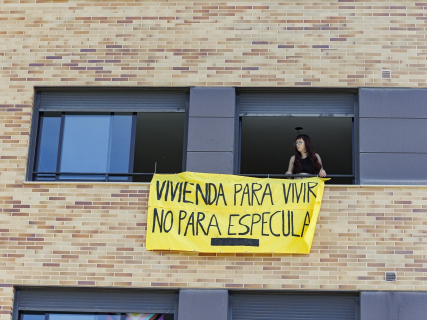
The Government has approved the new State Housing Plan 2026-2030 with 7 billion euros and permanent protection of the public housing stock. A package of measures, which the president of the populares, Alberto Núñez Feijóo, has branded an "absolute and complete failure".
For the opposition leader, the Government has turned housing into a luxury good in its eight years in office. "A Housing Plan, eight years after arriving at La Moncloa. Another housing plan," he pointed out on the same day that Congress debates the consideration of the Bill of Measures for Urban Development and Housing. An initiative that, according to the Popular Group, has been blocked by Francina Armengol for a year.
The opposition counterattacks
With its bill, the PP seeks to capitalize on discontent over rent and tries to position itself as an alternative in a context of scarce supply and growing social concern about housing.
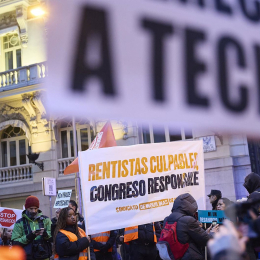
The text that Congress votes on at the last minute to reform the Land Law, opts for unlocking housing and avoiding "cascade nullity". In this sense, it opts for streamlining land developments, limiting the total annulment of plans due to formal defects, and reducing administrative blockages.
The focus is also on increasing the stock of affordable public housing, on rehabilitation, on mobilizing vacant stock, on boosting access for young people, and on the rural world.

The PP's plan can be summarized in eleven ideas:
- Reports within the deadline to avoid blockages
- State centralization of urban planning reports
- Faster permits: silence becomes positive
- End of cascading nullities of urban planning
- Urban planning rulings with solutions and not blockages
- End of abusive urban planning challenges
- Procedural reforms to provide stability to the system
- Recovery of urban planning powers
- Repeal of rent-controlled market areas
- End of interventionism in rental prices
- End of impunity for 'squatting'
The Government's Numbers
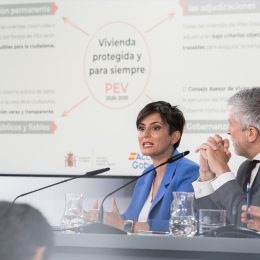
For its part, the Executive continues to present the housing problem as a capital axis of its policy and with this plan it intends to silence social and opposition criticism about the lack of action.
Featured story
The numbers of the new Housing Plan: 7 billion to expand the affordable housing stock
3 minutes
Co-financing. The mobilized investment foreseen amounts to 7,000 million euros, of which 60% will be assumed by the General State Administration, conditioned on the autonomous communities assuming the remaining 40%.
New housing. The plan provides aid of up to 85,000 euros per dwelling for the construction of public housing or housing under public-private partnership.
Land development. Financing of development works to mobilize housing when there is at least 40% of protected housing, with up to 8,000 euros per future protected housing.
Industrialized construction. Additional aid of up to 8,500 euros per dwelling when industrialization techniques are used, which would raise the total coverage aid to 93,500 per new dwelling when it is built with industrialized methods.
Tense areas. The construction of new housing in tense areas will have an additional aid of 8,500 euros, so financing could reach 102,000 euros in case industrialization methods are used.