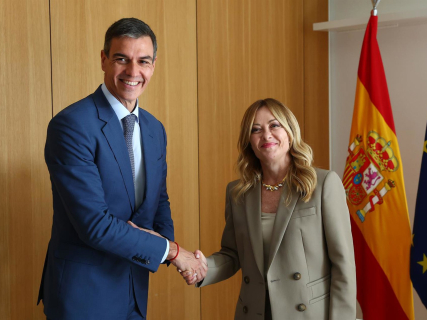
Spain gives Italy until Sunday to restore Schengen and warns of reprisals if Meloni does not yield.

Spain demands that Italy lift the Schengen controls now and warns of proportional measures if Meloni does not rectify before Sunday.

1 minute

fotonoticia 20260807130332 1920

fotonoticia 20260807130332 1920

Add DEMÓCRATA to Google

Ask FREN

Published

Last updated

1 minute

Most read

The Spanish Government has demanded that Italy immediately lift the suspension of the "Schengen area" decreed after the migratory crisis in Ceuta more than a week ago, and has set a deadline of two days, until Sunday, August 9, for it to do so. Otherwise, "Spain will be forced to adopt proportional measures to protect the interests and dignity of its citizens."

Government sources have urged Giorgia Meloni's Executive to rectify as soon as possible, to "end the controls and treat Spaniards like the rest of European citizens."

According to the account of the Spanish Government, on August 1, Italy reintroduced "border controls with Spain," which has affected "the mobility of thousands of passengers and generated legal insecurity during the summer period."

In Moncloa, they have emphasized that this decision has been applied "without precedent in recent history," in addition to being taken "without prior notice, unilaterally, and with spurious arguments that do not conform to either the Schengen Border Code or the truth." They have reiterated that "it is unjust, contrary to the interests of the EU, and discriminatory towards the Spanish population."

The Executive has stressed that Meloni overlooks that none of the migrants who entered irregularly in Ceuta last week "could or can enter freely into the Schengen area because the autonomous city" has "a special regime within it." They have also pointed out that the "vast majority" of irregular migrants "have already returned to Morocco."

As the President of the Government, Pedro Sánchez, has already pointed out, the same sources have indicated that Italy is, according to Frontex, the "member state that has recorded the most irregular crossings in recent years, with figures that have reached double those of Spain" and that its Executive, since 2022, "does not comply with the Dublin Regulation, generating an additional burden of migratory pressure on the rest" of European partners.

With all this, the Spanish Government has defended that "it has never introduced controls for Italy and has always shown solidarity," welcoming "part of the migrants who arrived in Lampedusa in 2023 and opening its ports recurrently to migrants who are rescued on the central Mediterranean route."

More key points, information and questions with FREN

AI-GENERATED CONTENT

What parliamentary procedures or processes are necessary for a Member State to reintroduce border controls within the Schengen area?

The reintroduction of controls at Schengen internal borders is, legally, a decision of the national executive power within the framework of EU law, while the role of Parliament depends on the internal legal system of each State. The Schengen Borders Code foresees different scenarios (foreseen threat, urgency, and "exceptional circumstances"), but does not impose a uniform parliamentary procedure. In practice, Parliaments usually intervene through prior authorization only in very intense or prolonged cases, and more generally through subsequent political control (debates, questions, appearances). Below are the typical models of parliamentary intervention in each scenario, in a general and theoretical way.

General framework: Executive, Parliament, and Schengen

In all Member States, the immediate competence to activate controls lies with the Government (or a competent minister), because it concerns border management and internal security. The Schengen Borders Code requires:

  • That the measure be exceptional, limited in time, and proportionate to a serious threat.
  • That the State notify and justify the decision before the EU institutions and the other Member States.

What the Code does not do is define how the national Parliament must participate: this is determined by the Constitution, emergency or internal security laws, and parliamentary regulations. This is where the classic parliamentary control over Government action fits: authorization, validation, or at least information and accountability.

1. Foreseen and temporary serious threat

When the risk to public order or security is foreseeable (for example, a major event, an anticipated increase in migratory flows, or a non-immediate terrorist risk), the national procedure is usually the most "orderly" and allows greater parliamentary intervention. The most common theoretical models are:

  • Formal prior authorization: the internal law of some States requires that, before reintroducing controls for a relevant period (for example, more than a few days or weeks), the Government requests parliamentary authorization. Parliament debates the existence of the threat, the proportionality of the measure, and its maximum duration.
  • Implicit authorization or extension control: the Executive can adopt the first decision without authorization but needs Parliament's approval for successive extensions or to exceed a certain time threshold.
  • Prior information and subsequent political control: in other systems, the Government is only obliged to inform Parliament (through written communication or committee appearance) before or immediately after notifying the EU, and control is exercised via questions, interpellations, or motions.

In all these schemes, compatibility with the Schengen Code is guaranteed because the Government remains the body that decides and notifies the EU, but it does so within an internal framework in which Parliament can limit the duration, request corrections, or even force the withdrawal of the measure through political decisions (for example, a motion withdrawing support for the control policy).

2. Immediate emergency situation

When the threat is immediate and unforeseen (attack, sudden crisis in a neighboring country, abrupt entry of people at a specific point), the Code allows activating controls very quickly. In these cases, almost all national models agree in granting the Executive a margin of decision without prior authorization but with ex post control mechanisms:

  • Direct government decision: the Government or competent minister orders the controls and notifies the EU institutions with shortened deadlines.
  • Subsequent parliamentary ratification or debate: the decision is later submitted to Parliament, either for formal validation (similar to urgent decrees) or at least for a dedicated debate in plenary or committee.
  • Intensive use of control instruments: oral and written questions, appearances by Interior or Foreign Affairs officials, and in extreme cases, interpellations that may lead to motions of censure or no confidence.

The key to compatibility with Schengen is that parliamentary control must not prevent the Executive's rapid reaction to the emergency but subject it afterwards to political and legal scrutiny, including the possibility of shortening or not renewing the controls.

3. Exceptional circumstances and risk to the overall functioning of Schengen

The Code foresees a third level, linked to exceptional circumstances that threaten the functioning of the Schengen area as a whole (for example, a large-scale migratory or health crisis). Here, intervention can be more intense on both levels:

  • At the EU level: European institutions can issue recommendations or decisions conditioning the duration, intensity, or coordination of controls. The European Parliament exercises political control over the Commission and the States through resolutions, debates, and questions, although it does not authorize the specific national measure case by case.
  • At the national level: it is common for internal regulations to require a more robust basis, such as the declaration of emergency situations, which do pass through Parliament (prior authorization, extension, or ratification). In these scenarios, border controls are integrated into a broader package of security or crisis measures.

In this context, national Parliaments can decisively condition the continuity of controls, either by approving or rejecting prolonged extensions, demanding exit plans, or linking their support to guarantees on fundamental rights.

Specific parliamentary control instruments

Regardless of the scenario (foreseen threat, urgency, or exceptional circumstances), Parliaments have a battery of instruments applied to the control of border controls just like any other security policy:

  • Oral and written questions addressed to the Government about the reasons, duration, risk assessment, and economic and social effects of the controls.
  • Appearances of the competent minister and police or administrative officials in interior, foreign affairs, or European affairs committees.
  • Interpellations and motions that allow guiding Government policy, urging it to lift or modify controls.
  • Investigative committees in case of abuses, serious effects on rights, or coordination failures.

Thus, although the Schengen Borders Code places the immediate decision in the hands of the Executive, the internal constitutional design can make it so that, in practice, no prolonged or controversial reintroduction of controls escapes parliamentary scrutiny, whether through authorization, validation, or intense subsequent political control.

In which specific cases have national Parliaments blocked or limited extensions of border controls within Schengen? What are the main differences between the parliamentary control exercised by a State like Spain and that of other Schengen partners when reintroducing border controls? How is the political control of the European Parliament coordinated with that of national Parliaments when several States activate controls simultaneously?

What are the powers and functions of the President of the Government of Spain according to the Constitution, and which party does Pedro Sánchez lead?

The Spanish Constitution precisely establishes the role of the President of the Government, but in the information available from the consulted sources, there is no concrete and literal breakdown of his powers and functions. Therefore, only a very general explanation can be offered, and it must be noted that the legal details directly derived from the constitutional text are missing. However, it is clearly stated that Pedro Sánchez Pérez-Castejón is currently the President of the Government of Spain and that he leads the political party PSOE (Spanish Socialist Workers' Party). Below is, on one hand, a contextual explanation and, on the other, the available data about Pedro Sánchez's leadership.

Limitations on the powers of the President of the Government

The question focuses on the powers and functions of the President of the Government "according to the Constitution." However, in the available research, only detailed information about the functions of the President of the Congress of Deputies (the highest authority of the Lower House) has been found, which is not the same position nor the subject of the inquiry. That information describes tasks such as representing the Congress, directing parliamentary debates, convening sessions, and safeguarding the Chamber's documents, but it refers exclusively to the internal scope of the Legislative Power and cannot be extrapolated to the President of the Government.

Since no summary or specific list of constitutional articles related to the President of the Government has been located in the sources, there is no sufficient documentary basis to detail, in a legally precise manner, his powers regarding:

  • Political leadership of the Executive and Government action.
  • Relationship with ministers and the rest of the Cabinet.
  • Relationship with the Cortes Generales (Congress and Senate).
  • Relationship with the Crown (the King as head of State).
  • Other institutional functions and general Government responsibilities.

In an ordinary analysis, this type of response would be supported by a direct reading of the corresponding constitutional articles and, if applicable, basic development norms. However, the applied methodological rules prevent incorporating legal content not explicitly recorded in the available sources. Therefore, it must be warned that a systematic and verified list of the President of the Government's powers extracted directly from the Constitution cannot be offered here.

In summary, regarding this first part of the question, it can only be affirmed that the Constitution configures the President of the Government as the central figure of the Executive Power in Spain, but without detailing article by article or breaking down specific functional categories, since that information does not appear in the consulted materials.

Party led by Pedro Sánchez

Regarding the second part of the question, the sources are clear and complete. From Pedro Sánchez Pérez-Castejón's political profile, it is evident that:

  • He has been the President of the Government of Spain since June 2018.
  • His parliamentary group in Congress is the Socialist Parliamentary Group.
  • His "agroupation" (political party) is the PSOE, acronym for Spanish Socialist Workers' Party.

Additionally, the brief available biography indicates that Pedro Sánchez is an economist and doctor, born in Madrid in 1972, and that he has been leader of the PSOE since 2014 (with a brief internal hiatus in the party). From the Presidency of the Government, he has led different coalition governments: first with Unidas Podemos and later with Sumar, facing a legislature marked by crises such as the COVID‑19 pandemic, inflation, and the territorial issue in Catalonia.

The same profile notes that, as president, his institutional position is located in the Presidency of the Government, where he holds the role of "President" within that body. This dual condition — leader of the main Government party (PSOE) and head of the Executive Power — is consistent with the Spanish parliamentary model, in which the President of the Government is usually also the top leader of the majority party in the governing coalition.

Therefore, directly answering the second question: the party led by Pedro Sánchez is the Spanish Socialist Workers' Party (PSOE), while he serves as President of the Government of Spain.

Can you detail, article by article, what the Constitution exactly says about the President of the Government? What role does the President of the Government have in his relationship with the Congress and the Senate, beyond what the Constitution generally establishes? How has Pedro Sánchez's leadership influenced the strategy and political position of the PSOE since 2014?

What legal requirements must a country meet to temporarily suspend the application of the Schengen Borders Code?

A Member State can only temporarily re-establish controls at Schengen internal borders in exceptional cases of serious threat to public order or internal security, following a strict procedure and limits set out in the Schengen Borders Code. The measure must be proportionate, a last resort, and limited in time and space. Additionally, there is a duty of notification and coordination with the European Commission and other Member States, and the decision is subject to political and judicial control. Below are the main legal requirements.

Enabling scenarios

The Schengen Borders Code (SBC) distinguishes several scenarios in which reintroducing controls at internal borders is allowed:

1. Foreseeable threat to public order or internal security
  • Cause: a serious threat identified in advance (for example, major sporting events, international summits, elevated risk of terrorism or serious disturbances).
  • Legal basis: articles on temporary re-establishment of controls in foreseeable cases (public order and internal security).
  • Exceptional nature: the absence of controls at internal borders is the rule; their re-establishment is the exception.
2. Urgent need (immediate threat)
  • Cause: sudden appearance of a serious threat requiring immediate action (for example, a recent terrorist attack or intelligence about an imminent risk).
  • Special regime: reintroduction of controls without the usual advance notice is allowed but still subject to requirements of justification, proportionality, and rapid notification.
3. Exceptional circumstances in the Schengen area
  • Cause: serious and persistent deficiencies in controlling an external border that globally risk Schengen's functioning (for example, a State's inability to effectively control a critical external border).
  • Particularity: activating this scenario usually involves an EU-level recommendation or proposal and more intense coordination among States.

Material requirements: necessity, proportionality, and non-discrimination

For the measure to be valid, the State must justify that:

  • There is a serious and concrete threat, described in sufficient detail (nature of the risk, probability, impact).
  • The measure is necessary: no less restrictive alternatives exist (enhanced police cooperation, mobile internal controls, selective surveillance, etc.) that can address the risk.
  • The measure is proportionate in:
    • Geographical scope (only necessary crossings or sections, not the entire territory unless indispensable).
    • Intensity of controls (no more intrusive than strictly necessary).
    • Duration (no longer than needed to address the threat).
  • There is no discrimination based on nationality or other prohibited grounds; controls must apply to all persons crossing the border, respecting fundamental rights and asylum rules.

Procedure, deadlines, and notifications

1. Reintroduction in case of foreseeable threat
  • Initial duration: normally up to 30 days or for the expected period of the threat if shorter.
  • Extensions: successive extensions may be agreed, but the SBC sets a maximum cumulative limit (in this ordinary regime, up to 6 months).
  • Prior notification: the State must notify the Commission, other Schengen States, and the European Parliament with minimum advance notice (for example, 4 weeks when possible), explaining:
    • Detailed reasons for the measure.
    • Territorial scope (which borders or crossings will be affected).
    • Expected duration and intensity of controls.
    • Impact assessment on free movement.
  • Consultation: the Commission and other States may make observations; the State must consider them, although the formal decision belongs to it.
2. Reintroduction in case of urgency
  • Immediate application: the State may reintroduce controls without respecting the advance notice period.
  • Duration: initially limited (for example, up to 10 days), with the possibility of short extensions, not exceeding a stricter maximum (usually up to 2 months total in this urgent regime).
  • Rapid notification: must be communicated to the Commission and other States as soon as possible, with justification of the urgency.
3. Measures in prolonged exceptional circumstances
  • Reinforced procedure: usually requires an EU-level assessment of external border control deficiencies and may involve Council recommendations, on the Commission's proposal.
  • Longer time limits: the set of extensions in this regime can reach up to 2 years, but under continuous supervision by the Commission and the Council.

Institutional and judicial control

The re-establishment of controls is not discretionary in an absolute sense but subject to several controls:

  • European Commission control: reviews the notification, may issue opinions, request clarifications, and if it considers the mechanism is abused or the SBC violated, initiate infringement proceedings.
  • Political control: the European Parliament can debate the issue and demand explanations; other Member States can raise objections in the Council.
  • Judicial control: national courts and the Court of Justice of the EU can examine the measure's compatibility with EU law (for example, in appeals against specific decisions taken at the border).

In summary, to effectively "suspend" the ordinary free movement regime at a Schengen internal border, a country must demonstrate a serious threat, respect the principles of necessity and proportionality, comply with the strict deadlines of the Schengen Borders Code, and submit to intense transparency and supervision by EU institutions and other Member States.

What recent examples are there of States that have temporarily re-established controls at Schengen internal borders and with what legal justification? How does the reintroduction of controls at internal borders by other Schengen States affect citizens and residents in Spain? What role does Spain play in European debates on reforming the Schengen Borders Code and the use of these temporary controls?

Play

Test your knowledge with FREN!

How much do you know about this topic? Answer the following 3 questions.

What is the main demand that Spain has made to Italy regarding border controls?

Question 1 of 3

What argument does the Spanish Government use to consider Italy's measure unjustified?

Question 2 of 3

What action has Spain announced if Italy does not rectify before the established deadline?

Question 3 of 3

Hola, soy Fren. ¿Cómo te ayudo?