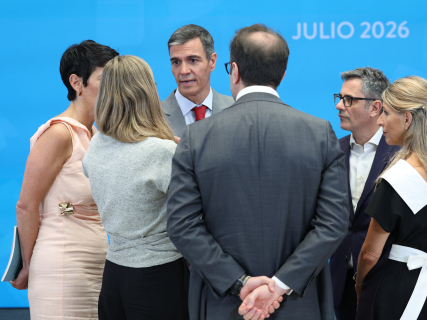

The parliamentary vacation of the Government of Pedro Sánchez comes to an end with a institutional pulse opened with the Senate. The Popular Party has demanded the appearance of several ministers to explain the migration crisis in Ceuta, but the Executive has decided to take its explanations to Congress and has announced that its members will appear there on August 25.
The problem is that the Upper Chamber has already set its own appearances.
The Government maintains that the ministers will give explanations before Congress and considers that this route allows addressing the situation jointly. But the Senate is also one of the two Chambers of the General Courts and has its own mechanisms of parliamentary control.
The question that now arises is simple to formulate: can a minister unilaterally decide not to attend the Senate because he plans to appear later in Congress?
The Regulations of the Upper Chamber establishes an express obligation to appear. And what the Senate Regulations particularly state is that it obliges ministers to appear. The central regulation is found in the article 66 of the Senate Regulations.
Its first section establishes that the commissions can agree to the appearance of members of the Government on their own initiative or at the request of a parliamentary group. The request is processed through the Presidency of the Senate.
But the second section is the one that acquires special importance in the current conflict. The current wording states that members of the Government and other authorities and officials of the Public Administrations are obliged to appear before the commissions and their bodies.
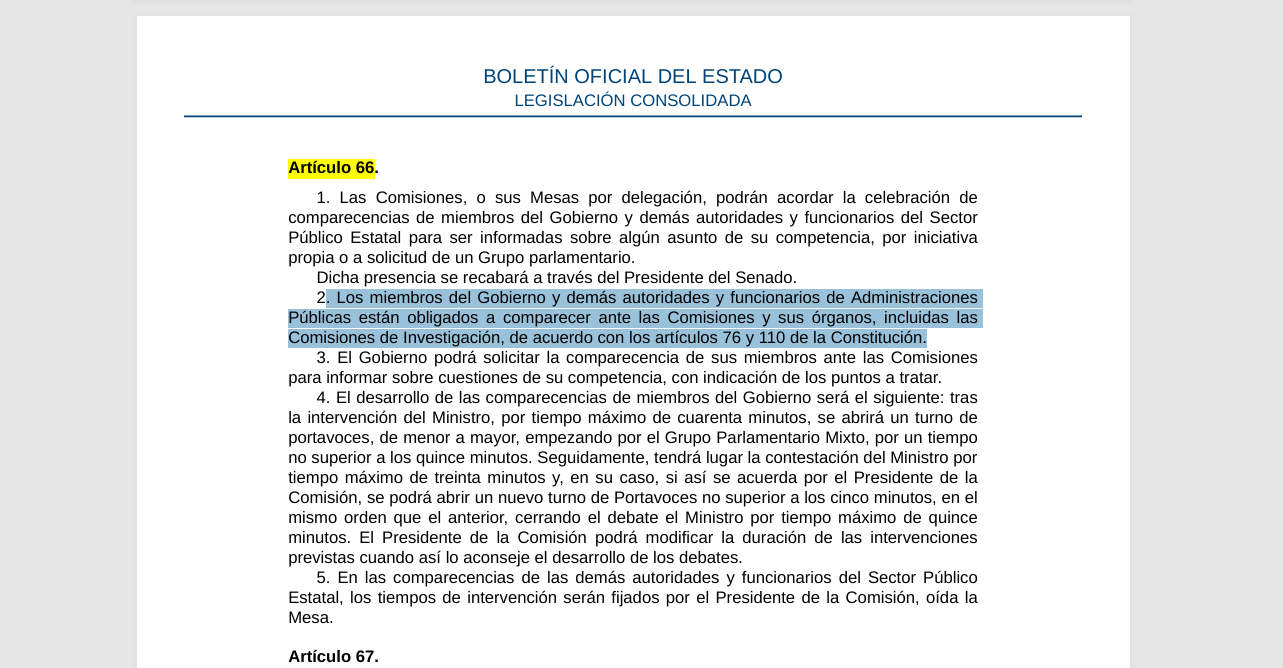
The modification of this precept came into force in November 2025. Therefore, the debate is not limited to determining whether it is more convenient for the Government to explain the crisis in Congress or in the Senate. These are different issues.
One thing is that the Executive prefers to concentrate its explanations in one Chamber. Another, that it can replace at its own decision a hearing requested by the Senate with another later in the Congress, because the Regulation, according to our regulations, does not establish that possibility of unilateral replacement.
Why does the Government want to wait until August 25?
The explanation of the Executive involves concentrating the hearings in the Congress. In fact, and at the proposal of the Government, the ministers Fernando Grande-Marlaska, Margarita Robles, José Manuel Albares, and Félix Bolaños are called to explain different aspects related to the crisis in Ceuta before the Lower House on August 25.
But the chosen date introduces a relevant element. The hearings requested by the Senate occur beforehand. And between both appointments there are 23 days, practically, in the final stretch of the August holidays.
In ordinary circumstances, a difference of three weeks could be a simple matter of parliamentary calendar. But according to political sources, the situation in Ceuta does not respond to an ordinary scenario, since the migration crisis has placed the Spanish border with Morocco at the center of the political and security agenda and, the Security Forces also maintain under surveillance the possibility of new attempts to enter.
That is why the PP considers it insufficient for the Government to send the explanations to the Congress within three weeks.
The unknown of August 15
To this parliamentary issue is added another circumstance. On social media, messages have circulated pointing to August 15 as a possible date for a new attempt at mass entry into Ceuta.
The existence of those messages does not mean that a new avalanche will necessarily occur. It also does not allow knowing in advance its magnitude. But it does constitute an element of vigilance for the Security Forces and adds uncertainty to the coming weeks.
And there appears one of the reasons why the opposition demands explanations before August 25, asking among certain questions, what information does the Government handle? What measures has it adopted? What coordination does it maintain with Morocco? or, what forecasts exist regarding possible new attempts to enter?
The discussion now is whether the Government can choose when and before which Chamber to do so.
The precedent of Sánchez and Óscar Puente
The current confrontation does not start from scratch. The Government of Pedro Sánchez already starred in a similar episode with the Senate. When the Upper Chamber requested the appearance of the president of the Government, Sánchez did not attend and the Executive sent in his place the then Minister of Transport, Óscar Puente.
The episode generated a conflict between the Government and the Senate that ended up reaching the Constitutional Court. At that time, the Upper Chamber raised a conflict between constitutional organs considering that the president's absence had prevented the exercise of its control functions.
The Plenary of the Constitutional Court admitted that conflict for processing in May 2026. However, the admission decision does not imply that the Constitutional Court has resolved that the Government violated the Constitution, since, as is known in legal jargon, the substance of the matter still needs to be resolved.
But it does set an immediate institutional precedent: the Senate has already gone to the Constitutional Court to defend its capacity for control against a Government's refusal to appear.
What can happen if the ministers do not go?
This is where the current episode can become complicated. If the ministers summoned by the Senate decide not to attend and the Chamber understands that the Government has failed to fulfill its obligation to appear, the parliamentary groups can raise the corresponding parliamentary and institutional actions.
The most relevant avenue, in light of Sánchez's precedent, would be for the Senate to consider that there is a constitutional conflict and go again to the Constitutional Court.
This does not mean that the absence of a minister automatically triggers a criminal, administrative, or economic sanction. Nor does it mean that the Constitutional Court will necessarily resolve in the same way that the Senate demands.
What does exist is an institutional mechanism for the Chamber to defend its competencies if it considers that the Executive is preventing its control function. And that possibility gains special relevance because the Senate's Regulations now contain an express formulation that endorses that, the members of the Government are obliged to appear.
The Senate is not a secondary chamber
The substance of the conflict transcends the crisis in Ceuta.
The Senate is part of the General Courts along with the Congress of Deputies. The Constitution assigns parliamentary functions to both Chambers and, in its article 110, establishes that the Chambers and their committees can demand the presence of members of the Government.
Therefore, if the Executive considers it more convenient to appear before Congress, it can politically defend that position. What is under discussion is whether that preference allows it to ignore a formal summons from the Upper House.
The answer does not solely depend on the will of the Government. It depends on the constitutional and regulatory framework that governs the relations between the Executive and the Courts.
A new institutional pulse in the midst of a crisis
The situation places the Government before a decision it already knows.
It can go to the Senate and explain there the management of the Ceuta crisis, in addition to doing so later in Congress. Or, it can maintain its decision to concentrate the explanations in the Lower House and assume that the Upper House formally questions that refusal.
The second option would open a new institutional front. And the precedent of Sánchez and Puente shows that it would not be a merely political conflict between the Government and the opposition. The Senate has already brought a similar case before the Constitutional Court.
Meanwhile, the border continues under surveillance and August 15 appears as a marked date in the messages spread on networks, although a new massive entry cannot be considered certain.