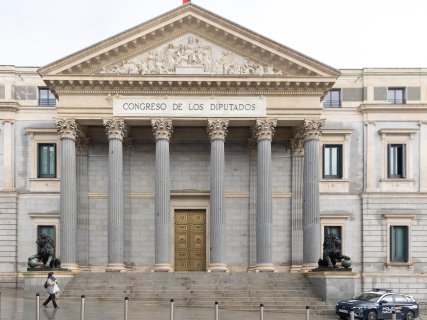

The Congress will host this Wednesday an act of remembrance for the victims of Francoism on the occasion of the Day of Remembrance and Tribute to the Victims of the Military Uprising, the Civil War and the Dictatorship, which is observed every October 31, and it will do so now without the paintings of the presidents of the Francoist Cortes in the gallery of the Palace.
The ceremony had been scheduled for the previous Wednesday, but the sinister rail accident that occurred in Urda (Toledo) on that same day forced the postponement of the call.
The president of the Congress, the Socialist Francina Armengol, will lead the tribute, which will begin at five in the afternoon in the Hall of Lost Steps. There, she will deliver an opening speech before giving way to a discussion between the historians and researchers María Rosón Villena and Sescún Marías Cadenas.
This edition will pay tribute to "Las rapadas" of Fuendejalón (Zaragoza), an episode of Francoist repression in which 39 women were taken from their homes, shaved and exhibited through the streets as punishment and humiliation for their status, ideology or family and political ties. The figure of the republican mayor of that municipality, María Domínguez, also will be evoked, who was executed by Francoist troops.
Remembrance of "Las rapadas"
The event will close with a puppet theatre performance, "Melón pelado", by the company ButacaZero, written by Esther Fernández Carrodeguas and directed by Xavier Castiñeira, as reported to Europa Press by parliamentary sources.
The main novelty this year is that this tribute to the victims of the civil war and the dictatorship will be carried out with the portraits of the presidents of the Francoist Cortes already removed from the gallery of the Congress. It was a demand repeatedly made for years by nationalist parties and left-wing forces that the PSOE has now decided to accommodate.
This is how the agreement approved last day 13 in the Congress Board is implemented, with the backing of PSOE and Sumar and the abstention of the PP.
The paintings that have been taken down correspond to Esteban de Bilbao y Eguía (1943-1965), Antonio Iturmendi Bañales (1965-1969) and Alejandro Rodríguez de Valcárcel y Nebreda (1969-1975), who presided over the Cortes during the dictatorship. The portrait of Torcuato Fernández Miranda is kept, however, since he is considered one of the driving forces behind the dissolution of those Francoist Cortes and the political reform that opened the Transition.
A historic request from the 1990s
The withdrawal of these portraits was first proposed in the 1990s by the PNV deputy Iñaki Anasagasti and, since then, has been claimed by Bildu and various left-wing formations, appealing to the memory of the victims of the regime.
In 2023, Bildu managed to force a vote to remove these paintings and also those of Manuel Fraga, former Francoist minister and one of the “fathers” of the Constitution. However, the proposal was rejected by PSOE, PP and Vox, which argued that the Congress portrait gallery was not subject to the Memory Law because it was not a public space and because it did not include military personnel or ministers directly linked to repression, who are the ones the law mentions.
More recently, the Association for the Recovery of Historical Memory (ARMH) sent a formal request to the President of the Congress in order to demand the removal of these portraits, even raising the possibility of taking legal action for violation of the Memory Law.
Toward a Congress “free of Francoist symbols”
Up to now, the PSOE’s position had been refusal or silence, but this time, with the Cortes dissolved, it has accepted the initiative driven by the representative of Sumar on the Permanent Deputy Commission Board, Esther Gil de Reboleño.
With the removal of these paintings, in addition to complying with the Law on Democratic Memory and leaving the Congress “free of Francoist symbols,” the door is opened to incorporating, when appropriate, the portraits of the former President of Congress Meritxell Batet and of Armengol herself, as well as of the future presidents elected during the democratic period.