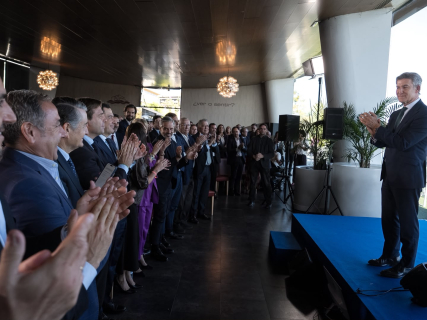
This is Feijóo’s industrial strategy: tax incentives, competitive energy, and a fast track for large investments

The PP proposes a favorable tax treatment for seven years for strategic technology projects, to simplify the obligations of companies with up to 250 workers, and to speed up industrial investments that generate at least one hundred jobs

feijoo andalucia

feijoo andalucia

Add DEMÓCRATA to Google

Ask FREN

Published

10 minutes

Most read

Hasta el día de las elecciones (29 de noviembre) se muestran los resultados de las elecciones generales anteriores, las del 23 de julio de 2023.

Resultados de las elecciones generales del 29N en directo

Elecciones generales del 23 de julio de 2023 · Congreso de los DiputadosSenado

Escrutado: 100,00 %Votantes: 24.952.447Participación: 66,59 %

Votos

PartidoEscañosVotosPorcentaje
PP1378.160.83733,06 %
PP: 137 escaños. Se presenta con estos nombres:
  • PARTIDO POPULAR (PP)131 escaños
  • PARTIDO POPULAR / PARTIT POPULAR (PP)5 escaños
  • PARTIT POPULAR / PARTIDO POPULAR (PP)1 escaño
PSOE1217.821.71831,68 %
PSOE: 121 escaños. Se presenta con estos nombres:
  • PARTIDO SOCIALISTA OBRERO ESPAÑOL (PSOE)85 escaños
  • PARTIT DELS SOCIALISTES DE CATALUNYA (PSC-PSOE)19 escaños
  • PARTIDO DOS SOCIALISTAS DE GALICIA-PSOE (PSdeG-PSOE)7 escaños
  • PARTIDO SOCIALISTA DE EUSKADI-EUSKADIKO EZKERRA (PSOE)5 escaños
  • PARTIDO SOCIALISTA DE ISLAS BALEARES-PSOE (PSIB-PSOE)3 escaños
  • PARTIDO SOCIALISTA DE NAVARRA-PSOE (PSN-PSOE)2 escaños
Vox333.057.00012,38 %
Sumar313.044.99612,33 %
Sumar: 31 escaños. Se presenta con estos nombres:
  • SUMAR10 escaños
  • SUMAR - EN COMÚ PODEM (SUMAR - ECP)7 escaños
  • SUMAR ANDALUCÍA (SUMAR)5 escaños
  • COMPROMÍS - SUMAR: SUMEM PER GUANYAR (SUMAR - COMPROMÍS)4 escaños
  • SUMAR GALICIA (SUMAR)2 escaños
  • SUMAR CANARIAS (SUMAR)1 escaño
  • SUMAR ARAGÓN1 escaño
  • SUMAR MÉS (MÉS PER MALLORCA-MÉS PER MENORCA-SUMAR)1 escaño
ERC7466.0201,89 %
Junts7395.4291,60 %
EH Bildu6335.1291,36 %
EAJ-PNV5277.2891,12 %
BNG1153.9950,62 %
CCa1116.3630,47 %
UPN152.1880,21 %
PACMA0169.2370,69 %
PACMA: 0 escaños. Se presenta con estos nombres:
  • PARTIDO ANIMALISTA CON EL MEDIO AMBIENTE (PACMA)0 escaños
  • PARTIT ANIMALISTA AMB EL MEDI AMBIENT (PACMA)0 escaños
CUP-PR099.6440,40 %
FO046.2740,19 %
NC-bc045.5950,18 %
PDeCAT-E-CiU032.0160,13 %
RECORTES CERO023.4210,09 %
PUM+J023.2900,09 %
PUM+J: 0 escaños. Se presenta con estos nombres:
  • POR UN MUNDO MÁS JUSTO (PUM+J)0 escaños
  • POR UN MUNDO MAIS XUSTO (PUM+J)0 escaños
  • BIDEZKO MUNDURANTZ (PUM+J)0 escaños
U.P.L.023.2010,09 %
EXISTE020.4400,08 %
EXISTE: 0 escaños. Se presenta con estos nombres:
  • TERUEL EXISTE - COALICIÓN EXISTE (EXISTE)0 escaños
  • ARAGÓN EXISTE - COALICIÓN EXISTE (EXISTE)0 escaños
PCTE013.3820,05 %
GBAI099380,04 %
SY096970,04 %
Adelante091910,04 %
JM+082930,03 %
ESCAÑOS EN BLANCO079860,03 %
XAV073620,03 %
BQEX058070,02 %
CJ056200,02 %
FE de las JONS046830,02 %
PAR041730,02 %
PCTC038750,02 %
ESPAÑA VACIADA031580,01 %
PH029020,01 %
ASTURIAS EXISTE EV023140,01 %
XH019310,01 %
VP019170,01 %
Zsi018430,01 %
VB017740,01 %
POR MI REGIÓN016980,01 %
AHORA CANARIAS-PCPC016740,01 %
PARTIDO AUTÓNOMOS014460,01 %
EVB014420,01 %
CpM012980,01 %
JxG012180,00 %
EV-PCAS-TC011840,00 %
PREPAL09640,00 %
Somos Cc09630,00 %
ALM08740,00 %
PCTG07020,00 %
F.I.A.05060,00 %
3e04840,00 %
Ud.Ca04630,00 %
ESCONS EN BLANC04620,00 %
GITV03660,00 %
PUEDE02690,00 %
EVC02650,00 %
LB02630,00 %
PCTE/ELAK02590,00 %
UNIDOS SI02530,00 %
+RDS+01650,00 %
CCD01530,00 %
FUERZA CÍVICA01150,00 %

Los partidos que se presentan con varios nombres van juntos: pasa por encima del ? para ver el detalle. Porcentajes sobre votos válidos. Resultados definitivos del 23J de 2023.

Escaños (350)

Mayoría: 176
PP: 137 escaños en 2023 (PARTIDO POPULAR: 131; PARTIDO POPULAR / PARTIT POPULAR: 5; PARTIT POPULAR / PARTIDO POPULAR: 1)PSOE: 121 escaños en 2023 (PARTIDO SOCIALISTA OBRERO ESPAÑOL: 85; PARTIT DELS SOCIALISTES DE CATALUNYA (PSC-PSOE): 19; PARTIDO DOS SOCIALISTAS DE GALICIA-PSOE: 7; PARTIDO SOCIALISTA DE EUSKADI-EUSKADIKO EZKERRA (PSOE): 5; PARTIDO SOCIALISTA DE ISLAS BALEARES-PSOE: 3; PARTIDO SOCIALISTA DE NAVARRA-PSOE: 2)Vox: 33 escaños en 2023Sumar: 31 escaños en 2023 (SUMAR: 10; SUMAR - EN COMÚ PODEM: 7; SUMAR ANDALUCÍA: 5; COMPROMÍS - SUMAR: SUMEM PER GUANYAR: 4; SUMAR GALICIA: 2; SUMAR CANARIAS: 1; SUMAR ARAGÓN: 1; SUMAR MÉS: 1)ERC: 7 escaños en 2023Junts: 7 escaños en 2023EH Bildu: 6 escaños en 2023EAJ-PNV: 5 escaños en 2023BNG: 1 escaño en 2023CCa: 1 escaño en 2023UPN: 1 escaño en 2023137121333120232023
  • PP 137
  • PSOE 121
  • Vox 33
  • Sumar 31
  • ERC 7
  • Junts 7
  • EH Bildu 6
  • EAJ-PNV 5
  • BNG 1
  • CCa 1
  • UPN 1

Simulador de Pactos

Pulsa los partidos para sumar sus escaños.Abrir el Simulador de Pactos

Los escaños más ajustados

Quién tiene el último escaño, quién le sigue y los votos que le faltan
  1. GironaJxCAT - JUNTSyPP285 votos

    El último escaño de Girona (el 6.º) es para JxCAT - JUNTS. Le sigue el PP, que necesitaría 285 votos más para quitárselo. Ver Girona ›

  2. CantabriaVOXyPP403 votos

    El último escaño de Cantabria (el 5.º) es para VOX. Le sigue el PP, que necesitaría 403 votos más para quitárselo. Ver Cantabria ›

  3. TarragonaJxCAT - JUNTSyPSC1247 votos

    El último escaño de Tarragona (el 6.º) es para JxCAT - JUNTS. Le sigue el PSC, que necesitaría 1247 votos más para quitárselo. Ver Tarragona ›

  4. AlbacetePSOEyVOX1412 votos

    El último escaño de Albacete (el 4.º) es para el PSOE. Le sigue VOX, que necesitaría 1412 votos más para quitárselo. Ver Albacete ›

  5. SalamancaPPyPSOE1495 votos

    El último escaño de Salamanca (el 4.º) es para el PP. Le sigue el PSOE, que necesitaría 1495 votos más para quitárselo. Ver Salamanca ›

Ver todas las provincias y el mapa

Provincias donde el último escaño cambiaría de manos con menos votos, con lo escrutado hasta ahora. Pulsa una para ver el detalle.

Senado

100,00 % escrutado
PartidoSenadores
PP120
PSOEPSOE: 73 senadoresSe presenta con estos nombres:
  • PSOE48
  • PSC12
  • PSdeG-PSOE4
  • PSE-EE (PSOE)4
  • PSN-PSOE3
  • PSIB-PSOE1
  • PSOE-SUMAR-EUIB-ARA EIVISSA1
73
EH Bildu4
EAJ-PNV4
ERCERC: 3 senadoresSe presenta con estos nombres:
  • ERC-ESQUERRES PER LA INDEPENDÈNCIA2
  • ERC1
3
Junts1
UPN1
A.H.I.1
ASG1

Los partidos que se presentan con varios nombres van juntos: pasa por encima para ver el detalle. Baleares y Canarias eligen sus senadores por islas.

Senadores (208)

Elegidos en las urnas
PP: 120 senadores en 2023PSOE: 73 senadores en 2023 (PSOE: 48; PSC: 12; PSdeG-PSOE: 4; PSE-EE (PSOE): 4; PSN-PSOE: 3; PSIB-PSOE: 1; PSOE-SUMAR-EUIB-ARA EIVISSA: 1)EH Bildu: 4 senadores en 2023EAJ-PNV: 4 senadores en 2023ERC: 3 senadores en 2023 (ERC-ESQUERRES PER LA INDEPENDÈNCIA: 2; ERC: 1)Junts: 1 senador en 2023UPN: 1 senador en 2023A.H.I.: 1 senador en 2023ASG: 1 senador en 20231207320232023
  • PP 120
  • PSOE 73
  • EH Bildu 4
  • EAJ-PNV 4
  • ERC 3
  • Junts 1
  • UPN 1
  • A.H.I. 1
  • ASG 1

Los senadores designados por los parlamentos autonómicos no se eligen en las urnas.

Mapa

Ganador por provincia

    CanariasCeutaMelillaAraba/Álava: PSE-EE (PSOE) 27,7 %Albacete: PP 39,9 %Alicante/Alacant: PP 36,7 %Almería: PP 40,9 %Ávila: PP 43,3 %Badajoz: PSOE 39,2 %Illes Balears: PP 35,6 %Barcelona: PSC 35,7 %Burgos: PP 40,6 %Cáceres: PSOE 38,9 %Cádiz: PP 34,8 %Castellón/Castelló: PP 35,2 %Ciudad Real: PP 40,5 %Córdoba: PP 37,9 %A Coruña: PP 43,1 %Cuenca: PP 39,8 %Girona: PSC 28,9 %Granada: PP 37,0 %Guadalajara: PP 36,3 %Gipuzkoa: EH Bildu 31,2 %Huelva: PP 36,4 %Huesca: PP 38,2 %Jaén: PP 37,3 %León: PP 36,9 %Lleida: PSC 29,5 %La Rioja: PP 45,6 %Lugo: PP 50,2 %Madrid: PP 40,6 %Málaga: PP 38,3 %Murcia: PP 41,2 %Navarra: PSN-PSOE 27,4 %Ourense: PP 50,0 %Asturias: PP 35,7 %Palencia: PP 42,0 %Las Palmas: PSOE 33,2 %Pontevedra: PP 39,7 %Salamanca: PP 46,9 %Santa Cruz de Tenerife: PP 35,4 %Cantabria: PP 42,1 %Segovia: PP 45,0 %Sevilla: PSOE 36,6 %Soria: PP 37,2 %Tarragona: PSC 32,9 %Teruel: PP 35,0 %Toledo: PP 37,8 %Valencia/València: PP 33,6 %Valladolid: PP 40,8 %Bizkaia: EAJ-PNV 26,9 %Zamora: PP 44,7 %Zaragoza: PP 36,0 %Ceuta: PP 38,8 %Melilla: PP 49,2 %

    Pulsa una provincia para ver sus resultados y elegir municipio.

    Mapa

    Partido con más senadores por provincia

    CanariasCeutaMelillaAraba/Álava: PSOE, 3 de 4 senadoresAlbacete: PP, 3 de 4 senadoresAlicante/Alacant: PP, 3 de 4 senadoresAlmería: PP, 3 de 4 senadoresÁvila: PP, 3 de 4 senadoresBadajoz: PSOE, 2 de 4 senadoresIlles Balears: PP, 3 de 6 senadoresBarcelona: PSOE, 3 de 4 senadoresBurgos: PP, 3 de 4 senadoresCáceres: PP, 2 de 4 senadoresCádiz: PP, 3 de 4 senadoresCastellón/Castelló: PP, 3 de 4 senadoresCiudad Real: PP, 3 de 4 senadoresCórdoba: PP, 3 de 4 senadoresA Coruña: PP, 3 de 4 senadoresCuenca: PP, 3 de 4 senadoresGirona: PSOE, 3 de 4 senadoresGranada: PP, 3 de 4 senadoresGuadalajara: PP, 3 de 4 senadoresGipuzkoa: EH BILDU-INDEPENDENTZIA EZKERRETIK, 3 de 4 senadoresHuelva: PP, 2 de 4 senadoresHuesca: PP, 3 de 4 senadoresJaén: PP, 3 de 4 senadoresLeón: PP, 3 de 4 senadoresLleida: PSOE, 3 de 4 senadoresLa Rioja: PP, 3 de 4 senadoresLugo: PP, 3 de 4 senadoresMadrid: PP, 3 de 4 senadoresMálaga: PP, 3 de 4 senadoresMurcia: PP, 3 de 4 senadoresNavarra: PSOE, 3 de 4 senadoresOurense: PP, 3 de 4 senadoresAsturias: PP, 3 de 4 senadoresPalencia: PP, 3 de 4 senadoresLas Palmas: PSOE, 4 de 5 senadoresPontevedra: PP, 3 de 4 senadoresSalamanca: PP, 3 de 4 senadoresSanta Cruz de Tenerife: PSOE, 3 de 6 senadoresCantabria: PP, 3 de 4 senadoresSegovia: PP, 3 de 4 senadoresSevilla: PSOE, 3 de 4 senadoresSoria: PP, 3 de 4 senadoresTarragona: PSOE, 3 de 4 senadoresTeruel: PP, 3 de 4 senadoresToledo: PP, 3 de 4 senadoresValencia/València: PP, 2 de 4 senadoresValladolid: PP, 3 de 4 senadoresBizkaia: EAJ-PNV, 3 de 4 senadoresZamora: PP, 3 de 4 senadoresZaragoza: PP, 3 de 4 senadoresCeuta: PP, 2 de 2 senadoresMelilla: PP, 2 de 2 senadores

    Pulsa una provincia para ver sus senadores y candidatos.

    Resultados definitivos de las elecciones generales del 23 de julio de 2023 (Ministerio del Interior). Mapas: Instituto Geográfico Nacional (es-atlas, CC BY 4.0). Demócrata.

    Alberto Núñez Feijóo wants to place the recovery of industrial competitiveness among the economic priorities of his Government if he manages to reach La Moncloa after the general elections of 29N. His strategy involves reviewing business taxation, reducing administrative barriers, guaranteeing energy supply, attracting technological investments, and making it easier for small and medium-sized enterprises to grow.

    The Popular Party candidate renews this commitment in the exclusive interview granted to DEMÓCRATA, published last Friday, in which he advances an urgent plan to solve within a maximum of 18 months the problems of access to the power grid that condition the rollout of industrial projects, data centers, and other technological investments.

    "Spain must take advantage of its advantages to attract data centers and artificial intelligence projects and other advanced technologies," Feijóo says.

    The main lines of this strategy were announced last July 7 in Bilbao, before the Círculo de Empresarios Vascos. There, the President of the PP identified five areas of action: taxation, legal certainty and administrative simplification, energy, human capital, and making use of the productive capacities of the entire country.

    Since then, the Populars have incorporated a large part of these proposals into their electoral program, La Reconstrucción Nacional, in which they spell out timelines, fiscal instruments, and regulatory changes to favor industrial activity.

    Taxation that incentivizes investment and innovation

    Feijóo commits to reviewing tax increases approved during the governments of Pedro Sánchez and to introducing a package of tax incentives aimed at fostering business investment, research, and technological development.

    The electoral program expressly includes an increase in tax deductions for research and innovation, as well as greater legal certainty in its application. The Populars intend to also simplify the procedures for accessing public aid and facilitate business use of patents developed by public organizations.

    Another of the instruments that the PP wants to strengthen is innovative public procurement. It is a matter of using the contracting capacity of administrations to drive technological solutions developed by start-ups and SMEs, which could find in the public sector one of their first customers.

    In terms of industrial investment, Feijóo had already proposed in June 2025, during a meeting with the automotive sector, to bring Spanish deductions for R&D&i closer to the standards of countries such as Germany and France.

    Making it easier for SMEs to grow in size

    One of the commitments included in the electoral program directly affects the structure of the Spanish business fabric. The PP wants to review the regulatory thresholds that require companies to take on new administrative, labor, or tax burdens when they reach certain dimensions.

    The conservatives propose simplifying the obligations of companies with up to 250 workers and establishing tax, labor, and administrative incentives for those that increase their size.

    In addition, when European regulations allow it, the new requirements associated with business growth would begin to apply once the company has consolidated that growth for four years.

    The proposal does not mean automatically modifying the European definition of an SME, but rather reviewing the obligations established by Spanish legislation and the thresholds from which they become enforceable.

    The goal is to prevent increases in headcount or turnover from discouraging the expansion of companies.

    An examination of productivity for the new laws

    Feijóo also wants to introduce a mechanism for a prior assessment of economic regulations. The PP program includes a productivity test that would make it possible to know, before approving a new regulation, its possible consequences for employment, productivity, and external competitiveness of Spanish companies.

    The results of these evaluations would be public, and any significant negative effects would have to be justified expressly.

    The measure would be complemented by a review of existing regulation and by the elimination of administrative barriers that make it difficult for business activity between autonomous communities.

    In his interview with DEMÓCRATA, Feijóo expressly cites the validity of the licenses throughout the national territory, the responsible declaration and positive administrative silence among the instruments he intends to use.

    The implementation of these measures would require determining which procedures can be simplified and which must retain prior authorizations for environmental, health, safety or other reasons.

    Strategic projects from one hundred jobs

    The electoral program introduces a specific figure to speed up large industrial investments.

    The PP proposes declaring strategic projects of national interest those that generate at least 100 jobs. The initiatives that obtain this consideration would have a single administrative direction, priority processing, and a unified digital procedure for the authorizations that correspond to the General Administration of the State, including environmental ones.

    The planning of their electrical connection must be carried out in six months.

    The conservatives also propose facilitating the availability of industrial land through collaboration with the autonomous communities and town councils, especially in locations close to universities and technological centers.

    The strategy aims to reduce the time that elapses between the business decision to invest and the effective start-up of an industrial installation, although its implementation will depend on the competences of the various administrations and the real availability of infrastructures.

    Seven years of favorable taxation for technological investments

    Another of the instruments the PP includes is the creation of strategic innovation zones to attract investments in sectors with high added value.

    These zones would have available land, access to electrical and digital infrastructures, accelerated administrative procedures, and connections with universities and research centers.

    Artificial intelligence, semiconductors, biotechnology, batteries, and aerospace technology projects could benefit from more favorable tax treatment for seven years.

    The program does not set up these sites as free zones. The benefits would be linked to investment, the hiring of workers, and the development of innovative activities in Spain.

    The PP also wants to promote technologies such as quantum computing, photonics, and sensing, in addition to extending the use of artificial intelligence to the traditional productive fabric.

    To that end, it considers making technological tools, training, advisory support, and protection against cyberattacks available to SMEs. The Conservatives want the Agencia Española de Supervisión de Inteligencia Artificial to also perform business accompaniment functions in the application of the regulations.

    Competitive energy and an 18-month deadline to unlock the grid

    Energy policy is one of the main components of Feijóo’s industrial strategy.

    In the interview with DEMÓCRATA, the popular candidate pledges to draw up an urgent plan to resolve the problems of access to the electrical grid that affect industrial projects, homes, and data centers.

    The electoral program establishes a maximum deadline of 18 months to tackle these obstacles through advance planning of demand, the review of capacity reserved for projects, and the reinforcement of transport and distribution infrastructures.

    The PP also proposes, during the first 1 00 days of Government, to process the extension of the useful life of nuclear power plants, conditioned on compliance with safety requirements and on the Nuclear Safety Council’s statement.

    The Conservatives want to eliminate the 7% tax on the value of electricity production, reduce the costs associated with system adjustment services and promote long-term supply contracts to provide greater stability to electricity prices.

    They also consider strengthening storage, European interconnections, and backup technologies.

    The electro-intensive industry, which includes activities such as steelmaking, metallurgy, and certain branches of the chemical industry, occupies a specific place in this strategy due to the weight electricity has in its production costs.

    Protection of supply chains

    The Conservatives’ industrial strategy also includes measures to reduce Spain’s external dependencies in certain strategic sectors.

    The PP proposes identifying the raw materials and essential components for the functioning of the productive chains, supporting their extraction, transformation, and recycling, and establishing strategic reserves in coordination with European partners.

    The program includes periodically assessing the capacity of supply chains to withstand disruptions and promote domestic production of certain essential goods.

    In the pharmaceutical sphere, the popular party wants to attract the manufacturing of essential medicines to Spain and take into account supply security in public contracting.

    They also propose identifying the dependencies of the agri-food supply chain on fertilizers, seeds, animal feed, and other products needed to guarantee its operation.

    Specialized training and the fight against absenteeism

    Human capital constitutes another of the five axes that Feijóo presented to Basque businesspeople in July.

    The popular party proposes strengthening dual Vocational Training and adapting the educational offering to the needs of sectors such as artificial intelligence, robotics, and biotechnology.

    The strategy also includes attracting researchers and specialized professionals. The electoral program sets a tax rate of 20% for six years for professionals who join major technological projects in Spain.

    In labor matters, the PP proposes reinforcing the resources of Social Security and the role of mutual insurance companies to speed up the management of temporary incapacity, improve the economic protection of people with serious illnesses, and pursue fraud in benefits.

    In addition, it proposes reducing unemployment contributions for companies that maintain a level of staff stability above the average for their sector.

    A specific plan for the automobile industry

    Automotive industry has its own roadmap within the PP’s industrial proposals.

    In June 2025, during the annual meeting of Sernauto, Feijóo presented the lines of a National Automobile Plan aimed at stimulating demand, modernizing industrial facilities, and facilitating the sector’s technological transition.

    Among its proposals are a Renove Plan that includes different engine technologies, discounts applied directly at dealerships, and an exemption from the registration tax for vehicles with Zero and ECO labels.

    The PP also proposes a digital single window to centralize assistance, licenses, and permits for the sector, as well as financing instruments for projects in automation, energy efficiency, and the circular economy.

    Technological neutrality is one of the central elements of this policy. The Popular Party defends maintaining emissions reduction targets, but adapting the pace and instruments of the transition to technological developments, demand, and industrial capacity.

    A strategy that began to take shape with Trump’s tariffs

    Feijóo’s industrial approach has a parliamentary precedent in April 2025, when the United States’ tariff policy led the PP to demand an Industrial Competitiveness Plan from the Government.

    On April 24, the Popular Party registered a non-legislative motion in Congress to urge the Executive to adopt fiscal, energy, and commercial measures aimed at improving the competitive capacity of Spanish companies.

    Among the proposals that Feijóo put forward at the time were the extension of the useful life of nuclear power plants, the elimination of the tax on electricity generation, tax incentives for investment, and the creation of support funds for companies affected by the tariffs.

    In July 2026, before Basque businesspeople, the PP leader expanded that approach until it became a structural industrial competitiveness strategy.

    The presentation of the electoral program on November 10 of last year has allowed some of its instruments to be specified. Others, such as the exact scope of tax benefits, the budgetary resources needed, the territorial distribution of innovation zones, or the financing mechanisms for major investments, will have to be developed if the Popular Party comes to Government.

    Its implementation will require legislative reforms, budgetary decisions, agreements with the autonomous communities, and adapting industrial support measures to European rules on competition and State aid.

    The main measures of the PP’s industrial strategy

    Area of action Measure Specific commitment
    Business growth Simplification of administrative obligations Companies with up to 250 employees
    Business growth Application of new obligations linked to business size Four years of consolidated growth, when allowed by European regulations
    Attraction of talent Tax incentives for professionals linked to major technological projects 20% taxation for six years
    Research and innovation Increase in tax deductions for R&D&i Greater incentives and legal certainty in its implementation
    Technological investments Creation of strategic innovation zones Favorable taxation for seven years
    Large industrial investments Declaration of strategic projects of national interest Projects that generate at least 100 jobs
    Electricity infrastructures Planning for connection of strategic industrial projects Six months
    Access to the electricity grid Urgent plan to unlock industrial investments, homes, and data centers Maximum deadline of 18 months
    Nuclear energy Processing of the extension of the useful life of nuclear power plants First 100 days of Government, subject to safety requirements
    Energy taxation Elimination of the Tax on Value of Electricity Energy Production Suppression of the 7% levy
    Security of supply Update of the operating rules of the electricity system Six months
    Automotive industry Renove Plan with technological neutrality and tax incentives Exemption from the vehicle registration tax for vehicles with Zero and ECO labels

    More key points, information and questions with FREN

    AI-GENERATED CONTENT

    What is the parliamentary status of the economic program 'La Reconstrucción Nacional' of the Partido Popular?

    "La Reconstrucción Nacional" does not have its own parliamentary processing: it is the electoral program of the Partido Popular, not a law pending approval. As of November 28, 2026, there is no record in the consulted sources of an initiative from the Congress or the Senate that processes the document as a whole under that name. Therefore, it is not appropriate to place it in the amendment, committee, voting, or inter-chamber referral phase.

    What document it is and when it was presented

    The PP presented "La Reconstrucción Nacional" on November 10, 2026, at the Espacio Torrelara in Madrid, as the program with which it runs in the general elections of November 29; it was not a formal presentation of a legislative text before the Cortes. (Demócrata, November 10).

    Although the question refers to its economic dimension, the document is broader: it gathers 249 commitments and covers administrative organization, institutions, territorial model, and economic and social policies. (Demócrata, electoral program).

    This distinction is important: a program expresses political commitments, while a parliamentary initiative opens a specific procedure, with a text, procedures, and decisions by the chamber's bodies. The publication or public presentation of the former does not automatically initiate the processing of the contained measures.

    What is its parliamentary status

    Regarding the program considered as a single document, the situation can be summarized as follows:

    • Parliamentary presentation: there is no record of an initiative incorporating it entirely under that title.
    • Admission for processing: there is no record of a decision by the Board of the Congress or Senate opening its joint processing.
    • Amendments and committee: there is no record of an amendment period, a subcommittee, or a report on the complete program.
    • Voting: there is no record of parliamentary approval or rejection of the whole.
    • Application: its publication as an electoral program does not enact its proposals nor modify taxes, benefits, or budgets by itself.

    Therefore, it would also not be accurate to describe it as a blocked, withdrawn, or rejected law. The conclusion is different: a unitary parliamentary procedure whose status can be tracked has not been identified. This does not prove that each individual proposal lacks parliamentary background; the status of each measure must be checked separately.

    What would have to happen to develop it

    The program itself was presented as a roadmap for a possible PP government legislature, with actions that would require legal reforms, parliamentary agreements, or participation of autonomous communities. (Demócrata, program presentation).

    Its development would not necessarily have a single path. Measures requiring law changes should be specified in specific normative texts; budgetary actions would need corresponding decisions on income and expenses; and others could be executed through administrative instruments within applicable competencies. Each action would have its own schedule and, when appropriate, its own parliamentary processing.

    Additionally, the prior announcement of a package of 70 laws, made in July as part of the national reconstruction project, described an agenda for a future term, but did not prove the joint presentation or approval of those laws. (Demócrata, July 13).

    In short: it is politically presented as an electoral program, but there is no record that it is being processed as a single legislative package. To know effective legal advances, the useful reference will be each concrete initiative that materializes its commitments, not the general name of the program.

    What are the legal competencies of the president of the Partido Popular regarding industrial policy according to Spanish legislation?

    In the Spanish legal system, the president of a political party — including the president of the Partido Popular (PP) — does not have legal competencies in industrial policy merely by holding that organizational position. Their powers derive from:

    • What the Constitution and laws establish regarding public offices (Prime Minister, ministers, deputies, etc.).
    • What the internal statutes of the party itself provide, which are private rules, not State laws.

    1. What the Constitution and laws say about parties

    The Spanish Constitution (Article 6) establishes that political parties:

    • Express political pluralism.
    • Participate in the formation and expression of popular will.
    • Are a fundamental instrument for political participation.

    But the Constitution does not assign material competencies (for example, "regulate industrial policy") to parties or their presidents. The competencies in industrial policy are assigned to:

    • The State (Government and General Courts) and the Autonomous Communities, according to the distribution of competencies in the Constitution (arts. 148 and 149 CE) and the Statutes of Autonomy.
    • Specific administrative bodies (for example, a Ministry of Industry or its autonomous equivalent).

    The Organic Law 6/2002 on Political Parties regulates their functioning, internal democratic guarantees, financing, etc., but it also does not grant the president of a party normative or executive power over a specific sector such as industry.

    2. Key difference: party position vs. public office

    The president of the PP may or may not hold public offices (for example, Prime Minister, Minister of Industry, president of an autonomous community, etc.). Here is the key:

    • If only president of the party: their power is political and organizational, not legal-public. They do not sign decrees, issue ministerial orders, or manage public budgets by that fact alone.
    • If they also hold an institutional office (for example, Prime Minister):
      • Their competencies in industrial policy come from that institutional office (Constitution, laws, organic regulations of each ministry or autonomous community).
      • Not from the status of PP president.

    That is, legally the "competence in industrial policy" lies, for example, with the Council of Ministers, the competent Ministry, or an autonomous department, never with the president of a party as such.

    3. What the president of the PP can do in industrial policy (in practical terms)

    Although they do not have direct legal competencies, the president of the PP exercises a decisive influence in industrial policy through several political, not legal, channels:

    • Guide the party's electoral program on industry (reindustrialization, aid, business taxation, energy, etc.).
    • Set the political line of the PP parliamentary group in Congress, Senate, and autonomous parliaments (which bills they present, which amendments they register, how they vote on industrial incentives, aid to specific sectors, etc.).
    • Negotiate agreements with other parties or social agents (employers, unions) on industrial matters, always as a political actor, not as an administrative body.
    • Appoint or influence the appointment of people who will hold public offices with formal competencies (ministers, autonomous counselors, senior industry officials, etc.).

    All these are internal political powers, deriving from the PP statutes, not from general legislation. Their decisions only become legal decisions (laws, decrees, resolutions) when:

    • Public representatives of the party approve them in Parliament, or
    • Government members adopt them as executive decisions (for example, a royal decree on industrial aid).

    4. Partido Popular Statutes

    The PP statutes (internal party rules) may specify:

    • That the president defines the general political line of the party.
    • Their capacity to propose or appoint leaders of sectoral areas, such as the industry head.
    • Their role in the approval of electoral programs and strategies in each public policy area.

    However, these statutes:

    • Are not State laws, but private party rules.
    • Do not grant the president executive powers over public administrations, unless coinciding with an institutional office.

    5. Conclusion

    From the perspective of Spanish legislation, the president of the Partido Popular:

    • Does not have legal competencies in industrial policy by being party president.
    • Their capacity to decide or implement industrial measures comes only from the public offices they may hold (Prime Minister, minister, autonomous president, etc.).
    • Within the PP, they exercise a decisive political leadership over the party's industrial policy orientation, but that influence is organizational and political, not legal.

    In summary: the PP president sets the political position of their party on industrial policy, but the legal competencies to approve and execute that policy reside in State and autonomous community bodies, not in the party's organizational office.

    What specific legal competencies does the Council of Ministers have regarding industrial policy in Spain? How are competencies in industrial policy divided between the State and the Autonomous Communities according to the Constitution and Statutes? What role does the Partido Popular's electoral program play in defining its industrial policy?

    What were the results of the Partido Popular in the last general elections held in Spain?

    The last general elections held in Spain were on July 23, 2023. In them, the Partido Popular obtained 8,091,840 votes, 33.05%, and 137 deputies in the Congress, and was the most voted candidacy. It was therefore 39 seats short of the 176 that mark an absolute majority (results of 23J).

    Main results

    The PP's result can be summarized in three figures, which describe different aspects of its electoral support and parliamentary representation (results of 23J):

    • 8,091,840 votes: was the number of votes its candidacy received across Spain.
    • 33.05% of the votes: approximately one in three valid votes corresponded to the Partido Popular.
    • 137 deputies: was its final representation in the Congress of Deputies.

    It is important to distinguish the vote percentage from the number of deputies: the first expresses electoral support and the second, the representation achieved. In this case, the PP led both figures but did not reach an absolute majority on its own (election overview).

    Its position relative to other candidacies

    The final distribution of the four candidacies with the most deputies was 137 for the PP, 121 for the PSOE, 33 for Vox, and 31 for Sumar. Therefore, the PP's advantage over the second candidacy was 16 seats; over Vox, 104; and over Sumar, 106 (comparison with final result).

    It is important not to confuse PP deputies with the sum of other candidacies. In those elections, PP and UPN ran separately: the PP obtained 137 representatives and UPN obtained one. Therefore, a comparison grouping both may show 138 seats, but that figure does not correspond to the PP result alone (clarification about PP and UPN).

    What the result meant

    The main conclusion is that the PP won in votes and seats, but that first position did not translate into the formation of a Government led by its candidate, Alberto Núñez Feijóo. Reports reviewing that call explicitly distinguish between electoral victory and lack of sufficient support to govern (popular result overview).

    The sum of the 137 PP deputies and the 33 from Vox reached 170 seats, six less than the absolute majority. This operation helps understand part of the parliamentary balance arising from the polls, but should not be confused with the individual result of either candidacy (final seat distribution).

    Why 2023 is mentioned

    As of this response date, November 28, 2026, the November 29 call has not yet taken place. The figures published before that day are survey estimates, not electoral results; therefore, the reference to answer your question remains the 23J of 2023 (results versus estimates).

    Play

    Test your knowledge with FREN!

    How much do you know about this topic? Answer the following 3 questions.

    What is one of the main objectives of the industrial strategy proposed by Alberto Núñez Feijóo?

    Question 1 of 3

    For how many years is a more favorable tax treatment foreseen in the strategic innovation zones proposed by the PP?

    Question 2 of 3

    What condition must an industrial investment meet to be considered a strategic project of national interest according to the PP's proposal?

    Question 3 of 3