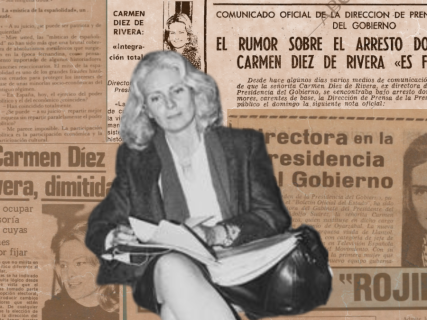
"Disorder in Moncloa", Díez de Rivera's experience as Suárez's chief of staff

On the occasion of the 50th anniversary of her appointment, DEMÓCRATA analyzes Carmen Díez de Rivera's time in Government: her complex relationship with the press, the progressive distancing from Suárez, and the privileged position she occupied during the Transition.

5 minutes

ILUSTRACIONES TEMAS (90)

ILUSTRACIONES TEMAS (90)

Add DEMÓCRATA to Google

Ask FREN

Published

Last updated

5 minutes

Most read

The magistrate of the Constitutional Court Luis Ortega stated that the institutional position occupied by chiefs of staff, "in a certain way privileged," contrasted "with the scarce opportunities for their work to be publicly recognized." A set of characteristics that, in his opinion, made "the cabinet an organ that simultaneously arouses curiosity and suspicion." Ortega made this reflection in 1991.

For decades, the men who whispered in the ears of the Prime Ministers remained anonymous. They made politics, set and dictated political information, but their names did not appear in the chronicles. The arrival of Pedro Sánchez at Moncloa and the election of Iván Redondo as his main guru changed this dynamic: Redondo was even nicknamed "the 23rd minister."

Never before had a chief of staff attracted so many headlines, but there was a chief of staff who, fifty years ago, managed to capture the media's attention: Carmen Díez de Rivera (1942-1999). Her status as a woman, the only one to date to have held the position, was the trigger for her media projection, but not the only characteristic that made her so attractive to the press of the Transition.
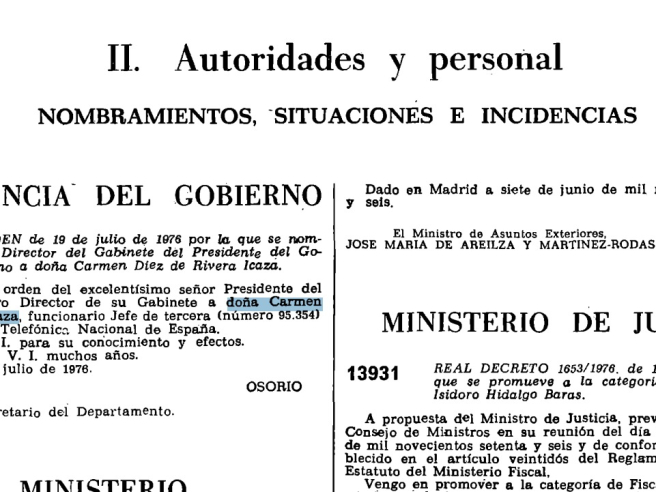
BOE 19-07-1976
BOE 19-07-1976 -

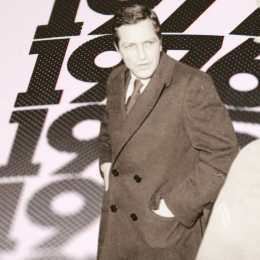
Five decades have passed since Adolfo Suárez appointed Díez de Rivera his right-hand woman in the Presidency. An aristocrat by birth marked by personal tragedy, but with firm progressive convictions, she remained in office for nine months. Neither politics, nor administration, nor the media are what they were then. On the occasion of the commemoration of her arrival at the post, DEMÓCRATA reconstructs her time at the head of Suárez's cabinet.

"Disorder in Moncloa"

Díez de Rivera occupied this privileged position between July 1976 and May 1977. She was on the front lines during the Law for Political Reform, the Atocha bombings, the legalization of parties, and the call for the first democratic elections after the dictatorship. Also during the move from Castellana 3, where the Presidency's headquarters were located, to the Moncloa complex.

She lived those months intensely, but also "suffered" them, as she reflected in her diaries, which after her death were published by her biographer Ana Romero in *Historia de Carmen* (2002). "Press chief, spokesperson, disorder in Moncloa. This is how I've been for eight months," Díez de Rivera wrote in March 1977.

“In Moncloa we still had no spokesperson, as in Castellana. I answered all the calls. After all, spokespersons are there to never say anything, right? Besides, the word had gotten out and everyone was calling me (…) if they asked me to take care of a prisoner, I took care of it,” she confessed to Romero in 1999, months before she died.

At that time, the structure of the cabinet and the Government in general was much more fragile. Of course, Díez de Rivera did not have the current resources, although she also did not perform all the functions that a chief of staff has today in the usual way.

Natalia Escalada worked with Suárez and with Leopoldo Calvo-Sotelo. At that time, Escalada was only separated by a glass door from the Chief of Staff's office. As she could observe, Díez de Riverta essentially had three tasks: maintaining contact with national politicians, foreign leaders, and the press. “She received many people, because she wanted to open the president to people with different ideas,” recalls Suárez's former personal assistant.

Regarding the relationship she forged with the press, Escalada recalls in conversation with DEMÓCRATA: “She was intelligent, she gave information to whomever she wanted about things that could be of interest, but she also knew how to measure not saying what she shouldn't."

Gossip and rumors

Díez de Rivera became a regular presence in the press of the Transition. She moved from the political chronicle pages to society pages and ended up being a recognizable figure for a large part of the Spanish population. To the point that, in many reports, they no longer even needed to mention that she was the head of the cabinet of the Presidency of the Government when they spoke of her. «Carmen and Dolores», titled ABC the chronicle about the return of La Pasionaria to Spain and the departure of Díez de Rivera from Moncloa.
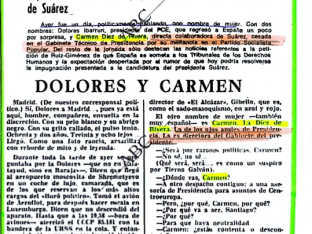
ABC | 14-05 -1977
ABC | 14-05 -1977 -

Her profile had all the ingredients to be "attractive" to the media: young, beautiful, progressive woman, with high institutional responsibility and a private life of great interest. But paradoxically, only El Alcázar, a far-right newspaper very critical of the process towards democracy, publicly recognized her role during those months.

After her dismissal and with the will to criticize the Government for the presence of “a communist in Moncloa,” she attributed to Díez de Rivera her contribution to the legalization of the PCE: “Always behind the scenes, with a record as discreet as it was effective, Díez de Rivera has been a decisive contact for the recognition of the PCE.” As well as her intervention in the meeting between the King and Tierno Galván which, however, when it occurred, was attributed to a management by Suárez: “Carmen Díez de Rivera could have directly or indirectly motivated Tierno’s long interview with the King.”
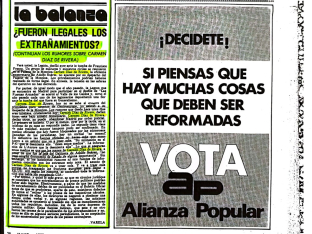
El Alcázar | 28-05-1977
El Alcázar | 28-05-1977 -

The two sides of the coin

Although on numerous occasions she expressed her discomfort with media attention and the criticism she received, Díez de Rivera soon understood the power of the press and knew how to use it to her advantage. Some of her statements went beyond the official discourse of the Government and reflected a more accelerated vision of the Transition than that of Suárez himself.

But far from being interpreted as a challenge to the Presidency, those words were read as a declaration of intentions about the direction the reform process should take, which at the same time aroused much criticism of the Government and the president from the most conservative sectors.

The press, focused on reproducing both her statements and the reactions they provoked, barely noticed in its chronicles that this dynamic was deteriorating the relationship between Suárez and what had been his closest collaborator since the times when he was in charge of RTVE.
Wave of vindication

After her departure from the Presidency as a result of discrepancies with Suárez, Díez de Rivera made many political missteps, but already in a discreet second row. Her presence in the media was notably reduced and, as far as her social projection was concerned, her time in the Government gave way to the personal scandal that marked her life: discovering at 17 that her boyfriend was her brother and that she was the illegitimate daughter of Serrano Suñer, who was Franco's "cuñadísimo" (brother-in-law).

The reissue of the memoirs written by Ana Romero under the title The Triangle of the Transition: Carmen, Suárez and the King (2013), the production of the documentary I Want to Be Free (2014), by RTVE, and the play Carmen, Nothing of Anyone (2024) have fueled a current that, in recent years, has vindicated her figure. In this context, the posthumous award of the Encomienda de la Orden de Carlos III by the Sánchez Executive is also framed.

More key points, information and questions with FREN

AI-GENERATED CONTENT

What are the legal functions of the Chief of Staff of the Presidency of the Government according to Spanish regulations?

The legal functions of the Chief of Staff of the Presidency of the Government (formally, the person holding the Directorate of the Cabinet of the President of the Government) are mainly defined today in Royal Decree 676/2025, of July 28, on the structure of the Presidency of the Government, as amended by Royal Decree 1081/2025, of December 2. The regulation distinguishes between the functions of the President's Cabinet itself and the specific functions assigned to its director. In summary, the Chief of Staff is a senior official with the rank of Secretary of State who directs the political and technical assistance body of the president, participates in the coordination of the Government, and assumes a central role in National Security matters. Additionally, they coordinate a broad network of bodies and departments that execute, within their scope, the functions attributed to the Cabinet.

Basic regulatory framework

The starting point is Royal Decree 676/2025, of July 28, which approves the structure of the Presidency of the Government, available in the BOE through this Royal Decree 676/2025. This regulation has been amended by Royal Decree 1081/2025, of December 2, which adjusts several of its articles, as stated in the BOE itself: Royal Decree 1081/2025.

The preamble of Royal Decree 676/2025 cites the authorization of article 2.2.j) of Law 50/1997, of November 27, of the Government, which empowers the president to determine the structure of the Presidency of the Government. From there, the royal decree specifies the organization and details the functions of the bodies that compose it, including the President's Cabinet and its Directorate.

General functions of the President of the Government's Cabinet

The President of the Government's Cabinet is expressly configured as a body of political and technical assistance. The royal decree attributes to it, among others, the following main functions:

  • Provide the President of the Government with the political and technical information necessary for the exercise of his functions.
  • Advise the president on matters and subjects he deems appropriate.
  • Be aware of the programs, plans, and activities of the different ministerial departments to facilitate the coordination of Government action.
  • Study and monitor the programs and actions of the European Union that affect the State's public policies, providing the necessary information for European decision-making.
  • Be aware of the policies and programs of the autonomous governments to facilitate cooperation and co-governance in matters of concurrent action.
  • Facilitate communication with the public, attending to and responding to suggestions, complaints, and information addressed to the president.
  • Assist the president in matters of national, international, and economic policy.
  • Advise on National Security matters.
  • Perform any other functions entrusted by the President of the Government.

These functions form the core of the institutional mission of the Cabinet: comprehensive support to the President of the Government in political leadership, government coordination, and relations with the public, the European Union, and the autonomous communities.

Specific functions of the Chief of Staff (Cabinet Directorate)

Royal Decree 676/2025 itself, in its current wording after Royal Decree 1081/2025, expressly regulates the position and functions of the Directorate of the Cabinet of the President of the Government. The main elements are:

  • Rank and hierarchy: the person holding the Directorate of the Cabinet of the President of the Government has the rank of Secretary of State.
  • Direction of dependent bodies: directly dependent on it are the Deputy Directorate of the Cabinet, the General Secretariat of the Presidency of the Government, the General Secretariat of National Policy, the General Secretariat of Institutional Relations and Citizenship, and several departments with the rank of general directorate (among others, European Affairs and Foreign Affairs). Each of them develops, within its scope, the functions attributed to the Cabinet.
  • Exercise of the Cabinet's functions: the royal decree establishes that each of these bodies will develop, within its competence, the functions attributed to the Cabinet in the corresponding article, “in addition to those specifically entrusted by the person holding the Directorate of the Cabinet of the President of the Government.” That is, the Chief of Staff has the capacity to assign and specify functions within that framework.
  • Participation in Government collegiate bodies: the person holding the Directorate of the Cabinet of the President of the Government attends the General Commission of Secretaries of State and Undersecretaries, a key body for preparing the matters of the Council of Ministers.
  • National Security: the royal decree establishes that the person holding the Directorate of the Cabinet of the President of the Government performs the functions of Secretary of the National Security Council.
  • Internal direction of the Presidency: additionally, they exercise the functions of direction, coordination, and promotion of the Steering Committee of the Presidency of the Government.
  • Immediate support body: as an immediate assistance body to the person holding the Directorate of the Cabinet, there is a Cabinet, with the level of deputy general directorate, which strengthens their coordination and advisory capacity.

Altogether, these legal provisions place the Chief of Staff as the main political and administrative responsible for the support machinery to the President of the Government, with a central role in interministerial coordination, government strategy, and National Security, always under the superior direction of the president himself.

How is the Director of the Cabinet of the President of the Government legally appointed and dismissed, and what formal requirements does the regulation demand? What practical role does the Chief of Staff have within the National Security Council and how is their function as secretary of this body articulated? How is the Cabinet of the President of the Government coordinated with the different ministries and autonomous communities according to this regulation?

What political and professional trajectory did Carmen Díez de Rivera have before and after being Chief of Staff?

Carmen Díez de Rivera developed a very unique political and professional trajectory: before becoming Chief of Staff for Adolfo Suárez, she trained as a political scientist with a strong international projection and worked with him at RTVE and in his closest political environment; after leaving that position, her career continued in party politics and, above all, in the European Parliament, where she specialized in environment and sustainable development. Her figure, both aristocratic and rebellious, moved from the heart of the Transition to a more critical and ecosocialist position in her later years. Throughout this journey, she maintained a constant trait: a very marked political independence, even against the parties she belonged to.

Education, origin, and first steps before the cabinet

According to the note from the Madrid City Council about the theatrical work dedicated to her life, Carmen Díez de Rivera was born in Madrid in 1942, into a family of aristocratic origins, and studied at university in Philosophy and Letters and Political Science, specializing in International Relations. Later, she expanded her studies at Oxford and the Parisian university of La Sorbonne, which gave her an unusual profile in late Francoist Spain, with a solid humanistic base and a strong international dimension, before entering the political frontline, as noted in the work “Carmen, nothing of anyone”.

Specialized biographies emphasize that from a young age she was linked to the environment of then Prince Juan Carlos, with whom she maintained a close friendship, and that this proximity to the Royal Palace was the way through which she met Adolfo Suárez, then an emerging senior official of the Franco regime but with reformist vocation ([link], [link]). In parallel, various sources indicate that despite her social origin, she sympathized with leftist positions and maintained contact with opponents of Francoism, which strained her family relationship.

The decisive professional leap prior to her appointment in Moncloa was her incorporation into Radiotelevisión Española when Suárez directed the public entity. According to the Madrid City Council, she worked at RTVE “during the time he directed the public entity,” and was in charge of the international area, which consolidated her profile as an expert in foreign relations and placed her in Suárez’s trusted circle even before he was appointed president of the Government ([link]).

Stage as Chief of Staff for Suárez

Although your question focuses on the “before and after,” her brief tenure as Chief of Staff is the turning point of her public life. The note from the Spanish Theatre recalls that, “during Adolfo Suárez’s government, Carmen Díez de Rivera held a position that no woman had held until then, that of Chief of Staff of the Presidency of the Government” ([link]). Political biographies describe her as a key figure in the “nine months” of reforms in which the institutional dismantling of Francoism accelerated, including the legalization of the PCE and the opening to party pluralism ([link], [link]).

This very influential but largely behind-the-scenes role led writer Francisco Umbral to dub her the “muse of the Transition,” a label she herself rejected for considering it minimized her effective political work ([link], [link]).

Political and professional trajectory after the cabinet

After leaving the Chief of Staff position, Díez de Rivera ventured into party politics. Biographies agree that she passed through different labels of the center-left space: first the Popular Socialist Party (PSP), then the Democratic and Social Centre (CDS) founded by Suárez himself, and finally the PSOE ([link], [link]). This mobility illustrates her discomfort with party structures and her tendency to maintain a very personal position in political debates.

The main axis of her “later” stage was the European Parliament. Sources indicate that she was elected MEP in the late 1980s and served two terms, until shortly before her death in 1999 ([link], [link]). There she focused her work on environment, sustainable development, public health, and regulation of sectors such as tobacco and energy, often confronting economic interests and the voting discipline of her own political group ([link]).

In that final phase, she defined herself as “ecosocialist” and showed growing skepticism about institutional politics, without renouncing using her seat to promote pioneering sustainability and quality of life agendas ([link], [link]).

Díez de Rivera had to leave her parliamentary activity due to breast cancer and died in Madrid in 1999, at 57 years old, as recalled by the Spanish Theatre note ([link]). Her legacy today lies at the intersection between the memory of the Transition and that of the first policies that brought the green and feminist agenda to European institutions.

What specific role did Carmen Díez de Rivera play in the legalization of the Communist Party during the Transition? How is the figure of Carmen Díez de Rivera reflected in recent biographies and cultural works about the Spanish Transition? In which committees and debates of the European Parliament did Carmen Díez de Rivera leave the greatest mark as an MEP?

What requirements and procedure exist for the granting of the Encomienda of the Order of Carlos III?

The granting of the Encomienda of the Royal and Distinguished Spanish Order of Carlos III is governed by the Regulation approved by Royal Decree 1051/2002, of October 11, which configures this Order as the highest Spanish civil distinction and determines its grades, requirements, and procedure. The Encomienda is an intermediate grade within the Order and, in general terms, it is required to have been previously distinguished with the Cross and that at least three years have passed. The file is processed in the Chancellery of the Order, under the Presidency of the Government, and the granting is made in the name of His Majesty the King, Grand Master of the Order. The grants of the different grades are formalized by means of a title issued with the signature of the King and the President of the Government as Grand Chancellor.

Applicable regulations and structure of the Order

The basic regulation is the Royal Decree 1051/2002, which approves the Regulation of the Royal and Distinguished Spanish Order of Carlos III. The preamble itself highlights that it is the highest of the Spanish civil orders and that its purpose is to reward those who, with their efforts, initiatives, and work, have rendered eminent and extraordinary services to the Nation.

The Regulation establishes that the Order consists of the following grades:

  • Collar
  • Grand Cross
  • Encomienda de Número
  • Encomienda
  • Cross

His Majesty the King is the Grand Master of the Order, and the President of the Government acts as Grand Chancellor, being invested as Knight or Dame Grand Cross upon taking office. The Chancellery of the Order is located in the General Secretariat of the Presidency of the Government.

Specific requirements for the Encomienda

Within the honorary career of the Order, the Regulation specifies:

  • The Encomienda may be granted to those who have already been distinguished with the grade of Cross, provided that more than three years have passed since the granting of the latter.
  • The Encomienda de Número may be granted to those who have the Encomienda with more than three years of seniority or meet the requirements of the Grand Cross.
  • As a general rule, entry into the Order is made at the grade of Cross, unless the entity of the merits justifies a higher grade.

Additionally, the Regulation foresees that the Grand Master, at the proposal of the Grand Chancellor, may exempt from compliance with some conditions “when there are exceptional situations that advise it,” which introduces some flexibility for very singular cases.

Competent bodies and numerical limits

The Chancellery of the Order (General Secretariat of the Presidency of the Government) is responsible for processing all granting files, obtaining reports from authorities, courts, and entities, and evaluating:

  • The importance of the merits contracted.
  • The professional category and seniority of the proposed person.
  • The age and insignia already possessed.

There is a Council of the Order, composed of the Grand Chancellor, the Head of the Household of H.M. the King, and seven decorated members of different grades, which advises and makes proposals to enhance the prestige of the grants.

The Regulation establishes numerical limits for some grades (not for the simple Encomienda):

  • Collar: maximum of 25 living Spaniards, excluding members of the Royal Family.
  • Grand Cross: maximum of 100, excluding Government Ministers decorated.
  • Encomienda de Número: maximum of 200, with the same exclusion.

Granting procedure and file processing

The files for granting insignia of the Order (including the Encomienda) may be initiated:

  • Ex officio, by the President of the Government.
  • At the request of:
    • The President of the Congress of Deputies.
    • The President of the Senate.
    • The President of the Constitutional Court.
    • The President of the General Council of the Judiciary.
    • The Head of the Household of His Majesty the King.

The file must include, at a minimum:

  • Full name.
  • Nationality.
  • Place and date of birth.
  • Usual residence and address.
  • Profession or job position and other positions held.
  • Decorations already possessed.
  • Detailed exposition of the merits that justify the request.

Any other initiative must be channeled through these authorities, considering the area of activity of the merits, the territorial scope, or the professional link of the proposed person. The Chancellery processes the file, requests reports, determines the corresponding grade, and submits a proposal to the Grand Chancellor, who in turn submits the draft Royal Decrees for granting the higher grades to the Council of Ministers.

Formal granting, title, and publication

Once the insignia is granted, the Chancellery issues the title, which must be authorized with the signature of His Majesty the King and that of the Grand Chancellor. The Minister-Secretary of the Order records the mandate, and the Master of Ceremonies-Accountant “takes note” on the back of the title. No insignia may be used until the interested party has obtained the appropriate granting title.

The grants made by Royal Decree are published in the Official State Gazette, as shown by Royal Decree 1260/2004, which granted the Grand Cross of the Order to Doña Letizia Ortiz Rocasolano. The Regulation does not introduce specific prohibitions other than numerical limits and the requirement of extraordinary merits, beyond the possibility of denying or not processing files that are not properly justified.

What specific types of merits are usually invoked in practice to propose an Encomienda of the Order of Carlos III? What differences in precedence and use do the Encomienda and the Encomienda de Número have within official protocol? Could you explain a recent case in which an Encomienda of the Order of Carlos III was granted and how it was motivated?

Play

Test your knowledge with FREN!

How much do you know about this topic? Answer the following 3 questions.

How long did Carmen Díez de Rivera serve as chief of staff of the Presidency of the Government?

Question 1 of 3

What was one of the main reasons for Carmen Díez de Rivera's media projection as chief of staff?

Question 2 of 3

What posthumous recognition did Carmen Díez de Rivera receive from Pedro Sánchez's government?

Question 3 of 3

Hola, soy Fren. ¿Cómo te ayudo?