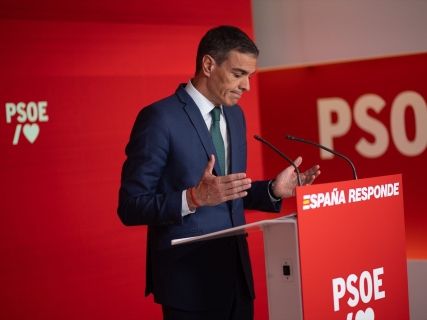

The PSOE once again looks at one of the most traumatic chapters in its recent history. The publication of several unreleased videos from the Federal Committee of October 1, 2016, disseminated this week by The Objective, has reactivated the debate on how Pedro Sánchez's fall as general secretary of the party occurred and on the cross-accusations of irregularities during that day.
The images correspond to a meeting that lasted more than twelve hours and ended with Sánchez's resignation after an unprecedented internal battle between two opposing blocs: the supporters of the then socialist leader, known as pedristas, and the critical sector, largely identified with the then Andalusian president Susana Díaz.
Who was Pedro Sánchez in 2016?
At that time, Pedro Sánchez was not president of the Government nor the consolidated leader who today leads the PSOE. He was secretary general since 2014 and faced strong internal opposition after two general elections without a clear majority and with the party in electoral decline.
The great strategic discussion revolved around what to do with the investiture of Mariano Rajoy, leader of the PP. A relevant part of the PSOE defended facilitating his Government through abstention to avoid a third election. Sánchez, on the other hand, rejected that option and explored an alternative majority with Podemos and other parliamentary forces.
Who was Susana Díaz in 2016?
Susana Díaz was then one of the leaders with the greatest territorial power in the PSOE. She presided over the Junta de Andalucía and controlled the Andalusian socialist federation, historically one of the most influential in the party.
For many analysts of the time, Díaz represented the internal alternative to Sánchez. Although he did not formalize his candidacy at that time, his political circle was key in the offensive that questioned the leadership of the general secretary. The confrontation between the two also symbolized two party models: one more linked to the traditional territorial apparatus and another that sought to rely on the militancy.
What happened in the Federal Committee?
The immediate trigger was the resignation of 17 members of the Federal Executive, a maneuver driven by critics with the aim of forcing Sánchez's departure.
The Federal Committee — the party's highest body between congresses — had to decide how to interpret that situation and what steps to take. What was supposed to be an internal meeting ended up becoming a chaotic day, with interruptions, recesses, discussions about the rules, and public confrontations.
The new images show moments of maximum tension between the members of the table, especially during the debate on how to vote.
Why is there talk of a "rigged election"?
The word pucherazo is used in Spain to refer, colloquially, to an alleged electoral rigging or vote manipulation. It does not necessarily imply a proven crime, but rather the perception that a process has not been clean or transparent.
In this case, the term was used by leaders of the critical sector when a secret ballot vote was attempted to be enabled within an adjoining room, far from the visible plenary of the Committee.
Critics considered that this system lacked transparency and sought to benefit Sánchez. They advocated for a roll-call vote or a show of hands so that each member would publicly identify themselves. Supporters of the ballot box argued, on the contrary, that the secret ballot protected Committee members from territorial pressures.
The urn that unleashed the conflict
One of the central moments of the videos is the appearance of a methacrylate urn placed in a side room, while several leaders close to Sánchez were preparing to vote.
That scene provoked shouts, protests, and immediate accusations of "rigging". Various leaders questioned the legality and appropriateness of the procedure. The tension forced the vote to be stopped and the process to be reordered.
Finally, the Committee resolved the crisis against Sánchez, who ended up presenting his resignation as general secretary.
García-Page reopens the wound
After the images were released, the president of Castilla-La Mancha, Emiliano García-Page, described what happened as "enormously painful" and assured that on that day there was "an attempt to steal the democracy of the Socialist Party".
Page, one of the critics of Sánchez at that time, stated that it was a "shabby putsch" and that it was the worst day of his political life. His statements show again that, almost a decade later, that episode continues to be an open wound within Spanish socialism.
From the overthrow to the return
Paradoxically, the fall of 2016 did not mean the political end of Sánchez. Months later, he launched a campaign directly to the membership, toured Spain, and won the 2017 primaries against Susana Díaz and Patxi López.
That triumph changed the internal balance of the PSOE and consolidated Sánchez as the undisputed leader of the party. A year later he would arrive at La Moncloa after the motion of no confidence against Rajoy.
For this reason, the 2016 Federal Committee was not just an organic crisis: it was the breaking point that ended up redefining the leadership of the PSOE and subsequent Spanish politics.
Why does it matter today?
The publication of these videos does not formally alter what happened, but it does bring back to the forefront a question that never completely disappeared: whether that fall was a legitimate political decision within the party's rules or a disorderly process tainted by internal maneuvers.
What the images show, in any case, is the rawness of an internal war that marked a before and after in the PSOE.