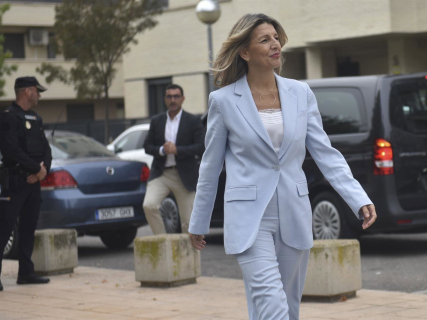

The second vice president of the Government and Minister of Labour and Social Economy, Yolanda Díaz, faces this Monday, 16 November, one of the most important decisions of her political career. The Spanish leader aims to become Director-General of the International Labour Organization (ILO), the United Nations body responsible for promoting workers’ rights and decent working conditions throughout the world.
The vote will take place in Geneva, from 10:00 a.m., within the framework of the 358th meeting of the ILO’s Governing Body. Díaz, whose candidacy was officially put forward by the Spanish Government last July, will be up against the current head of the institution, Gilbert F. Houngbo, from Togo, who has held the post since 2022 and is seeking a second term.
The election represents an opportunity for Spain to access for the first time the leadership of an international institution founded in 1919 which currently has 187 member states. It could also mark a change in Díaz’s career, who has defended her candidacy as a way to bring to the international arena some of the labour policies developed during her time in the Executive of Pedro Sánchez.
However, the decision does not rest with European governments or with a vote among the organization’s 187 countries. The outcome will depend on a small group of representatives of governments, workers and employers, with a specific election procedure and the majority required to take the post.
Who votes to elect the ILO Director-General
The election of the head of the ILO is carried out by its Governing Body, the institution’s executive body, composed of 56 members with voting rights.
Its main peculiarity is that it is a tripartite organization, in which representatives from three different spheres participate: governments, employers’ organizations and trade unions.
The votes are distributed as follows:
-
28 government representatives, elected in accordance with the rules governing the composition of the Governing Body.
-
14 worker representatives, coming from the trade union sphere.
-
14 employer representatives, linked to employers’ organizations.
This distribution means that governments cannot decide on their own the appointment without taking into account trade union and business representatives. The support that each candidacy secures among the three groups will be decisive for the outcome.
The election is carried out by secret ballot and by absolute majority. If all 56 members participate and cast valid votes, a candidate will need at least 29 supports to be elected. The rules provide for new votes when none reaches the necessary majority.
During the process, the applicants have had to submit their programs and appear before the organization’s representatives. On 23 September, they took part in a public meeting to present their proposals, while the 9 November private hearings took place before the Board of Directors.
The result of the vote on this Monday will be made public once the procedure is concluded.
Yolanda Díaz faces Houngbo after the withdrawal of the Peruvian candidate
The Spanish candidacy is not the only one submitted to lead the organization. Gilbert F. Houngbo, the current Managing Director, is seeking to renew the mandate that began in October 2022.
Initially, he was also aiming for the position of Javier González-Olaechea, former Minister of Foreign Affairs of Peru, whose candidacy had been put forward by the Government of Peru. However, Peru announced on 2 November its withdrawal from the race, so the election has been reduced to a contest between Díaz and Houngbo.
The Peruvian decision came after the International Organisation of Employers (IOE) and the International Trade Union Confederation (ITUC) publicly expressed their support for Houngbo’s continuation. The Government of Peru interpreted those supports as an obstacle to its candidate’s ambitions.
These positions are relevant because of the weight that trade union and business representatives have on the Board of Directors, even though the support announced by international organizations does not equate to individual votes cast. The final result will only be known once the secret election has been held.
Díaz, for her part, has put forward her candidacy as an alternative to continuity. Last Friday she said that her goal is "to 'recover' the ILO and to strengthen her role in the changes the labour market is undergoing.
Among its proposals is the creation of a Global Charter of Labour Rights, with which it intends to establish a minimum level of protection for workers on an international scale. It also advocates strengthening social dialogue and addressing the consequences of artificial intelligence for employment.
What power does the ILO Director-General have
The ILO’s directorate is one of the positions of greatest responsibility within the international system for the protection of labour rights, but it does not amount to running a Government nor does it allow laws to be approved that apply automatically in member countries.
The Director-General heads the International Labour Office, the organisation’s permanent secretariat, based in Geneva. It is responsible for its operation, for administrative management, and for the implementation of the programmes and decisions adopted by its governing bodies.
According to the institution’s official structure, the ILO has about 3,500 officials who carry out activities in 107 countries. The Director-General oversees this structure, coordinates its priorities, and represents the organisation institutionally to governments, trade unions, businesses, and other international bodies.
It also plays a prominent role in preparing reports, proposals, and programmes aimed at improving working conditions, combating child labour and forced labour, promoting equality, and strengthening social protection.
However, the approval of international labour conventions is the responsibility of the International Labour Conference, in which representatives of governments, employers, and workers from the member States participate.
These conventions may acquire legally binding character for the countries that ratify them. By contrast, ILO recommendations function as international guidelines and do not, in themselves, have mandatory character.
Therefore, even though the person who holds the Director-General position can influence the organisation’s priorities, they cannot unilaterally impose an increase in the minimum wage, a reduction in working hours, or a labour reform in Spain or in any other country.
Its capacity to act consists mainly in driving international agreements, promoting labour standards, coordinating technical activity, and encouraging States to comply with the commitments they have undertaken.
When would Yolanda Díaz take office if she wins the election
The vote this Monday will determine who will lead the ILO during the period between 1 October 2027 and 30 September 2032.
That is, although Díaz is elected on 16 November 2026, she would not take office immediately. Houngbo’s mandate continues officially until the end of September 2027, so the person chosen will have several months to prepare for taking up the role.
The length of the mandate will be five years, with the possibility of renewal in accordance with the institution’s internal rules.
Moreover, the election takes place at a time of political uncertainty in Spain, less than two weeks before the general elections of 29 November. A victory for Díaz would open up a new scenario for her institutional career and her participation in national politics, although any decision about her continuing in the Spanish Executive would have to be addressed separately.
The Government has publicly backed her candidacy and has highlighted her experience leading the Ministry of Labour, where she pushed forward the 2021 labour reform, increases in the interprofessional minimum wage and various measures related to workers’ rights.
An election shaped by the future of work and artificial intelligence
The vote arrives at a stage of transformation in industrial relations, with international debates on regulating digital platforms, the expansion of artificial intelligence, protecting migrant workers and the future of social protection systems.
The ILO also faces financial and institutional challenges that will condition the actions of whoever assumes its general directorship.
Díaz has argued that the organization needs to regain prominence in these debates and become a point of reference for establishing new labour guarantees. Houngbo, for her part, aims to continue the strategy developed during her first mandate, focused on social justice and the promotion of decent work.
The outcome will be known this Monday, 16 November, when the 56 representatives of the Governing Body vote in secret. If she obtains the necessary majority, Yolanda Díaz would become the first woman and the first Spanish person to assume the general directorship of the ILO, although her mandate would not begin until October 2027.