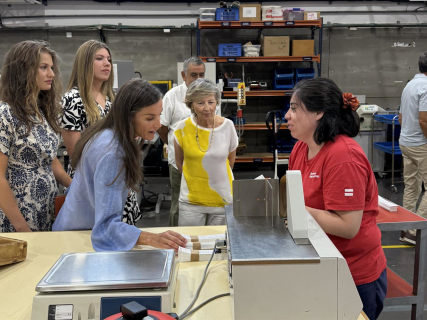
Letizia, Leonor, and Sofía unexpectedly visit the Casa Esment to learn about its social work.

Queen Letizia, Princess Leonor, and Infanta Sofía surprise visit the Casa Esment to learn about its work in training and labor inclusion.

1 minute

fotonoticia 20260807112924 1920

fotonoticia 20260807112924 1920

Add DEMÓCRATA to Google

Ask FREN

By democrata

Published

Last updated

1 minute

Most read

Queen Letizia, along with Princess Leonor and Infanta Sofía, unexpectedly visited the Esment House with the aim of firsthand understanding the trajectory of this foundation, focused on innovation, training, and labor inclusion, as well as the daily reality of the people who are part of its team.

The visit took place this Thursday morning, without a press call, and lasted about two hours. During this time, Queen Letizia and her daughters showed special interest in the dual training model applied by the entity and highlighted the importance of the support offered to the users, according to sources from the foundation who spoke to Europa Press.

According to these same sources, the meeting took place in a very close and relaxed atmosphere, and the Queen, the Princess, and the Infanta agreed at all times to take photographs with the workers.

As noted by Esment, it was Queen Letizia herself who expressed her desire to visit to closely understand the reality of the foundation, despite the fact that in the middle of August, the activity is lower than usual. During the tour, they visited the printing house, one of the spaces that maintains some activity these days, where they greeted each employee individually and inquired about their day-to-day lives and the training paths they have followed.

The foundation has expressed its gratitude for this visit, which was communicated the day before, and has emphasized the boost it provides for the visibility of people with disabilities.

More key points, information and questions with FREN

AI-GENERATED CONTENT

What are the official competencies of Queen Letizia according to the Spanish Constitution and legislation?

Queen Letizia, as consort of King Felipe VI, does not have constitutional powers of political authority or Head of State. Her legal status is based on two ideas: the Constitution expressly limits the functions of the Queen consort and a royal decree sets her titles, treatments, and honors. She could only assume constitutional functions if she were to become Regent in the cases provided by the Constitution. The rest of her institutional activity is representative in nature and exercised within the framework of the Crown, but without her own decision-making powers.

1. Spanish Constitution: limits on the functions of the Queen consort

The key reference is the Spanish Constitution. In Title II, dedicated to the Crown, the relevant provision states:

"The Queen consort or the consort of the Queen may not assume constitutional functions, except as provided for the Regency."

Several important legal consequences can be deduced from this statement:

  • General prohibition: Queen Letizia, by virtue of being consort, cannot assume any of the constitutional functions that the text attributes to the King (sanctioning laws, proposing the President of the Government, calling elections, etc.). These competencies belong exclusively to the holder of the Crown.
  • Only exception: Regency: The Constitution contemplates the Regency for cases of minority of age of the King or disability. In those provisions, it is foreseen that the Regency may fall, among other cases, on the father or mother of the King or other relatives, but it does not create a “function proper” of the consort, but a distinct constitutional office, with its own oath and regime.
  • Absence of other mentions: in the rest of the constitutional text, no specific competence is assigned to the Queen consort; her position is defined by exclusion (she cannot assume constitutional functions) and by the general rules of the Royal Family and succession.

The rest of the provisions cited in the investigation about the constitutional referendum, such as the Royal Decree 2560/1978, do not add competencies to the consort, but refer to the approval process of the Constitution itself.

2. Royal Decree 1368/1987: title, treatment, and honors

The specific regulation governing the external status of the Queen consort is Royal Decree 1368/1987, on titles, treatments, and honors of the Royal Family and Regents. Its most relevant provisions for Queen Letizia are:

  • Denomination: "The consort of the King of Spain, while she is so or remains a widow, shall receive the denomination of Queen."
  • Treatment: she shall have the treatment of Majesty.
  • Honors: she is recognized "the honors corresponding to her Dignity established in the legal system" (order of precedence, military honors, etc.).

This royal decree regulates, therefore, the protocolary and honorary status of the Queen consort, but does not attribute government, command, or political representation functions of her own, beyond those that the King and the organization of the Crown entrust to her institutionally.

3. Household of H.M. the King and institutional role

The public activity of Queen Letizia is articulated through the Household of H.M. the King, regulated by Royal Decree 434/1988 and its subsequent amendments, including Royal Decree 297/2022, Royal Decree 372/2019, Royal Decree 1033/2001, and Royal Decree 657/1990, which develop the internal organization.

Article 1 of Royal Decree 434/1988 indicates that the Household is the body that, under the direct dependence of the King, has the mission to support him "in all activities derived from the exercise of his functions as Head of State" and to attend to relations with official bodies, the security of the Royal Family, and the internal regime of his residence. This regulation:

  • Does not confer specific formal competencies to the Queen consort.
  • Does provide the administrative and support framework for her representative activity (agendas, official acts, trips, patronages, etc.).

The historical origin of this structure is found in Decree 2942/1975 creating the Royal Household and in Royal Decree 2157/1977 on its insignia, later amended by Royal Decree 725/1993.

4. Practical consequence: institutional role without constitutional power

In practice, Queen Letizia’s “competencies” are of a representative and symbolic nature: presiding over events, promoting social or cultural causes, making official visits, and supporting the projection of the Crown. All this is done within the framework of the Head of State exercised by the King and without signing acts with their own legal effect.

There are no provisions in the analyzed legislation that attribute normative, executive, or political control powers to her. Even in general criminal law — for example, the Organic Law 10/1995 of the Penal Code and its broad reform by Organic Law 1/2015, itself modified by Organic Law 2/2020, Organic Law 11/2003, Organic Law 5/2000, Organic Law 7/1998, Organic Law 7/2012, Organic Law 3/1989, Organic Law 8/1984, or Organic Law 5/1985— mentions of the Crown affect the King as Head of State, not the Queen consort.

Other sectoral provisions related to the figure of the King, such as orders for issuing commemorative coins (Order EIC/495/2018 and Order ECC/2525/2012), also do not attribute competencies to the Queen consort, but merely highlight milestones of the Head of State.

In summary, the current legal framework configures Queen Letizia as Queen of Spain, with the treatment of Majesty and high protocol rank, but without her own constitutional competencies, except for the eventuality — purely hypothetical today — that she might assume the Regency according to the Constitution.

In what specific cases could Queen Letizia exercise the Regency according to the Constitution? What legal difference exists between Queen Letizia and the Princess of Asturias regarding their future functions? How is the Household of H.M. the King internally organized to support Queen Letizia’s institutional activity?

What is the background and studies of Princess Leonor and to which party does the current head of state belong?

Princess Leonor combines an international academic background with intense military training aimed at her future role as head of state. After completing the International Baccalaureate in Wales, she has completed three years of instruction in the three armed forces and is about to begin a Degree in Political Science at a public university in Madrid. In parallel, the figure of the current head of state, Felipe VI, is defined by the political neutrality typical of a parliamentary monarchy, with no role as a party leader. Available information describes the Crown as an institution situated above partisan confrontation.

Academic background of Princess Leonor

According to the newspaper Demócrata, the heir to the throne completed the International Baccalaureate at the UWC Atlantic College in Wales, which allowed her to access university through the admission procedure for students trained abroad, without the need for EBAU, as detailed in the piece about her admission to Carlos III University of Madrid (Leonor and Carlos III). Another Demócrata report on the studies of the kings highlights that she is part of a generation of European heiresses with profiles strongly oriented towards higher education and international relations (what the kings studied).

Starting in the 2026 academic year, Leonor will pursue a Degree in Political Science at the Getafe campus of Carlos III University. According to Demócrata, she will follow the same curriculum as other students, in a four-year program combining fundamentals of political science, constitutional law, world politics, and electives such as fundamental rights, gender, or climate change (Leonor and Carlos III). The newspaper highlights that this choice reinforces a profile oriented towards knowledge of the functioning of the State, diplomacy, and democratic institutions (what the kings studied).

Military training and institutional trajectory

The other major axis of the Princess’s preparation is her military training. Demócrata recalls that her military career has been organized in three successive academic courses at the General Military Academy of the Army (Zaragoza), the Naval Military School (Marín, with a cruise on the training ship Juan Sebastián Elcano), and the General Air and Space Academy (San Javier, Murcia) (training path; video about her military training).

In the aeronautical field, Demócrata has documented milestones such as her first solo flight with a Pilatus training aircraft at the Air Academy (first solo flight), and a second solo flight coinciding with the announcement of her university studies (second solo flight). Another news item reports the completion of her basic parachuting course at the Alcantarilla air base, where she became the first member of the Royal Family to perform parachute jumps (parachuting course).

This trajectory has been accompanied by institutional recognitions: Demócrata notes, for example, the Gold Medal of the Region of Murcia awarded to the Princess after her time in San Javier (Gold Medal of Murcia) or the issuance of a 60-euro commemorative coin representing her in Air Force uniform, agreed in the BOE (commemorative coin).

Symbolically, other Demócrata reports show her growing public agenda: her presence alongside Infanta Sofía at events with young people with disabilities (meeting with young people with disabilities), her role supporting her sister in her first public speech (Infanta Sofía’s first speech), or her recent participation in the 2026 World Cup final alongside the Kings and her sister, in a gesture of international projection of the Crown (Leonor at the World Cup final). Another piece highlights her interest in the historical titles she holds, such as Princess of Viana, linked to the former Kingdom of Navarre (title of Princess of Viana).

Demócrata places Leonor within a generation of European heiresses — such as Victoria of Sweden or Elisabeth of Belgium — characterized by the combination of international education, military training, languages, and a progressive incorporation into public life, with a “perfectly defined roadmap” in the Spanish case (generation of European heiresses).

Political situation of the head of state: to which party does he belong?

Regarding the current head of state, King Felipe VI, the consulted information does not mention affiliation or membership in any political party. Rather, it emphasizes his institutional role. An analysis by Demócrata on his functions in crisis situations recalls that the Constitution defines him as “head of state, symbol of its unity and permanence,” with the mission to “arbitrate and moderate” the functioning of institutions, always within the competencies fixed by the Constitution and laws themselves (what the King can do in a crisis).

Another Demócrata piece on his speeches before the Cortes underlines that he “reigns but does not govern” and that his presence in Parliament expresses the link between national sovereignty and the Head of State, reaffirming commitments to citizens, democracy, and Spain (a decade of speeches before the Cortes). In the same vein, former president José Luis Rodríguez Zapatero emphasizes the “neutrality” required of the parliamentary monarchy and the idea that the King must stand above partisan struggle (neutrality required in the Monarchy).

From the political sphere, an intervention by Popular Party senator Alicia García praises Felipe VI’s “commitment” to democracy, freedom, and the Spanish Constitution, and presents the Crown as a reference shared by a social majority, without partisan character (commitment to the Constitution). From this set of information, it follows that the King exercises the Head of State as a neutral and non-partisan constitutional figure, without public ties to any political party.

On what dates and under what conditions will Princess Leonor’s military training be exactly completed and will she receive her commissions in the three armed forces? What kind of institutional acts is Princess Leonor already assuming and how does her agenda compare with that of Felipe VI when he was heir? What political criticisms and support does the Monarchy currently receive in Spain and which parties defend its abolition or maintenance?

What other foundations or entities in Spain have dual training models similar to Esment and have received institutional visits?

Available sources confirm that the Adapted Dual Training model of Amadip Esment (Esment Escola Professional) is currently a national benchmark in labor inclusion of people with intellectual disabilities and vulnerable youth, and that it has received high-level institutional visits. Based on official notes and public communications, several entities in Spain are identified that, without being exact copies of the Esment model, combine training and professional practice in real contexts and have been the subject of institutional visits: mainly programs of Fundación ONCE, occupational centers with a clear pre-labor component, and alternating training projects promoted by regional governments and municipalities. However, there is no exhaustive catalog of “Esment models” replicated, but partial and complementary examples.

The Esment model as a reference

The note from the Balearic Government about Esment Escola Professional details that:

  • Esment was born in 2015 to promote the labor insertion of people with intellectual and developmental disabilities and vulnerable youth.
  • It develops a model of Adapted Dual Training with itineraries of up to three years, based on real business environments and apprenticeship contracts.
  • 85% of students achieve employment upon completing the training and more than 1,000 people have already been trained in this model.
  • The Minister of Business, Employment and Energy visited the foundation to learn about the model, touring production centers and classrooms, accompanied by Esment’s management and the Balearic Regional Development Agency.

This is the clearest case that simultaneously meets the two conditions of your question: inclusive dual training and explicit institutional visit.

Fundación ONCE and the “Por Talento Digital” program

A second relevant pole is technological training for people with disabilities promoted by Fundación ONCE:

  • The Education Minister of Galicia, Román Rodríguez, visited in Madrid the Por Talento Digital center of Fundación ONCE, described as a pioneering center of adapted technological training aimed at improving employability of people with disabilities, with programs in web development, robotics, and artificial intelligence, according to the Xunta de Galicia note about Por Talento Digital.
  • The Catalan Minister Martínez Bravo and Minister Saiz also visited this facility, which is presented as a benchmark in training and labor inclusion for people with disabilities, especially through digital skills, according to the Catalan Government note [link].
  • More broadly (not strictly dual), the SEPE highlights the “Por Talento” program for young people with disabilities under Youth Guarantee, with training co-financed by ESF+ and executed by Fundación ONCE and Inserta, according to SEPE information about Por Talento.

Although not formally classified as “Dual Vocational Training,” the logic is very similar to Esment’s: specialized training, strong labor market orientation, partnerships with companies, and a visible role of administrations, evidenced by official visits.

Occupational and educational centers with pre-labor dimension

Several occupational or special education centers, with programs combining training and preparation for employment, have also received institutional visits:

  • The Pascual Veiga occupational center was visited by Belén do Campo, representative of the Xunta, who highlighted its work training adults with intellectual disabilities to acquire skills that facilitate their labor and social integration, according to the Xunta note about Pascual Veiga.
  • The Javier Peña occupational center, in Andalusia, is presented as a resource for attention to people with disabilities that stands out “especially for its promotion oriented to the labor field,” with a specific program for this; its work has been projected institutionally through the piece “A papal chalice full of social inclusion” by the Andalusian Government [link].
  • The Lenda Educativa special education center offers adapted training in agricultural crops, livestock, and care for people in dependency situations; it was also the subject of an official visit by Belén do Campo, who valued its role in diversity and inclusion, according to the Xunta note about Lenda Educativa.
  • The San Juan occupational center, in the Valencian Community, received a visit from the regional secretary before the EU within the framework of the workshops “United in diversity”; the center offers care and training to people with intellectual and developmental disabilities of working age, focusing on autonomous life skills and pre-labor training, according to the Valencian Government [link].

In all these cases, there is a component combining training and preparation for employment, although it is not always legally structured as “dual training” in the style of Vocational Training.

Alternating training programs for vulnerable groups

Finally, there are broader initiatives by regional governments that finance alternating training projects for people with disabilities or at risk of exclusion, comparable in logic to the Esment model:

  • The Balearic Government has launched the program “SOIB Alternating Training for Vulnerable Groups,” which offers students an alternating training contract and, simultaneously, professional training or work specialties, with itineraries of up to three years, according to the official call for training and hiring.

No specific entities like Esment associated with political visits within this program have been identified in the sources, but it is confirmed that the scheme of training + paid work for vulnerable people is spreading as public policy.

In summary, Esment appears as a paradigmatic case; around it, an ecosystem of foundations (especially Fundación ONCE) and occupational or educational centers that combine training and labor insertion and are subject to institutional visits is deployed, although with varying degrees of formalization of the dual component. No further information is available in the consulted sources to map entities with a model strictly comparable to Esment.

Could you detail exactly how Esment’s Adapted Dual Training differs from ordinary Dual Vocational Training in Spain? What role do autonomous communities play in financing and expanding these inclusive dual training models? Are there impact data (employment, salaries, stability) of Fundación ONCE’s programs and others similar compared to Esment?

Play

Test your knowledge with FREN!

How much do you know about this topic? Answer the following 3 questions.

Who made a surprise visit to Casa Esment to learn about its trajectory and activity?

Question 1 of 3

What type of training model showed special interest to the royal family during their visit to Casa Esment?

Question 2 of 3

Why was the activity at Casa Esment lower during the royal family's visit?

Question 3 of 3

Hola, soy Fren. ¿Cómo te ayudo?