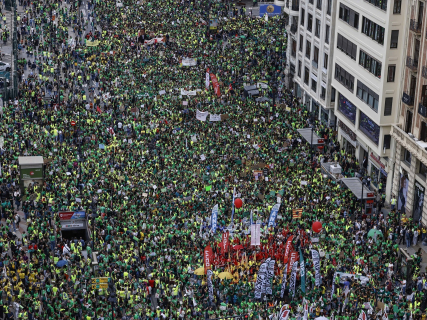

The teacher conflict takes center stage again this Monday with new days of teacher strikes and mobilization in several autonomous communities, in a scenario of simultaneous protests, but with different demands depending on each territory.
Valencian Community, Catalonia, and Aragon face this start of the week with new protest calls from teachers, in open conflicts with their respective educational administrations and without a unified national call. The coincidence of mobilizations, however, once again places teacher discontent at the center of the educational debate.
The day comes after several weeks of tension in different parts of the country, with strikes, rallies, and open negotiations between unions and regional governments.
Valencian Community: indefinite strike without agreement
The most intense conflict remains in the Valencian Community, where public education teachers are maintaining the indefinite strike called by several unions after the failure of negotiations with the Conselleria de Educación.
The unions are demanding salary improvements, reduction of class sizes, reinforcement of staff, less bureaucratic burden, and changes in regional educational policy.
Last week, the large demonstration held in Valencia visualized the scope of the conflict, with thousands of teachers, students, and families in the streets amid escalating pressure on the Generalitat. The strike continues this Monday awaiting new developments in the negotiation.
Catalonia and Aragon also maintain protests
In Catalonia, teachers are also keeping their mobilization calendar active within a strike call promoted by several teacher unions between May and June.
Monday's protest is concentrated in the Barcelona area within that calendar and responds to the union's rejection of the educational agreement reached by the regional department with other organizations, in addition to demands regarding working conditions, resources, and class sizes.
In Aragon, the educational conflict has another origin. There, teachers are maintaining mobilizations due to the rejection of decisions related to subsidized education, especially in Bachillerato.
Although the reasons are different, the coincidence of protests highlights a climate of teacher tension in different territories.
It is not a coordinated statewide teachers' strike, but rather several simultaneous conflicts that once again put the spotlight on the situation of public education and the working conditions of teachers in different autonomous communities.