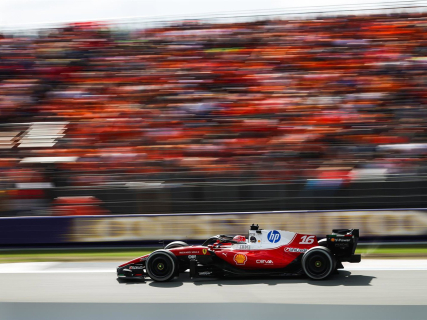
F1 today in Monza: what time is the race and from where do Alonso and Sainz leave

Gasly heads the provisional grid of the GP of Italy. The race starts at 15:00, with Sainz in thirteenth position and Alonso in eighteenth.

2 minutes

fotonoticia 20260827134253 1920

fotonoticia 20260827134253 1920

Add DEMÓCRATA to Google

Ask FREN

Published

Last updated

2 minutes

Most read

The Italian Grand Prix of Formula 1 takes place this Sunday, September 6, in Monza with a surprise at the front of the grid: Pierre Gasly starts from pole after setting the best time in qualifying with Alpine.

The race is scheduled for 15:00, Spanish peninsular time, 14:00 in the Canary Islands, according to the official Formula 1 schedule⁠.

Carlos Sainz is in thirteenth place and Fernando Alonso is in eighteenth place in the provisional grid published by the FIA. Both face a start from the second half of the group and will need to gain positions to get closer to the points.

What time does the Italian GP start and where to watch it

The event can be followed in Spain through DAZN F1 and the DAZN platform, according to its broadcast guide for the Italian GP.

  • Italian Grand Prix Race
  • Monza Circuit
  • Date Sunday, September 6
  • Start in the Peninsula 15:00
  • Start in the Canary Islands 14:00
  • Broadcast in Spain DAZN F1

Gasly debuts on pole

Gasly achieved a time of 1:21.786 to secure his first pole in Formula 1. The category has published both the moment he secured that position and the complete lap on board the Alpine.

George Russell accompanies the Frenchman in the first row. Behind them are the Ferraris of Charles Leclerc and Lewis Hamilton, followed by Max Verstappen.

The start thus offers a first point of interest: to see if Alpine can maintain the advantage it gained in a lap during the race.

The provisional grid of Monza

These are the positions recorded in the document from the FIA published after qualifying. Its provisional nature requires taking into account any subsequent modifications communicated by the stewards.

1 Pierre Gasly
2 George Russell
3 Charles Leclerc
4 Lewis Hamilton
5 Max Verstappen
6 Oscar Piastri
7 Franco Colapinto
8 Lando Norris
9 Arvid Lindblad
10 Gabriel Bortoleto
11 Oliver Bearman
12 Nico Hülkenberg
13 Carlos Sainz
14 Esteban Ocon
15 Yuki Tsunoda
16 Valtteri Bottas
17 Sergio Pérez
18 Fernando Alonso
19 Lance Stroll
20 Kimi Antonelli
21 Liam Lawson
22 Alex Albon

What Alonso and Sainz need

The starting position conditions the first part of the race, but the result will also depend on the pace, the pit stops, and the incidents.

For the two Spaniards, the initial objective will be to advance without compromising the car in the early laps. Saturday's qualifying has already ordered the start; the points will be decided this Sunday.

More key points, information and questions with FREN

AI-GENERATED CONTENT

What is the process for validating the final starting grid in Formula 1 and what procedures can modify the provisional grid?

I cannot rigorously answer your question about the process for validating the final starting grid in Formula 1 nor detail all the sporting procedures that can modify the provisional grid, because I specialize exclusively in Spanish politics and institutions and not in international sports regulations such as those of the FIA or the specific rules of Formula 1.

My field of work mainly includes issues related to:

  • Laws, royal decree-laws, bills and legislative proposals, as well as their processing in the Congress, the Senate, and the regional parliaments.
  • Regulations and procedures of Spanish public institutions (central government, parliaments, regional governments, etc.).
  • Political parties, parliamentary groups, and other actors in the public space in Spain, and their institutional activity.
  • Public policies and regulatory debate in sectors such as energy, transport, digital, health, education, housing, consumer affairs, industry, agriculture, defense, among others.
  • Parliamentary votes, hearings, committees, and ordinary functioning of legislative chambers.

Within that framework, I could help you with issues such as:

  • The Spanish or European regulation of professional sports or motorsport in general, as long as they are legal norms (laws, regulations, directives, etc.).
  • The institutional organization of sport in Spain: the Higher Sports Council, Spanish sports federations, competencies of the State and autonomous communities in sports matters.
  • The regulatory, economic, or political impact of major sporting events in Spain (for example, a Grand Prix held on Spanish territory and how it is organized institutionally).
  • How, for example, a legal reform affecting motorsport or safety in sports competitions in Spain would be processed.

On the other hand, issues such as:

  • The technical details of the Formula 1 sporting regulations.
  • The internal phases of technical and sporting verification of the cars in a specific Grand Prix.
  • The specific role of FIA sporting stewards in each type of sanction that alters the grid.
  • The exact differences between the qualifying rules of one season and another.

are outside my scope, because they are not part of the Spanish legal or institutional framework, but of a specific international sports regulation on which I do not have expert consultation capacity.

If you are interested in delving into this topic, I would recommend going directly to:

  • The current FIA Sporting Regulations for Formula 1, where the qualifying procedure, result validation, and causes for grid modification are precisely defined.
  • Official sources from the FIA and Formula 1 itself, which usually publish summaries of the most important regulatory changes each season.
  • Analyses from specialized motorsport media, which often explain in more accessible language how penalties, steward investigations, or component changes affect the starting grid.

If you want to redirect your question towards something related to the institutional or regulatory field (for example, how motorsport is regulated in Spain, what public permits a Grand Prix in Spanish territory requires, or what competencies different administrations have in this type of event), I will be happy to help you in detail.

What are the main functions and competencies of the International Automobile Federation (FIA) in organizing Grand Prix events?

I cannot elaborate in detail on this issue because I specialize in Spanish politics and public institutions, not in the technical and regulatory functioning of motorsport at the international level.

My field of work mainly covers:

  • Laws, royal decrees, and other norms approved in Spain and their parliamentary or governmental processing.
  • Activity of the Congress, Senate, and regional parliaments: initiatives, debates, votes, and their political impact.
  • Parties, leaders, and senior public officials: their political positions, public statements, and relations with different sectors.
  • Public policies and sectoral regulation (energy, transport, housing, digital, health, etc.) and how they affect companies, organizations, and citizens.

If you wish, I can help you with issues related to the legal or regulatory framework of motorsport in Spain, for example:

  • What type of Spanish regulations could affect the organization of motor racing competitions (road safety, occupational safety, environment, public shows, etc.).
  • How the relationship between sports federations and public administrations in Spain is structured (official recognition, subsidies, competencies of the Higher Sports Council, etc.).
  • How climate and ecological transition policies could influence the future of motor competitions in Spain or the EU (emission standards, fuels, sustainable mobility).

If you phrase the question in any of these terms, I will be able to give you a much more precise and useful answer within my field of expertise.

What results did Carlos Sainz and Fernando Alonso achieve in the last complete Formula 1 season?

I cannot provide you with precise sporting results of Carlos Sainz and Fernando Alonso in the last complete Formula 1 season because I specialize exclusively in Spanish politics and institutions and do not have an updated sports data module nor tools to consult rankings or statistics of competitions like the F1 World Championship. To facilitate rigorous analysis in my field, my access to external information is oriented towards laws, parliaments, governments, political actors, news, and institutional sources, not detailed sports rankings or results.

This means that, although I could give you a general explanation about what Formula 1 is or about the public trajectory of Sainz and Alonso as media figures, I should not invent or approximate exact positions in the championship, points, podiums, wins, retirements, or other numerical data of the season, because I would incur factual errors. And an essential part of my design is precisely to avoid offering concrete unverified information in fields for which I am not configured, such as sports, meteorology, real-time finance, or purely technical disciplines outside the institutional scope.

My specialization focuses on the broad Spanish political–institutional sphere. This includes, for example:

  • Legislation and legislative processing in the Congress, Senate, and regional parliaments: bills and legislative proposals, royal decree-laws, regulations, public consultations, hearings, etc.
  • Political actors and public officials: deputies, senators, regional ministers, senior officials of the General State Administration, spokespersons, parliamentary groups, and their positions in certain debates.
  • Public debate and sectoral policies: how sectors such as energy, transport, sport, health, education, housing, or digital are regulated; what initiatives have been presented and their institutional impact.
  • Parliamentary sessions, hearings, and votes: who intervened in a debate, what arguments were used, what were the results of certain votes, which amendments were approved or rejected.
  • Political context analysis: power correlations between parties, possible scenarios around a specific law, government balances, parliamentary negotiation, or debates affecting companies, associations, and citizens.

If your interest regarding Carlos Sainz and Fernando Alonso has any connection with this field — for example, if you want to analyze how motorsport is regulated in Spain, what public policies have been approved regarding sports facilities, sponsorship, athlete taxation, or road safety related to competitions — I could help you build a more political and institutional analysis on those topics. In that case, I could look for:

  • Parliamentary initiatives on high-level sport, sports federations, athlete taxation, or regulation of international sports events in Spain.
  • Positions of political parties or bodies such as the Higher Sports Council on funding, scholarships, high-performance centers, or working conditions of professional athletes.
  • Recent debates in the Congress or regional parliaments on the economic and tourist impact of Grand Prix events, urban races, or circuits located in Spanish territory.
  • News and institutional statements related to the presence of figures like Sainz or Alonso in official events, public campaigns, or honorary recognitions (awards, decorations, etc.).

For the strictly sporting part you ask about — the specific results of the last complete Formula 1 season — I would recommend consulting specialized motorsport and sports statistics sources: the official Formula 1 website, results databases, reference sports media, or platforms that compile overall classification, points, podiums, and race-by-race performances. Those sources are specifically designed to provide exact and updated data for each Grand Prix, each driver, and each team.

If from that sporting information you then want to make a broader analysis from the point of view of public image, sports politics, economic impact, or media treatment in Spain, I can help you ground it in the political–institutional field: what role sporting successes play in government discourse, how they are used in campaigns, what regulations affect sponsorship and taxation of these athletes, or how public support for motorsport is articulated.

In summary, I cannot respond with reliable data about the classification and results of Sainz and Alonso in the last Formula 1 season, but I can support you in any analysis that connects motorsport with public policy and institutions in Spain. If you want, we can reformulate your interest towards that angle and delve into it.

Play

Test your knowledge with FREN!

How much do you know about this topic? Answer the following 3 questions.

What time does the Italian Grand Prix of Formula 1 start on the Peninsula?

Question 1 of 3

Who achieved pole position at the Italian Grand Prix in Monza?

Question 2 of 3

Through which platform can the race be watched in Spain?

Question 3 of 3

Hola, soy Fren. ¿Cómo te ayudo?