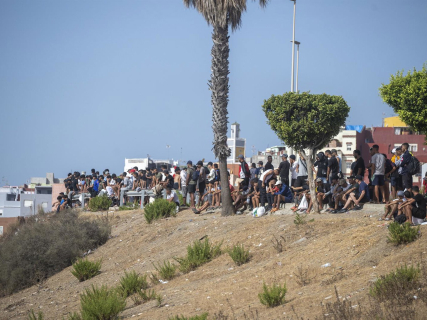
Read here the complete police report from Ceuta: 55 pages on the Moroccan "active guidance" and the plan to collapse the border.

See and download here the document from the CENIF sent to the National Court, which rules out a spontaneous mobilization, describes a coordinated campaign on social media, and points out actions by the security forces of Morocco.

4 minutes

fotonoticia 20260902202244 1920

fotonoticia 20260902202244 1920

Add DEMÓCRATA to Google

Ask FREN

Published

Last updated

4 minutes

Most read

Read here the 55-page police report on the mass entry recorded in Ceuta on July 30 and 31, 2026. The document was prepared by the National Immigration and Borders Center (CENIF), dependent on the General Commissariat of Immigration and Borders, and sent to the magistrate of the National Court María Tardón.

Read and download here the police report on Ceuta

DOCUMENT | Police report from the National Immigration and Borders Center on the mass entry in Ceuta

📄 Read here the full document from CENIF on the entry of migrants in Ceuta
Preview in the news (if your browser allows it)
If you do not see the document (some mobiles block the viewer), use "Open in tab" or "Download".

The report reconstructs the events before, during, and after the arrival of tens of thousands of people to the autonomous city. Its conclusions rule out that it was an occasional or spontaneous episode and point to the existence of prior planning, strategic direction, and coordination on the ground.

The Police rule out that it was something spontaneous

The document analyzes the calls disseminated on Facebook, Instagram, TikTok, and closed WhatsApp groups; the movements to the border; the actions of the Moroccan security forces; the different profiles of the people who entered Ceuta and the institutional, political, and geopolitical effects of the crisis.

The first conclusion of CENIF is that the events must be analyzed as a process composed of three phases: a prior preparation stage, the mobilization developed during July 30 and 31 and a subsequent phase whose effects were still ongoing when the report was closed.

"It is not something incidental whose generation can be associated with an occasional or spontaneous factor," states the document published by Demócrata.

The Police compare what happened with the entries recorded in Ceuta during 2021 and 2024. According to the analysis, the experience gained in those episodes would have allowed for the organization to be refined and to turn the mobilization of 2026 into a "much more complex and elaborate" action.

The chosen location, the specific access areas, the date, the time slots, and the different profiles mobilized are considered elements whose coincidence reveals prior planning.

The migratory purpose would have functioned as a cover

The report states that immigration operated as a "formal cover" to direct a massive flow of people towards Ceuta.

The researchers base this conclusion on the fact that approximately 90% of those who entered the city did not remain in Spanish territory and later returned to Morocco. Only about 10% would have maintained behavior compatible with that of conventional irregular immigration.

For the CENIF, the main objective would not have been to permanently relocate tens of thousands of people to Spain, but to provoke a mobilization capable of overwhelming the border system and generating institutional, political, and geopolitical consequences.

"Active guidance" by Moroccan forces

One of the most relevant passages of the report refers to the actions of the Moroccan Security Forces.

The document notes a Moroccan police and military presence significantly lower than usual during the first hours of the entry. It also includes testimonies and images in which uniformed agents and plainclothes individuals would have given directions to those moving towards the border.

In its conclusions, the CENIF explicitly speaks of the "active guidance" of the mass towards the crossing points by the Moroccan security forces.

The report does not literally state that the Moroccan Government planned or executed the entirety of the operation. It also does not identify the chain of command or the person who would have made the decision. It does attribute to Moroccan agents specific behaviors that facilitated movement towards the entry points.

The tactic to collapse the Ceuta border

The Police describe a tactical configuration developed in two phases.

The first would have sought to collapse the border management system in a specific place and manner. The massive arrival by sea forced Spain to dedicate resources to rescue efforts, saturated reception and containment areas, and reduced the available resources to maintain perimeter surveillance.

Once the collapse was provoked and the "opening of doors" occurred, the second objective would have been to "eliminate Spain's response capacity."

The report observes that at that moment the profile of the people accessing Ceuta changed. Young men from the first waves were joined by families, women, and minors, which further limited the possibilities for action of the Spanish forces.

The mafias did not have the capacity to organize the mobilization

The report rules out the participation of the criminal organizations known to the Police as responsible for the call.

The CENIF assures that it monitored the groups, profiles, and phones commonly used by networks dedicated to human trafficking and that it found no references to those organizations promoting mass entry.

The investigators consider that the mafias operating in Morocco did not have the capacity to immediately mobilize between 75,000 and 85,000 people, coordinate their arrival, modify the profiles of the different waves, and simultaneously control the movements of entry and exit.

The document does detect an economic exploitation afterwards by organizations and individuals who clandestinely transported some people from Ceuta to the Peninsula.

An alert about the CNI and the destabilization of Spain

The CENIF concludes that the effects of the entry projected onto different areas.

On the institutional level, it caused the saturation of the capacities for prevention, containment, assistance, and response. In civil society, it affected public safety, health, trust in institutions, and the exercise of rights.

The report also notes an "evident internal political destabilization," a deterioration of Spain's international image, and coordination problems among the different structures of the State.

The last warning directly affects the National Intelligence Center. The document points out that the questioning of the CNI's ability to detect what happened ended up becoming what the investigators describe as a "manual offensive counterintelligence action."

More key points, information and questions with FREN

AI-GENERATED CONTENT

What is the parliamentary process for the Interior Minister's appearance in cases of border crises like the one in Ceuta?

The appearance of the Interior Minister before the Cortes in a border crisis (such as the one experienced in Ceuta) does not have a special ad hoc procedure, but it is articulated by intensively applying the general rules of parliamentary control over the Government. The scheme is similar both in the Congress and in the Senate, with minor regulatory variations.

1. Who can request the appearance?
  • The Government itself or the minister: the Interior Minister can request to appear, usually before the Interior Commission or, if applicable, before the Plenary, to report on the situation and the measures adopted.
  • Parliamentary groups or a minimum number of deputies/senators: the opposition usually files requests for appearances when it considers that the crisis requires immediate political explanations.
  • The Permanent Deputation: if the crisis occurs outside the ordinary session periods, the appearance can be requested before the Permanent Deputation, which exercises control functions when the Chambers are not convened.

In all cases, the appearance is formalized through a initiative registered in the Chamber, which is specifically addressed to the Interior Minister and indicates whether it is requested before the Plenary or before a Commission.

2. Qualification and admission for processing
  • The request reaches the Board of the Chamber (or, if it is already specified for a commission, also to the Board of that commission).
  • The Board verifies that the request meets the formal and material requirements of the Regulations (competent body, sufficient signature, clear object, etc.).
  • If admitted, the initiative is sent to the competent Commission (usually Interior or, if applicable, another related one, such as Defense or Foreign Affairs if it concerns mixed issues of security and international relations).

In crisis contexts, groups usually file requests with a character of political urgency, although the Regulations do not always have a specific formal category: urgency is translated into the priority that the Board and the Spokespersons' Board give to setting a date.

3. Setting the date and convening
  • Once admitted, the Board of the commission, in agreement with the Government and after hearing the Spokespersons' Board, sets the day and time of the appearance.
  • If it is decided to be in Plenary, it must be included in the agenda of a plenary session, which is also approved with the intervention of the Spokespersons' Board.
  • In situations of special gravity, an extraordinary Plenary or an extraordinary commission session can be convened, at the request of the Government, the majority of the Chamber, or a significant number of deputies/senators, according to the Regulations.

In political practice, a crisis like Ceuta's usually generates media and parliamentary pressure for the appearance to take place within a few days.

4. Development of the appearance

The format is relatively standardized, with slight variations between Congress and Senate:

  • Initial presentation by the minister: the Interior Minister reports on the facts (chronology of the crisis, actions at the border, coordination with other ministries and with the EU) and on the political and operational decisions adopted.
  • Turns of the parliamentary groups: the spokespeople of the groups intervene, usually starting from the smallest to the largest representation or according to the order set by regulation, raising questions, criticisms, or proposals.
  • Minister's response: the minister answers globally or by blocks to the interventions of the groups.
  • Reply and rejoinder (if allowed): some Regulations provide a brief turn of reply from the groups and a final intervention by the minister.

The appearance has a mainly informative and control character. There are usually no formal votes at the end, unless linked to some type of non-legislative motion or to the subsequent presentation of initiatives (motions, proposals, investigative commissions) that are voted on at another time.

5. Political effects and possible consequences

Although the procedure is the ordinary one for appearances, several parliamentary consequences may arise in a border crisis:

  • Presentation of non-legislative motions urging the Government to adopt or change certain migration or border control policies.
  • Request for the creation of an investigative commission if it is understood that there have been serious management failures or rights violations.
  • Promotion of additional appearances of other Government members (for example, Foreign Affairs or Defense) or high-ranking police officials as experts.
  • In extreme cases, initiatives of political censure of the minister could be raised, although this follows its own regulatory channels.

In summary, in crises like Ceuta's, Parliament uses the general framework of appearances to demand information and political responsibilities from the Interior Minister, accelerating deadlines through extraordinary sessions and accumulating, if necessary, other control and political promotion initiatives.

What differences are there between an appearance in commission and one in Plenary regarding political effects and media impact? How could a parliamentary group force an urgent appearance of the Interior Minister if the Government resists? What other control tools, besides appearances, are used in the Congress in migratory or border crises?

What powers does the magistrate of the National Court María Tardón have in immigration and border security matters?

Based on the available information, the magistrate of the National Court María Tardón exercises criminal jurisdiction when facts related to immigration or border security may constitute crimes within the competence of the National Court (for example, crimes against State security, criminal organization, facilitation of illegal immigration, or human trafficking). However, she does not appear as an authority with general powers over expulsions, returns, Foreigners' Internment Centers (CIE), or ordinary management of migration policy.

Who she is and which body she leads

According to various press reports, María Tardón is a magistrate of the National Court and acts as head of a criminal investigation body. A 2025 Demócrata news article identifies her as "holder of the Instruction Section, Plaza No. 3, of the Central Court of the National Court" within the framework of Preliminary Proceedings 64/2026 on the Ceuta migratory crisis. In another 2025 piece, she is mentioned as magistrate of the Central Investigative Court No. 3, competent in complex investigations (for example, a case of data trafficking and cybercrime).

That is, her functional scope is criminal instruction in cases of special gravity and significance, framed within the jurisdiction of the National Court.

Actions in migration and border matters

María Tardón's relation to immigration and border security is especially seen in the case opened by the Ceuta migratory crisis of July 30 and 31:

  • One of her rulings, reported by Demócrata, agrees to initiate preliminary proceedings following a complaint by Iustitia Europa for possible crimes against State security and the Nation, facilitation of illegal immigration, human trafficking, criminal organization, and omission of the duty to prosecute crimes, related to an "irregular massive entry" of tens of thousands of people in Ceuta.
  • In that order, Tardón instructs the General Immigration and Borders Police Station (UCRIF) of the National Police to submit a detailed report on the massive entry, including identification of those who may have participated in the actions, to delimit possible criminal responsibilities.
  • In another provision, the magistrate requires the Information Headquarters of the Civil Guard to clarify if there were prior alerts before the massive entry and to report on the deployed operation, mortal victims, and circumstances of what happened, within the investigation framework for a possible crime against the peace and independence of the State.

These actions show that her powers in this field are articulated as criminal instruction of facts with migratory and border dimension, when there is a possible attack on State security or use of migratory flows for criminal or organized purposes.

What is not within her direct powers

In the materials consulted, María Tardón does not appear to have direct powers over:

  • general immigration or asylum policy,
  • management of expulsions or ordinary return procedures,
  • the regime of Foreigners' Internment Centers (CIE),
  • nor the adoption of administrative decisions on entries, border rejections, or residence authorizations.

These matters fall, according to other official sources collected in the investigation, within the action of the Ministry of the Interior and the judicial control exercised, if applicable, by the Contentious-Administrative Chamber of the National Court over acts of the Ministry in matters of international protection, asylum, stateless status, etc., as detailed in a 2025 Governing Chamber agreement published in the Official State Gazette (BOE). That agreement describes the powers by sections of the Chamber but does not link that contentious jurisdiction with magistrate María Tardón, who operates in the criminal field.

Real scope of her powers in immigration and border matters

In summary, María Tardón's powers in immigration and border security are:

  • Criminal instruction powers over facts related to migratory flows and border control when these may fit crimes within the competence of the National Court (State security, terrorism, organized crime, human trafficking, facilitation of illegal immigration, etc.).
  • Authority to direct the investigation: request reports from Immigration and Borders of the National Police, the Civil Guard, and other bodies; order proceedings to clarify how a border crisis developed and what criminal responsibilities may arise.
  • Lack of normative or administrative power: she does not make political decisions about who can enter, reside, or be expelled, nor regulate CIEs or hot returns; her role is strictly criminal jurisdictional, case by case.

Therefore, her relevance in immigration and border security is that of a criminal judge who investigates whether the use of migratory flows or failures in border control conceal serious crimes or attacks on State security, rather than that of an administrative immigration authority.

What requirements must the National Immigration and Borders Center meet to send reports to the National Court?

There is no "special regime" specific to the National Immigration and Borders Center (CNIF) to address the National Court in the regulations consulted. As a specialized unit of the Directorate General of Police, when it sends reports or statements to the National Court, it is subject to the general rules of cooperation between administrative bodies and judicial bodies resulting from the Organic Law of the Judiciary, the Criminal Procedure Law, the Law regulating the Contentious-Administrative Jurisdiction, and Law 39/2015 on administrative procedure.

1. Preliminary requirements of admissibility

For CNIF reports to be validly sent to the National Court, three basic conditions must generally be met:

  • Existence of a specific judicial procedure (criminal, contentious-administrative, extradition, asylum, etc.) in which the National Court is competent. Without an open procedure or proceedings, the sending of information is, in principle, merely informative and is usually channeled through the Ministry of the Interior, not directly to a Chamber or Central Court.
  • Objective and functional competence of the National Court over the matter: for example, Criminal Chamber in terrorism crimes or other serious crimes with supra-regional dimension; Contentious-Administrative Chamber against acts of central State bodies in matters of immigration, asylum, expulsions, CIE, etc.
  • Action, as a general rule, at judicial request: normally, the Central Court or Chamber issues an order or official letter requesting a "report" or "submission of the file" to the Ministry of the Interior, the Directorate General of Police, or the specific unit (CNIF). Spontaneous ex officio submission from CNIF is exceptional and is immediately redirected to a specific procedure.

2. Minimum formal requirements of the report or file

From the Criminal Procedure Law, the LJCA, and especially Law 39/2015 (when it concerns administrative files on immigration and borders), several formal requirements arise:

  • Identification of the issuing body: it must be clearly stated that the report is issued by CNIF, indicating its organizational framework (Directorate General of Police / Ministry of the Interior), address, and contact details.
  • Identification of the procedure and the judicial body recipient: procedure number (summary, preliminary proceedings, contentious-administrative appeal, extradition piece, etc.) and specific body (Central Investigative Court X, Criminal Chamber, Section of the Contentious-Administrative Chamber of the National Court).
  • Signature and competence of the signer: the report must be signed by a competent authority or official (usually the head of the unit or an authorized official) and, if applicable, with an official seal. In electronic files, the signature will be a recognized electronic signature according to electronic administration regulations.
  • Motivation and technical content: the document must orderly present the facts, consultations made in migratory databases, records of entries and exits, sanctioning files, expulsion resolutions, etc., and technical conclusions. In the criminal field, it acts in practice as a police report or judicial police report.
  • Attached documentation and custody: copies of administrative resolutions, entry/exit records, residence cards, detention reports, etc. When it concerns evidence or supports with criminal relevance, the chain of custody and provisions of the Criminal Procedure Law are respected.

3. Submission of the administrative file (Law 39/2015)

When the National Court is aware of a contentious-administrative appeal, it may request the submission of the administrative file related to an act in immigration or border matters. Law 39/2015 establishes that:

  • The file must be in electronic format, formed by the orderly aggregation of all documents, evidence, reports, and actions.
  • It must be sent complete, paginated, authenticated, and accompanied by an authenticated index of the documents it contains, guaranteeing the integrity and immutability of the file through interoperability technical standards.
  • The submission is made by secure electronic means (interoperable platforms between Administration and Justice, LexNET, or other enabled systems), respecting the National Interoperability Scheme and data protection regulations.

4. Communication channels and limits

In practice, CNIF reports reach the National Court:

  • In criminal processes: as police reports or judicial police reports, sent to the Central Investigative Court or the Criminal Chamber through ordinary judicial and police cooperation channels.
  • In contentious-administrative processes: as part of the administrative file sent by the Ministry of the Interior when the Contentious-Administrative Chamber of the National Court requests it.

In any case, CNIF does not decide or resolve on citizens' rights before the National Court: it only provides technical information and documentation. Its reports are fully subject to the judicial control of the court, which may assess their sufficiency, request clarifications, or even order the carrying out of new proceedings to the unit itself or other bodies.

Play

Test your knowledge with FREN!

How much do you know about this topic? Answer the following 3 questions.

What does the CENIF report conclude about the massive entry into Ceuta in July 2026?

Question 1 of 3

What was the main objective of the mobilization towards Ceuta according to the police report?

Question 2 of 3

According to the police report, what approximate percentage of people who entered Ceuta in 2026 later returned to Morocco?

Question 3 of 3

Hola, soy Fren. ¿Cómo te ayudo?