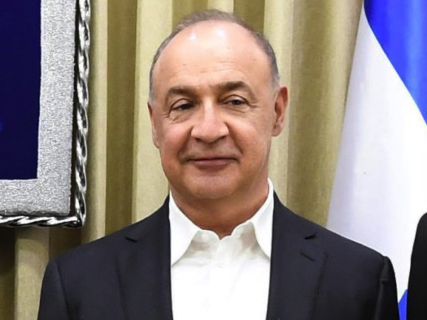
Who is Len Blavatnik, the owner of DAZN who has turned the World Cup into his great showcase

Len Blavatnik is one of the most discreet and powerful billionaires in the global music, sports, and entertainment business. Born in Odesa, naturalized British and American, he made his fortune after the fall of the USSR, bought Warner Music before the streaming boom, and controls DAZN, the platform that broadcasts the 2026 World Cup and that seeks to become the great Netflix of sports.

6 minutes

Blavatnik2

Blavatnik2

Add DEMÓCRATA to Google

Ask FREN

Published

Last updated

6 minutes

Most read

Len Blavatnik is the man who connects Ed Sheeran, Warner Music, DAZN, LaLiga, the 2026 World Cup, and one of the largest fortunes to emerge from the post-Soviet transition.

His name does not have the public exposure of Elon Musk, Jeff Bezos, or Peter Thiel, but his influence spans three key industries: music, sports, and digital entertainment. Through Access Industries, his investment group, Blavatnik controls Warner Music Group and is the main shareholder of DAZN, the sports platform that has turned the 2026 World Cup into one of its major global showcases.

The timing could not be more relevant. As the World Cup drives audiences, subscriptions, and sports conversation, DAZN is trying to consolidate itself as the major global platform for live sports. And behind that bet is Blavatnik, an entrepreneur who made his fortune in oil and aluminum, diversified into music when many doubted the sector, and is now trying to repeat the play in sports.

Who is Len Blavatnik

Len Blavatnik, born Leonard Valentinovich Blavatnik in Odesa in 1957, is a businessman of Soviet origin with British and American nationality.

His family emigrated to the United States during the Soviet era. There he studied, worked in the financial world, and ended up founding Access Industries, the vehicle with which he has built an empire of investments in commodities, chemicals, media, music, sports, technology, film, television, hotels, and real estate.

Blavatnik belongs to a generation of entrepreneurs who took advantage of the economic opening and privatization of assets after the fall of the Soviet Union. His first major businesses were linked to aluminum and oil, but over time he shifted the center of gravity of his fortune towards the United States, the United Kingdom, and the global entertainment economy.

Today his name is mainly associated with Warner Music and DAZN.

The Leap That Changed His Image: Warner Music

The operation that transformed Blavatnik's public image was the acquisition of Warner Music Group.

Access Industries acquired Warner Music in 2011 for 3.3 billion dollars, at a time when the music industry was still reeling from the blow of piracy and the collapse of the CD. The bet seemed risky: buying a major record label when many believed that the traditional music business was broken.

But streaming changed history. Spotify, Apple Music, YouTube and digital consumption rebuilt the value of music catalogs. Warner Music grew again and went public in 2020. The company now has a market capitalization close to 15 billion dollars.

The move made Blavatnik one of the big winners of the music industry's rebirth.

The owner behind DAZN

Blavatnik's other big bet is DAZN. The platform was born with a simple and ambitious idea: to transfer the digital subscription model that Netflix applied to movies and series to sports. But sports are much more expensive, more fragmented and more difficult to scale.

DAZN has bought rights to soccer, boxing, motorsports, tennis, basketball and other sports in different markets. In Spain, it is a well-known brand for its presence in LaLiga, Formula 1, MotoGP, international soccer and other sports content. The problem is that rights cost billions and profitability has been slow to arrive. Blavatnik has had to sustain the expansion with successive capital injections through Access Industries.

The 2026 World Cup, DAZN's great showcase

The 2026 World Cup has given DAZN extraordinary visibility. The platform offers coverage of the tournament and in Spain allows access to World Cup matches according to the contracted plan or through specific add-ons. The World Cup, with 48 teams and 104 matches, is the largest in history and is played in the United States, Mexico and Canada.

For DAZN, the tournament is much more than a sports product. It is an opportunity to attract users, strengthen the brand, test interactive features and consolidate itself as a regular destination for major global events.

The World Cup also comes at a time when sports consumption is fragmented. Traditional television retains key matches, but paid platforms want to keep the direct relationship with the fan.

That's where Blavatnik comes in, as his bet is that the future of sports involves global platforms, user data, subscriptions, on-demand content, highlights, statistics, betting, commerce and community.

From LaLiga to the World Cup: why DAZN matters in Spain

Spain is one of the markets where DAZN has more public relevance. The platform has built presence through LaLiga, Formula 1, MotoGP, boxing, women's soccer, international competitions and now the World Cup.

This makes Blavatnik an indirect but important player in Spanish sports. He doesn't appear on sets or in commentary, but his capital supports a platform that competes for the most valuable rights and influences how millions of users view sports.

Saudi Investment in DAZN

DAZN has also opened its capital to Saudi Arabia. The Saudi sovereign wealth fund, through SURJ Sports Investment, acquired a minority stake in the platform, and both parties launched a joint venture to develop DAZN MENA in the Middle East and North Africa.

The deal aligns with two parallel moves: DAZN's need to strengthen its capital and Saudi Arabia's strategy to grow in global sports ahead of the 2034 World Cup, which will be held in Saudi Arabia.

For Blavatnik, the Saudi entry helps sustain a very costly expansion. For Saudi Arabia, DAZN offers technology, distribution, rights, and experience in sports broadcasting.

Foxtel and International Expansion

DAZN has also taken a significant leap with the acquisition of Foxtel, the Australian pay-TV and entertainment group. The deal, valued at $2.2 billion in enterprise value, allows DAZN to strengthen its presence in Australia and expand its revenue, content, and customer base.

The acquisition of Foxtel is not just a geographical expansion. It is also a way to add scale, television expertise, sports rights, and commercial capacity in a market where pay-TV sports are highly significant.

The Big Question: When Will DAZN Be Profitable?

DAZN's biggest challenge is profitability. The platform has grown by acquiring expensive rights and entering highly competitive markets. This requires constant capital, patience, and a long-term commitment.

Blavatnik has demonstrated this patience for years. He has continued to finance DAZN despite losses, convinced that live sports will eventually capture a growing share of household digital spending.

However, the market no longer rewards only growth. It also demands profits, cost control, and a clear path to profitability.

This is why DAZN has sought new partners, acquired assets like Foxtel, explored corporate reorganizations, and reinforced its commitment to markets where it can combine rights, subscriptions, advertising, data, and additional services.

How Blavatnik Made His Fortune

Blavatnik's initial fortune was born far from sports and music. After emigrating to the United States, he studied and began his career in the financial world. In the late eighties, he founded Access Industries and, after the fall of the USSR, participated in operations linked to industrial assets, aluminum, and oil.

One of his major moves was his participation in TNK-BP, the Russian-British oil company that ended up being sold to Rosneft in a gigantic operation. That sale provided Blavatnik with enormous capital gains and gave him the muscle to diversify into Western sectors.

He also had complex operations in chemistry, such as LyondellBasell, a company that went through bankruptcy and subsequent recovery to become a highly valuable asset.

Blavatnik's story is that of an entrepreneur who started in natural resources and ended up building a much more Western, media, and technological portfolio.

Why he avoids public exposure

Blavatnik is not a magnate with a constant presence on social media or in interviews. His style is more discreet. He prefers to operate through Access Industries, support cultural and philanthropic projects, invest in strategic companies, and maintain a low profile compared to other billionaires.

This discretion has allowed him to move between very different sectors: music, sports, film, theater, real estate, universities, science, biotechnology, chemistry, energy, and technology.

It has also helped him manage a complex reputation due to his business origins in the post-Soviet space and his historical connections with large Russian fortunes, although his current portfolio is much more focused on the United States and the United Kingdom.

Philanthropy and cultural power

Blavatnik has donated large sums to universities and scientific and cultural institutions. His name is associated with the Blavatnik School of Government at the University of Oxford, scientific awards, and donations to top-tier academic centers.

Philanthropy serves several functions. It finances research, science, education, and culture, but it also consolidates social influence, reputation, and access to elite institutions.

More key points, information and questions with FREN

AI-GENERATED CONTENT

At what stage of parliamentary processing is the Spanish regulation of sports streaming platforms like DAZN?

Currently, there is no law under processing in the Spanish Parliament specifically aimed at regulating sports streaming platforms like DAZN. These platforms are mainly governed by Law 13/2022, General Audiovisual Communication Law, already in force, and by horizontal regulations (consumer protection, gambling, digital services, intellectual property) which are undergoing reform. What we do find are several ongoing bills that may indirectly affect DAZN and other sports OTTs (digital services governance, collective consumer actions, protection of minors, copyright), but none is a “DAZN law” nor a specific reform of the Sports Law focused on streaming. The fight against online sports piracy is currently being addressed by applying the existing framework and through parliamentary debates and non-legislative motions, not through a new specific sectoral regulation.

1. Main framework already approved: General Audiovisual Communication Law

The key regulation currently governing OTT platforms (including sports ones) is Law 13/2022, of July 7, General Audiovisual Communication Law, already in force and not currently under specific reform in Parliament. The consolidated text can be consulted in the Official State Gazette (here), with complementary information on its processing in the Senate (here) and the Government’s note when the project was approved in the Council of Ministers (here).

This law already extends the regulatory framework to OTT services and on-demand providers, so DAZN is integrated into the general audiovisual communication services regime (obligations on protection of minors, advertising, financing of European works, etc.). Its enforcement is reinforced with subsequent instruments such as the agreement between the Ministry and the CNMC published by Resolution of November 11, 2025 (BOE-A-2025-23343), which develops supervisory powers over these services.

According to another summary of search tools, no parliamentary reform of the LGCA specifically aimed at sports OTT platforms has been identified in 2025–2026, and the newspaper Demócrata itself indicates it has no information on specific reforms directed at DAZN or similar platforms.

2. Ongoing initiatives that indirectly affect the sector

In the Congress, there are several horizontal bills that may impact the ecosystem in which DAZN and other OTTs operate:

Draft Law on collective actions for the protection and defense of consumers’ and users’ rights and interests (121/000048): amendments open until 09/02/2026 (file). Presented by the Executive in the Council of Ministers on 02/25/2025 (reference). It will better organize collective claims by subscribers in case of incidents in digital services such as sports streaming.

Draft Law amending various legal provisions to improve democratic governance in digital services and media regulation (121/000068): also in amendment phase extended until 09/02/2026 (file, initial text in BOCG-15-A-66-1). It transposes and adapts the European Digital Services Act and the Media Freedom Regulation, impacting content moderation, removal orders, and intermediary liability regimes.

Organic Draft Law for the protection of minors in digital environments (121/000052): amendment period closed and amendments published on 12/12/2025 (BOCG-15-A-52-4; initial text in BOCG-15-A-52-1). It strengthens obligations of platforms and digital services towards minors, which will likely affect content offerings and parental controls also on sports platforms.

Draft Law creating the Spanish Office of Copyright and Related Rights (121/000013): in the Culture Commission, with amendments already published (BOCG-15-A-13-4, initial text in BOCG-15-A-13-1). Among its functions is to reinforce the fight against piracy of protected content, including online sports content.

• Additionally, there are projects linked to the public audiovisual sector, such as the amendment of the RTVE Law stemming from Royal Decree-law 5/2024 (121/000037, amendments until 09/02/2026, file), and the Draft Law on Cinema and Audiovisual Culture (121/000026, amendment period closed, file), which regulate the audiovisual ecosystem but do not focus on sports OTTs.

3. Sports piracy and IP blocking: political debate, not new law

The battle against live football piracy —which directly impacts DAZN and operators sharing rights with LaLiga— is being structured based on the Intellectual Property Law and the LGCA, complemented by judicial practice (dynamic IP blocking) and LaLiga’s action with its technological partners. The Congress debated a non-legislative motion critical of these blocks, which was rejected, thus supporting LaLiga’s strategy, as reported by Panorama Audiovisual. Other articles from the same outlet describe LaLiga’s agreements with CDNs and platforms to reduce piracy (here, here, here, here, here).

In Parliament, the issue has reappeared through written questions, such as one by Sumar on the effects of LaLiga’s IP blocks on essential services, to which the Government responded by recalling that they act under judicial resolutions but that the Ministry “monitors” possible effects on legitimate services, according to Redacción Médica. Additionally, a news item from the same outlet mentions that Congress approved a reform of the application of the Digital Services Act to mitigate collateral effects of these blocks, in line with the aforementioned digital services governance bill.

4. Sports Law and other sectoral regulations

No recent reform of the Sports Law directly and newly addressing the exploitation of audiovisual rights by sports OTT platforms is recorded in the agenda of the Congress or Senate. The CNMC continues analyzing, case by case, the commercialization models of rights (for example, in women’s football and futsal: CNMC note), and the Government has continued legislating on the gambling and sports betting environment through royal decrees and regulatory reforms, impacting advertising in sports broadcasts and video platforms, as detailed by the newspaper Demócrata reviewing legislative fronts in Consumer Affairs (article) and another piece on gambling regulation (article).

In this area, recent regulatory norms have also been approved, such as Royal Decree 369/2026 on the distribution of sports-charity betting proceeds (BOE-A-2026-9959) and Royal Decree 520/2026 on deposit limits in online gambling and safe gaming environments (BOE-A-2026-13762), which affect the economic ecosystem in which many sports broadcasts are embedded but do not create a new specific regime for DAZN.

5. Current situation for DAZN and other sports OTTs

In summary, as of July 2026, sports streaming platforms like DAZN are regulated by a mosaic of already effective regulations (LGCA, Sports Law, competition, consumer, gambling, digital services, and intellectual property regulations), and the Parliament is working on several cross-cutting reforms that will affect them, but there is no bill under processing exclusively aimed at regulating these platforms. Regulatory evolution will likely come more through that horizontal route (digital services, minors, copyright, consumer protection) and through practical application of the anti-piracy framework than through an ad hoc “DAZN law.”

Outside the strictly parliamentary sphere, different analyses from specialized and general media —such as those explaining DAZN’s business model in Spain (Xataka, Audiovisual451, Panorama Audiovisual, ReasonWhy, La Razón, AS, DAZN, DAZN News, eldiario.es, Panorama Audiovisual)— emphasize that the current regulatory framework already strongly conditions their operation (obligations to broadcast events of general interest free-to-air, CNMC supervision, advertising and gambling limits, etc.), even without a specific law under processing for them.

Finally, at the European level, the Commission’s Recommendation on the fight against piracy of sports and other live events, and works such as those by the EUIPO on e-sports (EUIPO), also shape the regulatory context in which Spain is adapting its legislation through the aforementioned bills.

At what specific point in parliamentary processing is the draft law on democratic governance in digital services and what changes does it introduce for audiovisual platforms? What specific obligations does the General Audiovisual Communication Law impose today on a sports platform like DAZN regarding protection of minors and advertising? How is the dynamic IP blocking system against online football piracy being applied in practice and what positions do the different parliamentary groups hold on this mechanism?

What are the main legal powers and attributions of the Ministry of Culture and Sport in Spain regarding the broadcasting of major sporting events?

The Ministry of Culture and Sport does not decide which channel broadcasts each match nor grants audiovisual licenses, but it does play a key role in the state sports policy, in defining and overseeing competitions, and in coordinating the bodies that classify major sporting events as being of general interest. It does so mainly through the Higher Sports Council (CSD), an autonomous body attached to the Ministry, and through its participation in the Council for Sports Broadcasts and Transmissions. The material framework of "what must be broadcast free-to-air" is currently established by Law 13/2022, General Audiovisual Communication Law, while the Sports Law and the CSD Statute delimit sports and institutional coordination competences. Overall, the Ministry acts as planner, coordinator, supervisor, and normative proposal actor at the intersection of sport and broadcasting of major events.

1. Audiovisual framework: right of access to events of general interest

Law 13/2022, of July 7, General Audiovisual Communication Law (BOE-A-2022-11311) is today the basic regulation on broadcasting major sporting events of general interest:

– It establishes the obligation to guarantee the citizens’ right to be informed about events of general interest and foresees the approval of a catalogue of events of general interest, valid for four years, by Agreement of the Council of Ministers. – This catalogue is approved at the proposal of the Ministry of Economic Affairs and Digital Transformation, not Culture, and after reports from the CNMC and the Government’s Delegated Commission for Economic Affairs. – The catalogue may expressly include major sporting events, such as the Olympic and Paralympic Games; official matches of the Spanish senior national teams, final phases of the European Championship and World Cup football, one match per matchday of the men’s and women’s First Division League, the Vuelta a España cycling race, major motorsport and motorcycle Grand Prix in Spain, etc. (art. 146, according to the consulted extract). – The law imposes obligations of free-to-air broadcasting and rules on rights transfer by those holding exclusive rights, as well as a specific sanctioning regime for non-compliance.

In this scheme, the Ministry of Culture and Sport is not the “competent audiovisual authority,” but it is the department overseeing the sport whose content is declared of general interest and, in practice, participates in the political definition of which competitions have that social and sporting relevance.

2. State sports competences: Law 39/2022 and CSD

Law 39/2022, of December 30, on Sport (BOE-A-2022-24430) assigns to the Government, and executively to the CSD, the direction of state sports policy:

– The CSD is an autonomous body attached to the Ministry of Culture and Sport that “will assume the direct management of state sports policy.” – Among its general competences (according to the consulted extract) are setting objectives and criteria for state sports policy, establishing sports promotion programs, and managing international relations and representation. – The law emphasizes the need for a clear competence scheme between CSD, federations, and leagues, and highlights the CSD’s competences in economic, financial, and administrative control of sports entities and in the qualification and oversight of competitions, including professional and high-level ones.

These sports competences are key because they condition which competitions exist, how they are organized (federations and professional leagues), and ultimately which events may end up included in the general interest catalogue of Law 13/2022.

3. CSD Statute and major events

Royal Decree 460/2015, of June 5, approving the Statute of the Higher Sports Council (BOE-A-2015-6645) specifies relevant functions:

– Defines the CSD as a body that “directly exercises the competences of the General State Administration in the field of sport” and attaches it to the (then) Ministry of Education, Culture and Sport. – Grants the President of the CSD (Secretary of State for Sport) the power to authorize the holding in Spain of official international sports competitions and the participation of Spanish teams in international competitions (art. 2 et seq. of the Statute, according to the consulted fragment). – The preamble explicitly mentions the former Deputy Directorate General for Major Sporting Events, whose functions are integrated into other CSD bodies, evidencing a structural competence over the planning and coordination of major sporting events.

In practice, this places the Ministry of Culture and Sport, via the CSD, as the reference administration for authorization, coordination, and support for the organization of major sporting events in Spain, which also conditions their media planning.

4. Council for Sports Broadcasts and Transmissions

Royal Decree 991/1998, of May 22, creating the Council for Sports Broadcasts and Transmissions (BOE-A-1998-12017), developed under Law 21/1997, is the piece that most directly connects the sports field (CSD/Ministry) with broadcasting:

– The RD recalls that Law 21/1997 assigned the Council the preparation and approval of the catalogue of sports competitions or events of general interest, with a report from the CSD and hearing of operators and organizers. – RD 991/1998 establishes that the Council for Sports Broadcasts and Transmissions is attached to the Ministry of Education, Culture and Sport and that its president is the President of the CSD. – Among its functions are approving the catalogue of sports events of general interest, ensuring compliance with broadcasting and transmission obligations set in Law 21/1997, reporting on development regulations, and preparing annual reports to the Government and Congress (art. 2, according to the consulted text).

Although the current regulation of catalogues has been assumed by Law 13/2022, this architecture shows that the state sports administration, and therefore the Ministry of Culture and Sport, is institutionally integrated into the mechanisms for defining and supervising broadcasts of sports events of general interest.

Additionally, the Constitutional Court Ruling 112/2006 (BOE-T-2006-8142) endorsed the basic scheme of Law 21/1997 regarding the classification of events of general interest and broadcasting obligations, reinforcing the legitimacy of public intervention – including sports – in this area.

5. Normative proposal and coordination functions

Finally, both Law 39/2022 and the CSD Statute foresee that the Council and its President exercise the competences attributed to them by “legal or regulatory norms” and act as an organ of interterritorial cooperation (Interterritorial Conference for Sport) and of relations with federations, leagues, and other actors. This places the Ministry of Culture and Sport in a central position to:

Propose or promote normative reforms on the sports regime of competitions that may later be declared of general interest. – Coordinate with autonomous communities and organizing entities the holding of major events and their international and media projection. – Inform and participate in collegiate bodies where catalogues are specified and compliance with broadcasting obligations is monitored.

In summary, the Ministry does not manage the signal nor audiovisual licenses, but its power over sports policy, competition organization, and its presence in bodies responsible for cataloguing and supervising broadcasts grant it a structural role in the broadcasting of major sporting events in Spain.

What legal requirements must foreign platforms like DAZN meet to operate and broadcast sports competitions in Spain?

Foreign platforms like DAZN, to operate legally in Spain and broadcast sports competitions, are mainly governed by audiovisual communication, telecommunications, and sports rights regulations. They must be registered as audiovisual communication service providers, be registered (or have been registered) in the corresponding state Registry, comply with obligations on protection of minors, advertising, and financing of European works, and also acquire and exploit sports rights according to the applicable commercialization regime. Supervision falls to the state audiovisual authority and the National Commission on Markets and Competition (CNMC), especially regarding competition and access to key content. All this is articulated within a framework that incorporates the country of origin principle but imposes specific obligations when services are directed at the Spanish public.

Basic audiovisual communication framework

The central axis is Law 13/2022, of July 7, General Audiovisual Communication Law (text in BOE), which updates the framework for all audiovisual services, including those provided by global platforms competing for the Spanish audience. This law transposes Directive (EU) 2018/1808 and assumes the country of origin principle but makes clear that providers reaching the Spanish audience are subject to obligations on user protection, cultural diversity, and competition.

In direct development of this law, Royal Decree 1138/2023, of December 19, regulates the state Registry of providers (text in BOE). It establishes that:

  • Providers of audiovisual communication services (linear and on-demand) must notify the start of activity when applicable and be registered in the Registry.
  • Providers of video-sharing services via platform and audiovisual service aggregators, and users of special relevance, must also be registered, although without prior notification.
  • Licenses by public tender are only required for terrestrial hertzian wave TV or radio broadcasts; OTT platforms like DAZN, operating via the internet, are subject to the liberalized regime of prior communication/registration.

Content obligations, protection of minors, and European works

Law 13/2022 incorporates and updates classic obligations on pluralism, protection of minors, and regulation of audiovisual commercial communications. The previous Law 7/2010, partially repealed, remains partly relevant and is available at this link, along with its antecedents such as Law 22/1999 and the 2010 CMT Resolution.

Regarding advance financing of European audiovisual works, the Royal Decree 988/2015, of October 30 (text in BOE) remains a reference, developing what was foreseen in the old article 5 of Law 7/2010. It establishes that certain providers must allocate a percentage (historically 5%) of their revenues to finance European production (films, series, documentaries, animation). The obligations on broadcasting quotas and financing have been subsequently adapted by Law 13/2022, but the mandatory contribution scheme to the European sector remains in force for operators reaching certain income and presence levels.

Sports broadcasting rights

The specific regime for professional football rights is contained in Royal Decree-law 5/2015, of April 30 (text in BOE), developed by Royal Decree 2/2018, of January 12 (text in BOE). This framework:

  • Assigns audiovisual rights ownership to clubs but obliges their joint commercialization by the National Professional Football League or the RFEF.
  • Regulates sales, contract durations, exploitation conditions, and transparency obligations in rights auctions.

Any platform (including foreign ones) can only broadcast these competitions if it acquires these rights under the conditions set by the regulation and contracts with leagues/federations. Additionally, the Constitutional Court has upheld the constitutionality of economic compensation for radio access to stadiums for live broadcasts, in Ruling 7/2023, of February 21 (text in BOE).

Infrastructure, telecommunications, and conditional access

If the platform is also a network operator or provides electronic communications services, Law 11/2022, of June 28, General Telecommunications Law (text in BOE) applies, replacing Law 9/2014. This law regulates operator registration, network access obligations, numbering, and CNMC supervisory powers, as well as commercial communications and subscriber data protection (complemented by CNMC Circular 4/2025, text in BOE).

Regarding conditional access and pay channels, previous regulations remain a reference, such as Law 10/2005 (text in BOE) and its development by telecommunications and competition regulations, including Royal Decree-law 1/2009, Royal Decree 2296/2004, and Constitutional Court rulings on sector liberalization (Ruling 329/2005).

CNMC, competition, and intellectual property

The National Commission on Markets and Competition exercises its functions under Law 3/2013 (text in BOE) and its organic statute, Royal Decree 657/2013 (text in BOE). It supervises that there are no anti-competitive agreements or practices in the acquisition and resale of sports rights, in wholesale and retail pay TV packages, and in access obligations to essential content.

In the field of intellectual property and related rights, Royal Decree-law 24/2021, of November 2 (text in BOE) is relevant, transposing EU directives on exercising copyright and related rights in certain online transmissions and radio and TV retransmissions. Alongside this, the First Section of the Intellectual Property Commission’s actions are reflected in agreements such as the December 17, 2025 agreement on tariffs for broadcasting operators (text in BOE), which, although focused on radio, illustrates the general tariff framework for phonogram use.

Other related regulations and context

The regulatory ecosystem is completed with:

In summary, any foreign platform wishing to operate in Spain must: (1) fit into one of the provider categories foreseen by Law 13/2022 and comply with its registration, content, and user obligations; (2) respect the commercialization and exploitation regime of sports rights (especially professional football) and intellectual property; and (3) submit to sectoral and competition supervision by the CNMC and telecommunications regulations when applicable.

What specific obligations on protection of minors and advertising would a platform like DAZN have to comply with under Law 13/2022? How does the CNMC practically supervise the rights purchase agreements of LaLiga by platforms like DAZN or Movistar? What regulatory differences exist between an OTT platform like DAZN and a sports channel on DTT that also broadcasts competitions?

Play

Test your knowledge with FREN!

How much do you know about this topic? Answer the following 3 questions.

Where is Len Blavatnik originally from?

Question 1 of 3

Which major music company did Access Industries acquire under Len Blavatnik's leadership in 2011?

Question 2 of 3

Which global sporting event uses DAZN as its main global showcase in 2026?

Question 3 of 3

Hola, soy Fren. ¿Cómo te ayudo?